{"title":"Ultrasensitive Room Temperature Formaldehyde Sensors Based on F Doped ZnO Nanostructures Activated by UV Light","authors":"Siyuan Guo, Xiaodong Chen, Hao Chen, Peiru Li, Xiaoyu Wang, Yvnan Liu, Tengfeng Xie, Ziheng Li, Yanhong Lin","doi":"10.1021/acs.langmuir.4c03304","DOIUrl":null,"url":null,"abstract":"It is urgent to develop an ultrasensitive formaldehyde (HCHO) sensor that can operate at room temperature and has a low detection limit. Metal oxide semiconductors are excellent gas sensitive materials. Therefore, in this paper, we present the synthesis of fluorine (F) doped zinc oxide (ZnO) porous nanomaterials through a straightforward one-pot method with the optimization of F doping levels to achieve the detection of low concentrations of HCHO under UV light at room temperature. Under 375 nm UV light, the sensor exhibits a response value of 386% to 10 ppm of HCHO, which is 2.6 times higher than that of pure ZnO, and its detection limit is as low as 75 ppb. It has excellent selectivity, stability, and moisture resistance, which can meet the requirements of HCHO detection in daily life. Analysis reveals that doping ZnO with F not only increases the material’s specific surface area but also introduces active sites. Furthermore, it alters the state of HCHO on the material’s surface from physical adsorption to chemical adsorption. The above reasons together enhance the adsorption of HCHO on the gas sensitive material, thereby improving its gas sensitivity performance. Overall, this work demonstrates that F-doped ZnO is a potential material for ultrasensitive HCHO sensors and provides insights into the interpretation of the effect of doping on the gas sensitivity properties of materials.","PeriodicalId":50,"journal":{"name":"Langmuir","volume":"1 1","pages":""},"PeriodicalIF":3.9000,"publicationDate":"2024-11-07","publicationTypes":"Journal Article","fieldsOfStudy":null,"isOpenAccess":false,"openAccessPdf":"","citationCount":"0","resultStr":null,"platform":"Semanticscholar","paperid":null,"PeriodicalName":"Langmuir","FirstCategoryId":"92","ListUrlMain":"https://doi.org/10.1021/acs.langmuir.4c03304","RegionNum":2,"RegionCategory":"化学","ArticlePicture":[],"TitleCN":null,"AbstractTextCN":null,"PMCID":null,"EPubDate":"","PubModel":"","JCR":"Q2","JCRName":"CHEMISTRY, MULTIDISCIPLINARY","Score":null,"Total":0}
引用次数: 0
Abstract
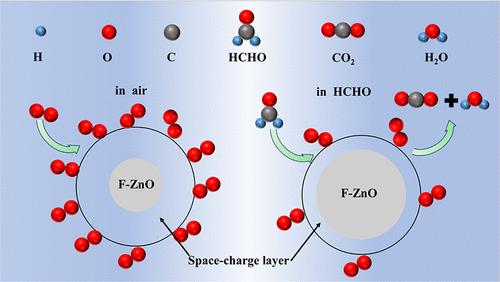
It is urgent to develop an ultrasensitive formaldehyde (HCHO) sensor that can operate at room temperature and has a low detection limit. Metal oxide semiconductors are excellent gas sensitive materials. Therefore, in this paper, we present the synthesis of fluorine (F) doped zinc oxide (ZnO) porous nanomaterials through a straightforward one-pot method with the optimization of F doping levels to achieve the detection of low concentrations of HCHO under UV light at room temperature. Under 375 nm UV light, the sensor exhibits a response value of 386% to 10 ppm of HCHO, which is 2.6 times higher than that of pure ZnO, and its detection limit is as low as 75 ppb. It has excellent selectivity, stability, and moisture resistance, which can meet the requirements of HCHO detection in daily life. Analysis reveals that doping ZnO with F not only increases the material’s specific surface area but also introduces active sites. Furthermore, it alters the state of HCHO on the material’s surface from physical adsorption to chemical adsorption. The above reasons together enhance the adsorption of HCHO on the gas sensitive material, thereby improving its gas sensitivity performance. Overall, this work demonstrates that F-doped ZnO is a potential material for ultrasensitive HCHO sensors and provides insights into the interpretation of the effect of doping on the gas sensitivity properties of materials.
期刊介绍:
Langmuir is an interdisciplinary journal publishing articles in the following subject categories:
Colloids: surfactants and self-assembly, dispersions, emulsions, foams
Interfaces: adsorption, reactions, films, forces
Biological Interfaces: biocolloids, biomolecular and biomimetic materials
Materials: nano- and mesostructured materials, polymers, gels, liquid crystals
Electrochemistry: interfacial charge transfer, charge transport, electrocatalysis, electrokinetic phenomena, bioelectrochemistry
Devices and Applications: sensors, fluidics, patterning, catalysis, photonic crystals
However, when high-impact, original work is submitted that does not fit within the above categories, decisions to accept or decline such papers will be based on one criteria: What Would Irving Do?
Langmuir ranks #2 in citations out of 136 journals in the category of Physical Chemistry with 113,157 total citations. The journal received an Impact Factor of 4.384*.
This journal is also indexed in the categories of Materials Science (ranked #1) and Multidisciplinary Chemistry (ranked #5).



 京公网安备 11010802042870号
京ICP备2023020795号-1
京公网安备 11010802042870号
京ICP备2023020795号-1

 分享
分享
 求助内容:
求助内容: 应助结果提醒方式:
 扫码关注我们
