Tianyue Gao, Leanna Schulte, Langqiu Xiao, Eisuke Yamamoto, Amy S. Metlay, Colton J. Sheehan, Sariah Marth, Heemin Park, Sayantan Sasmal, Francisco J. Galang, Chulsung Bae, Adam Z. Weber, Shannon W. Boettcher, Thomas E. Mallouk
{"title":"Bipolar Membranes With Controlled, Microscale 3D Junctions Enhance the Rates of Water Dissociation and Formation","authors":"Tianyue Gao, Leanna Schulte, Langqiu Xiao, Eisuke Yamamoto, Amy S. Metlay, Colton J. Sheehan, Sariah Marth, Heemin Park, Sayantan Sasmal, Francisco J. Galang, Chulsung Bae, Adam Z. Weber, Shannon W. Boettcher, Thomas E. Mallouk","doi":"10.1002/aenm.202404285","DOIUrl":null,"url":null,"abstract":"<p>A soft lithographic method is developed for making bipolar membranes (BPMs) with catalytic junctions formed from arrays of vertically oriented microscale cylinders. The membranes are cast from reusable polydimethylsiloxane (PDMS) molds made from silicon masters, which are fabricated on 2″ to 4″ wafer scales by nanosphere lithography. High-aspect-ratio junctions are made on a length scale similar to the thickness of optimized catalyst layers for water dissociation, creating a platform for probing the dual effects of catalysis and local electric field at the microscale BPM junction. Optimized polymer materials and nanoscale metal oxide catalysts are used in this study. 3D BPMs are tested under reverse and forward bias conditions, exhibiting superior performance relative to their 2D counterparts. Under forward bias in H<sub>2</sub>-O<sub>2</sub> fuel cells, 3D BPMs achieve a current density of 1500 mA cm<sup>−2</sup>, ≈7 times higher than 2D membranes made from the same materials.</p>","PeriodicalId":111,"journal":{"name":"Advanced Energy Materials","volume":"15 12","pages":""},"PeriodicalIF":26.0000,"publicationDate":"2024-11-09","publicationTypes":"Journal Article","fieldsOfStudy":null,"isOpenAccess":false,"openAccessPdf":"https://onlinelibrary.wiley.com/doi/epdf/10.1002/aenm.202404285","citationCount":"0","resultStr":null,"platform":"Semanticscholar","paperid":null,"PeriodicalName":"Advanced Energy Materials","FirstCategoryId":"88","ListUrlMain":"https://advanced.onlinelibrary.wiley.com/doi/10.1002/aenm.202404285","RegionNum":1,"RegionCategory":"材料科学","ArticlePicture":[],"TitleCN":null,"AbstractTextCN":null,"PMCID":null,"EPubDate":"","PubModel":"","JCR":"Q1","JCRName":"CHEMISTRY, PHYSICAL","Score":null,"Total":0}
引用次数: 0
Abstract
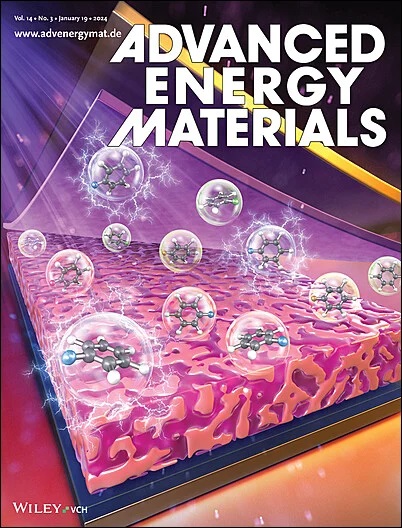
A soft lithographic method is developed for making bipolar membranes (BPMs) with catalytic junctions formed from arrays of vertically oriented microscale cylinders. The membranes are cast from reusable polydimethylsiloxane (PDMS) molds made from silicon masters, which are fabricated on 2″ to 4″ wafer scales by nanosphere lithography. High-aspect-ratio junctions are made on a length scale similar to the thickness of optimized catalyst layers for water dissociation, creating a platform for probing the dual effects of catalysis and local electric field at the microscale BPM junction. Optimized polymer materials and nanoscale metal oxide catalysts are used in this study. 3D BPMs are tested under reverse and forward bias conditions, exhibiting superior performance relative to their 2D counterparts. Under forward bias in H2-O2 fuel cells, 3D BPMs achieve a current density of 1500 mA cm−2, ≈7 times higher than 2D membranes made from the same materials.
期刊介绍:
Established in 2011, Advanced Energy Materials is an international, interdisciplinary, English-language journal that focuses on materials used in energy harvesting, conversion, and storage. It is regarded as a top-quality journal alongside Advanced Materials, Advanced Functional Materials, and Small.
With a 2022 Impact Factor of 27.8, Advanced Energy Materials is considered a prime source for the best energy-related research. The journal covers a wide range of topics in energy-related research, including organic and inorganic photovoltaics, batteries and supercapacitors, fuel cells, hydrogen generation and storage, thermoelectrics, water splitting and photocatalysis, solar fuels and thermosolar power, magnetocalorics, and piezoelectronics.
The readership of Advanced Energy Materials includes materials scientists, chemists, physicists, and engineers in both academia and industry. The journal is indexed in various databases and collections, such as Advanced Technologies & Aerospace Database, FIZ Karlsruhe, INSPEC (IET), Science Citation Index Expanded, Technology Collection, and Web of Science, among others.








 京公网安备 11010802042870号
京ICP备2023020795号-1
京公网安备 11010802042870号
京ICP备2023020795号-1

 分享
分享
 求助内容:
求助内容: 应助结果提醒方式:
 扫码关注我们
