Shilong Fu , Boaz Izelaar , Ming Li , Qi An , Min Li , Wiebren de Jong , Ruud Kortlever
{"title":"The effect of carbon supports on the electrocatalytic performance of Ni-N-C catalysts for CO2 reduction to CO","authors":"Shilong Fu , Boaz Izelaar , Ming Li , Qi An , Min Li , Wiebren de Jong , Ruud Kortlever","doi":"10.1016/j.nanoen.2024.110461","DOIUrl":null,"url":null,"abstract":"<div><div>Carbon-supported nickel and nitrogen co-doped (Ni-N-C) catalysts have been extensively studied as selective and active catalysts for CO<sub>2</sub> electroreduction to CO. Most studies have focused on adjusting the coordination structure of Ni-N<sub>x</sub> active sites, while the impact of the carbon supports has often been overlooked. In this study, a series of Ni-N-C catalysts on different carbon supports, including carbon black (CB), multi-walled carbon nanotubes (CNT), and activated nitrogen-doped biochar (ANBC), were synthesized using a ligand-mediated method. The effect of the carbon support on the electrocatalytic performance for CO<sub>2</sub> reduction was investigated at both low current densities, in a H-cell, and high current densities, in a MEA electrolyzer. All of the prepared Ni-N-C catalysts show good faradaic efficiencies (FE) toward CO production (up to ∼90 %), however, the onset potentials and partial current densities for CO production vary greatly. The textural properties of the carbon support and the distribution of Ni-N<sub>x</sub> active sites on the carbon support are demonstrated as the main factors behind the performance differences. In particular, hierarchical porous structures with a large specific surface area are helpful to facilitate mass transport and improve the dispersion of active sites, which allows for a better CO<sub>2</sub> reduction performance of Ni-N-ANBC compared to Ni-N-CB and Ni-N-CNT. This study demonstrates the importance of the carbon support for Ni-N-C catalysts and provides new insights into the design of efficient Ni-N-C catalysts for the CO<sub>2</sub>RR.</div></div>","PeriodicalId":394,"journal":{"name":"Nano Energy","volume":"133 ","pages":"Article 110461"},"PeriodicalIF":17.1000,"publicationDate":"2025-01-01","publicationTypes":"Journal Article","fieldsOfStudy":null,"isOpenAccess":false,"openAccessPdf":"","citationCount":"0","resultStr":null,"platform":"Semanticscholar","paperid":null,"PeriodicalName":"Nano Energy","FirstCategoryId":"88","ListUrlMain":"https://www.sciencedirect.com/science/article/pii/S2211285524012138","RegionNum":1,"RegionCategory":"材料科学","ArticlePicture":[],"TitleCN":null,"AbstractTextCN":null,"PMCID":null,"EPubDate":"2024/11/8 0:00:00","PubModel":"Epub","JCR":"Q1","JCRName":"CHEMISTRY, PHYSICAL","Score":null,"Total":0}
引用次数: 0
Abstract
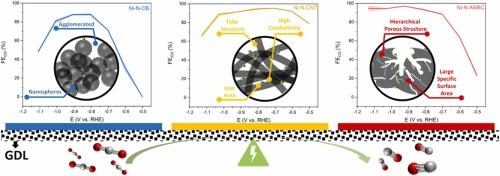
Carbon-supported nickel and nitrogen co-doped (Ni-N-C) catalysts have been extensively studied as selective and active catalysts for CO2 electroreduction to CO. Most studies have focused on adjusting the coordination structure of Ni-Nx active sites, while the impact of the carbon supports has often been overlooked. In this study, a series of Ni-N-C catalysts on different carbon supports, including carbon black (CB), multi-walled carbon nanotubes (CNT), and activated nitrogen-doped biochar (ANBC), were synthesized using a ligand-mediated method. The effect of the carbon support on the electrocatalytic performance for CO2 reduction was investigated at both low current densities, in a H-cell, and high current densities, in a MEA electrolyzer. All of the prepared Ni-N-C catalysts show good faradaic efficiencies (FE) toward CO production (up to ∼90 %), however, the onset potentials and partial current densities for CO production vary greatly. The textural properties of the carbon support and the distribution of Ni-Nx active sites on the carbon support are demonstrated as the main factors behind the performance differences. In particular, hierarchical porous structures with a large specific surface area are helpful to facilitate mass transport and improve the dispersion of active sites, which allows for a better CO2 reduction performance of Ni-N-ANBC compared to Ni-N-CB and Ni-N-CNT. This study demonstrates the importance of the carbon support for Ni-N-C catalysts and provides new insights into the design of efficient Ni-N-C catalysts for the CO2RR.
期刊介绍:
Nano Energy is a multidisciplinary, rapid-publication forum of original peer-reviewed contributions on the science and engineering of nanomaterials and nanodevices used in all forms of energy harvesting, conversion, storage, utilization and policy. Through its mixture of articles, reviews, communications, research news, and information on key developments, Nano Energy provides a comprehensive coverage of this exciting and dynamic field which joins nanoscience and nanotechnology with energy science. The journal is relevant to all those who are interested in nanomaterials solutions to the energy problem.
Nano Energy publishes original experimental and theoretical research on all aspects of energy-related research which utilizes nanomaterials and nanotechnology. Manuscripts of four types are considered: review articles which inform readers of the latest research and advances in energy science; rapid communications which feature exciting research breakthroughs in the field; full-length articles which report comprehensive research developments; and news and opinions which comment on topical issues or express views on the developments in related fields.




 京公网安备 11010802042870号
京ICP备2023020795号-1
京公网安备 11010802042870号
京ICP备2023020795号-1

 分享
分享
 求助内容:
求助内容: 应助结果提醒方式:
 扫码关注我们
