Ji-Won Son, Donghwi Kim, Chaewon Hwang, Seonho Lee, Soobin Yang, Yejin Nam, Changwoo Kim
{"title":"Nanoplastic Release from Disposable Plastics: Correlation with Maximum Service Temperature","authors":"Ji-Won Son, Donghwi Kim, Chaewon Hwang, Seonho Lee, Soobin Yang, Yejin Nam, Changwoo Kim","doi":"10.1016/j.jhazmat.2024.136478","DOIUrl":null,"url":null,"abstract":"The potential for bioaccumulation of nanoplastics (NPs, <1<!-- --> <!-- -->µm) increases as the particle size decreases. Since several disposable plastic products used daily may release NPs, their intake may be unavoidable. Therefore, it is crucial to examine the release patterns of NPs from these products. This study investigates the relationship between NP release and the Maximum Service Temperature (MST) of five plastic types, confirming the correlation under real-world conditions. The releasing tendencies of NPs were investigated using plastic pellets. We simulated the packaging of hot food in plastic containers, considering the physical dynamics of food delivery, and replicated cooking in an oven and microwave. We observed that the mass of NPs released tended to reach its maximum at the material's MST. In real-life conditions, the release of NP was found to increase with higher container content temperatures and longer packaging or cooking durations. Physical impacts were confirmed to be the most significant contributors to NP release. Moreover, Higher microwave power levels lead to greater NP release, with polar materials releasing more NPs compared to non-polar materials. Consequently, to minimize NP ingestion, it is recommended to use containers made from non-polar materials with a high MST.","PeriodicalId":361,"journal":{"name":"Journal of Hazardous Materials","volume":"2 1","pages":""},"PeriodicalIF":11.3000,"publicationDate":"2024-11-10","publicationTypes":"Journal Article","fieldsOfStudy":null,"isOpenAccess":false,"openAccessPdf":"","citationCount":"0","resultStr":null,"platform":"Semanticscholar","paperid":null,"PeriodicalName":"Journal of Hazardous Materials","FirstCategoryId":"93","ListUrlMain":"https://doi.org/10.1016/j.jhazmat.2024.136478","RegionNum":1,"RegionCategory":"环境科学与生态学","ArticlePicture":[],"TitleCN":null,"AbstractTextCN":null,"PMCID":null,"EPubDate":"","PubModel":"","JCR":"Q1","JCRName":"ENGINEERING, ENVIRONMENTAL","Score":null,"Total":0}
引用次数: 0
Abstract
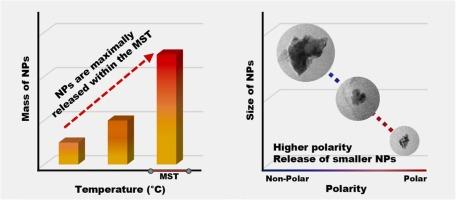
The potential for bioaccumulation of nanoplastics (NPs, <1 µm) increases as the particle size decreases. Since several disposable plastic products used daily may release NPs, their intake may be unavoidable. Therefore, it is crucial to examine the release patterns of NPs from these products. This study investigates the relationship between NP release and the Maximum Service Temperature (MST) of five plastic types, confirming the correlation under real-world conditions. The releasing tendencies of NPs were investigated using plastic pellets. We simulated the packaging of hot food in plastic containers, considering the physical dynamics of food delivery, and replicated cooking in an oven and microwave. We observed that the mass of NPs released tended to reach its maximum at the material's MST. In real-life conditions, the release of NP was found to increase with higher container content temperatures and longer packaging or cooking durations. Physical impacts were confirmed to be the most significant contributors to NP release. Moreover, Higher microwave power levels lead to greater NP release, with polar materials releasing more NPs compared to non-polar materials. Consequently, to minimize NP ingestion, it is recommended to use containers made from non-polar materials with a high MST.
期刊介绍:
The Journal of Hazardous Materials serves as a global platform for promoting cutting-edge research in the field of Environmental Science and Engineering. Our publication features a wide range of articles, including full-length research papers, review articles, and perspectives, with the aim of enhancing our understanding of the dangers and risks associated with various materials concerning public health and the environment. It is important to note that the term "environmental contaminants" refers specifically to substances that pose hazardous effects through contamination, while excluding those that do not have such impacts on the environment or human health. Moreover, we emphasize the distinction between wastes and hazardous materials in order to provide further clarity on the scope of the journal. We have a keen interest in exploring specific compounds and microbial agents that have adverse effects on the environment.



 京公网安备 11010802042870号
京ICP备2023020795号-1
京公网安备 11010802042870号
京ICP备2023020795号-1

 分享
分享
 求助内容:
求助内容: 应助结果提醒方式:
 扫码关注我们
