Dual function antioxidant and anti-inflammatory fish maw peptides: Isolation and structure-activity analysis via tandem molecular docking and quantum chemical calculation
Elliot Mubango , Zixin Fu , Peipei Dou , Yuqing Tan , Yongkang Luo , Liang Chen , Kefeng Wu , Hui Hong
{"title":"Dual function antioxidant and anti-inflammatory fish maw peptides: Isolation and structure-activity analysis via tandem molecular docking and quantum chemical calculation","authors":"Elliot Mubango , Zixin Fu , Peipei Dou , Yuqing Tan , Yongkang Luo , Liang Chen , Kefeng Wu , Hui Hong","doi":"10.1016/j.foodchem.2024.141970","DOIUrl":null,"url":null,"abstract":"<div><div>The structure–function relationship of gastrointestinal tract digestion-derived fish maw peptides remains largely unknown. This study aims to elucidate the active sites and cellular bioactivities of these peptides through molecular docking (MD), density functional theory (DFT) computations, <em>in silico</em> bioinformatic analysis, and <em>in cellulo</em> Caco-2 cell studies. <em>In silico</em> screening identified 29 non-toxic, non-allergenic, and water-soluble peptides. Seven peptides exhibited favorable binding to the Keap1-Kelch (2FLU) and TNF-α (2AZ5) proteins. Specifically, peptides WIDPNQG, GFPGER, and FLLFRQ demonstrated the highest electron affinities and smallest HOMO-LUMO energy gaps, suggesting strong free-radical scavenging potential. Both DFT and <em>ex situ</em> MD confirmed the active sites of the seven peptides. The guanidinium group was the dominant active site on six peptides. The isolated peptides improved cellular redox balance, reduced malonaldehyde, and suppressed inflammatory cytokines. This study confirmed DFT computations as a novel tool for elucidating the structure-function relationship of food-derived peptides.</div></div>","PeriodicalId":318,"journal":{"name":"Food Chemistry","volume":"465 ","pages":"Article 141970"},"PeriodicalIF":9.8000,"publicationDate":"2025-02-15","publicationTypes":"Journal Article","fieldsOfStudy":null,"isOpenAccess":false,"openAccessPdf":"","citationCount":"0","resultStr":null,"platform":"Semanticscholar","paperid":null,"PeriodicalName":"Food Chemistry","FirstCategoryId":"97","ListUrlMain":"https://www.sciencedirect.com/science/article/pii/S0308814624036203","RegionNum":1,"RegionCategory":"农林科学","ArticlePicture":[],"TitleCN":null,"AbstractTextCN":null,"PMCID":null,"EPubDate":"2024/11/9 0:00:00","PubModel":"Epub","JCR":"Q1","JCRName":"CHEMISTRY, APPLIED","Score":null,"Total":0}
引用次数: 0
Abstract
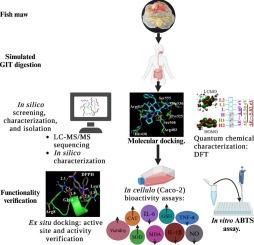
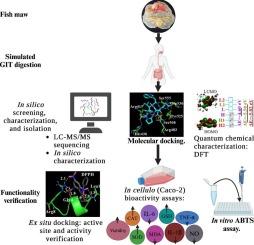
The structure–function relationship of gastrointestinal tract digestion-derived fish maw peptides remains largely unknown. This study aims to elucidate the active sites and cellular bioactivities of these peptides through molecular docking (MD), density functional theory (DFT) computations, in silico bioinformatic analysis, and in cellulo Caco-2 cell studies. In silico screening identified 29 non-toxic, non-allergenic, and water-soluble peptides. Seven peptides exhibited favorable binding to the Keap1-Kelch (2FLU) and TNF-α (2AZ5) proteins. Specifically, peptides WIDPNQG, GFPGER, and FLLFRQ demonstrated the highest electron affinities and smallest HOMO-LUMO energy gaps, suggesting strong free-radical scavenging potential. Both DFT and ex situ MD confirmed the active sites of the seven peptides. The guanidinium group was the dominant active site on six peptides. The isolated peptides improved cellular redox balance, reduced malonaldehyde, and suppressed inflammatory cytokines. This study confirmed DFT computations as a novel tool for elucidating the structure-function relationship of food-derived peptides.
期刊介绍:
Food Chemistry publishes original research papers dealing with the advancement of the chemistry and biochemistry of foods or the analytical methods/ approach used. All papers should focus on the novelty of the research carried out.




 京公网安备 11010802042870号
京ICP备2023020795号-1
京公网安备 11010802042870号
京ICP备2023020795号-1

 分享
分享
 求助内容:
求助内容: 应助结果提醒方式:
 扫码关注我们
