Zhanfeng Hou , Chuan Wan , Heming Jiang , Yuena Wang , Yun Xing , Jinpeng Wang , Zhihong Liu , Xiaochun Guo , Yuhao An , Wei Han , Rui Wang , Xinhao Zhang , Feng Yin , Zigang Li
{"title":"Photocatalytic acylation of lysine screened using a microfluidic-based chemical robotic system†","authors":"Zhanfeng Hou , Chuan Wan , Heming Jiang , Yuena Wang , Yun Xing , Jinpeng Wang , Zhihong Liu , Xiaochun Guo , Yuhao An , Wei Han , Rui Wang , Xinhao Zhang , Feng Yin , Zigang Li","doi":"10.1039/d4gc03562c","DOIUrl":null,"url":null,"abstract":"<div><div>The application scope of various bioconjugation technologies has been expanded through the implementation of photoredox catalytic bioconjugation technology, establishing a novel biomolecular framework with exceptional residue selectivity. Herein, we report a facile acylation reaction utilizing a thioacid and a photoexcited riboflavin tetraacetate (RFTA) catalyst under visible light (450 nm). The optimal reaction conditions were obtained using a high-throughput microfluidic-based chemical robotic system and GPR model. We have successfully modified a range of proteins and antibodies and utilized the functional handle to attach diverse biological molecules, demonstrating the versatility and generality of our approach. In addition, this photoredox catalytic reaction was also successfully employed in peptide modification, protein labeling, and antibody conjugation.</div></div>","PeriodicalId":78,"journal":{"name":"Green Chemistry","volume":"26 22","pages":"Pages 11238-11248"},"PeriodicalIF":9.2000,"publicationDate":"2024-10-08","publicationTypes":"Journal Article","fieldsOfStudy":null,"isOpenAccess":false,"openAccessPdf":"","citationCount":"0","resultStr":null,"platform":"Semanticscholar","paperid":null,"PeriodicalName":"Green Chemistry","FirstCategoryId":"92","ListUrlMain":"https://www.sciencedirect.com/org/science/article/pii/S1463926224008604","RegionNum":1,"RegionCategory":"化学","ArticlePicture":[],"TitleCN":null,"AbstractTextCN":null,"PMCID":null,"EPubDate":"2024/10/2 0:00:00","PubModel":"Epub","JCR":"Q1","JCRName":"CHEMISTRY, MULTIDISCIPLINARY","Score":null,"Total":0}
引用次数: 0
Abstract
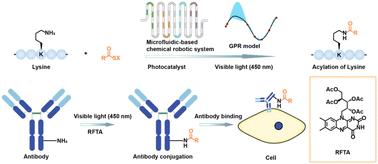
The application scope of various bioconjugation technologies has been expanded through the implementation of photoredox catalytic bioconjugation technology, establishing a novel biomolecular framework with exceptional residue selectivity. Herein, we report a facile acylation reaction utilizing a thioacid and a photoexcited riboflavin tetraacetate (RFTA) catalyst under visible light (450 nm). The optimal reaction conditions were obtained using a high-throughput microfluidic-based chemical robotic system and GPR model. We have successfully modified a range of proteins and antibodies and utilized the functional handle to attach diverse biological molecules, demonstrating the versatility and generality of our approach. In addition, this photoredox catalytic reaction was also successfully employed in peptide modification, protein labeling, and antibody conjugation.
期刊介绍:
Green Chemistry is a journal that provides a unique forum for the publication of innovative research on the development of alternative green and sustainable technologies. The scope of Green Chemistry is based on the definition proposed by Anastas and Warner (Green Chemistry: Theory and Practice, P T Anastas and J C Warner, Oxford University Press, Oxford, 1998), which defines green chemistry as the utilisation of a set of principles that reduces or eliminates the use or generation of hazardous substances in the design, manufacture and application of chemical products. Green Chemistry aims to reduce the environmental impact of the chemical enterprise by developing a technology base that is inherently non-toxic to living things and the environment. The journal welcomes submissions on all aspects of research relating to this endeavor and publishes original and significant cutting-edge research that is likely to be of wide general appeal. For a work to be published, it must present a significant advance in green chemistry, including a comparison with existing methods and a demonstration of advantages over those methods.



 京公网安备 11010802042870号
京ICP备2023020795号-1
京公网安备 11010802042870号
京ICP备2023020795号-1

 分享
分享
 求助内容:
求助内容: 应助结果提醒方式:
 扫码关注我们
