Qing-Bao Zhang , Feng Li , Bin Pan , Shanshan Zhang , Xiang-Guo Yue , Qiang Liu
{"title":"Visible light-induced strain-release transformations of bicyclo[1.1.0]butanes","authors":"Qing-Bao Zhang , Feng Li , Bin Pan , Shanshan Zhang , Xiang-Guo Yue , Qiang Liu","doi":"10.1039/d4gc03193h","DOIUrl":null,"url":null,"abstract":"<div><div>Bicyclo[1.1.0]butanes, as structurally unique compounds with high strain energy and diverse chemical properties, are becoming increasingly popular building blocks in organic and pharmaceutical chemistries. Strain-release transformation of bicyclo[1.1.0]butanes has received great attention from chemists as it is atom- and step-economical, and significant achievements have been made in this field. Visible-light photocatalysis, with its green and sustainable properties, enriches the strain-release strategy through an electron transfer or energy transfer pathway under mild conditions. In this review, we highlight the latest advancements in visible-light-induced strain-release reactions of bicyclobutanes, with a particular focus on the reaction mechanism. Organization of the content follows a subdivision based on reaction and product classes. Advances in obtaining unique chemical architectures continue to be breakthroughs in this fascinating field of research.</div></div>","PeriodicalId":78,"journal":{"name":"Green Chemistry","volume":"26 22","pages":"Pages 11083-11105"},"PeriodicalIF":9.2000,"publicationDate":"2024-10-08","publicationTypes":"Journal Article","fieldsOfStudy":null,"isOpenAccess":false,"openAccessPdf":"","citationCount":"0","resultStr":null,"platform":"Semanticscholar","paperid":null,"PeriodicalName":"Green Chemistry","FirstCategoryId":"92","ListUrlMain":"https://www.sciencedirect.com/org/science/article/pii/S1463926224008458","RegionNum":1,"RegionCategory":"化学","ArticlePicture":[],"TitleCN":null,"AbstractTextCN":null,"PMCID":null,"EPubDate":"2024/10/4 0:00:00","PubModel":"Epub","JCR":"Q1","JCRName":"CHEMISTRY, MULTIDISCIPLINARY","Score":null,"Total":0}
引用次数: 0
Abstract
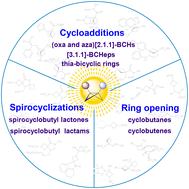
Bicyclo[1.1.0]butanes, as structurally unique compounds with high strain energy and diverse chemical properties, are becoming increasingly popular building blocks in organic and pharmaceutical chemistries. Strain-release transformation of bicyclo[1.1.0]butanes has received great attention from chemists as it is atom- and step-economical, and significant achievements have been made in this field. Visible-light photocatalysis, with its green and sustainable properties, enriches the strain-release strategy through an electron transfer or energy transfer pathway under mild conditions. In this review, we highlight the latest advancements in visible-light-induced strain-release reactions of bicyclobutanes, with a particular focus on the reaction mechanism. Organization of the content follows a subdivision based on reaction and product classes. Advances in obtaining unique chemical architectures continue to be breakthroughs in this fascinating field of research.
期刊介绍:
Green Chemistry is a journal that provides a unique forum for the publication of innovative research on the development of alternative green and sustainable technologies. The scope of Green Chemistry is based on the definition proposed by Anastas and Warner (Green Chemistry: Theory and Practice, P T Anastas and J C Warner, Oxford University Press, Oxford, 1998), which defines green chemistry as the utilisation of a set of principles that reduces or eliminates the use or generation of hazardous substances in the design, manufacture and application of chemical products. Green Chemistry aims to reduce the environmental impact of the chemical enterprise by developing a technology base that is inherently non-toxic to living things and the environment. The journal welcomes submissions on all aspects of research relating to this endeavor and publishes original and significant cutting-edge research that is likely to be of wide general appeal. For a work to be published, it must present a significant advance in green chemistry, including a comparison with existing methods and a demonstration of advantages over those methods.



 京公网安备 11010802042870号
京ICP备2023020795号-1
京公网安备 11010802042870号
京ICP备2023020795号-1

 分享
分享
 求助内容:
求助内容: 应助结果提醒方式:
 扫码关注我们
