Selina Tisler, Nastacha Kristiansen, Jan H. Christensen
{"title":"Chemical Migration from Reusable Plastic Bottles: Silicone, Polyethylene, and Polypropylene show Highest Hazard Potential in LC-HRMS Analysis","authors":"Selina Tisler, Nastacha Kristiansen, Jan H. Christensen","doi":"10.1016/j.jhazmat.2024.136391","DOIUrl":null,"url":null,"abstract":"Estimating the chemical hazards of drinking water stored in reusable plastic bottles is challenging due to the numerous intentionally and unintentionally added chemicals. To address this, we developed a broad screening strategy using evaporation enrichment and liquid chromatography high-resolution mass spectrometry (LC-HRMS) to evaluate migration of non-volatile chemicals from various reusable plastic bottles. The study analyzed a wide range of materials, revealing significant variability in chemical profiles across different bottle types. Over 70% of nearly 1,000 unknown compounds were unique to specific bottles. Silicone, HDPE, LDPE, and PP bottles showed the highest migration rates, with silicone releasing the most unknowns, but also phthalates and plasticizers. PP bottles exhibited concerning migration of clarifying agents and bisphenol A derivatives. In contrast, PS, PET, PETG, and PCTG had minimal migration, indicating lower health risks. These findings highlight the need for comprehensive assessments of plastic materials to improve consumer safety.","PeriodicalId":361,"journal":{"name":"Journal of Hazardous Materials","volume":"19 1","pages":""},"PeriodicalIF":11.3000,"publicationDate":"2024-11-12","publicationTypes":"Journal Article","fieldsOfStudy":null,"isOpenAccess":false,"openAccessPdf":"","citationCount":"0","resultStr":null,"platform":"Semanticscholar","paperid":null,"PeriodicalName":"Journal of Hazardous Materials","FirstCategoryId":"93","ListUrlMain":"https://doi.org/10.1016/j.jhazmat.2024.136391","RegionNum":1,"RegionCategory":"环境科学与生态学","ArticlePicture":[],"TitleCN":null,"AbstractTextCN":null,"PMCID":null,"EPubDate":"","PubModel":"","JCR":"Q1","JCRName":"ENGINEERING, ENVIRONMENTAL","Score":null,"Total":0}
引用次数: 0
Abstract
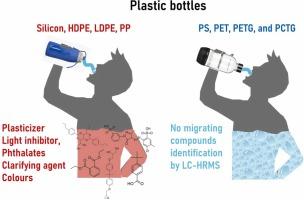
Estimating the chemical hazards of drinking water stored in reusable plastic bottles is challenging due to the numerous intentionally and unintentionally added chemicals. To address this, we developed a broad screening strategy using evaporation enrichment and liquid chromatography high-resolution mass spectrometry (LC-HRMS) to evaluate migration of non-volatile chemicals from various reusable plastic bottles. The study analyzed a wide range of materials, revealing significant variability in chemical profiles across different bottle types. Over 70% of nearly 1,000 unknown compounds were unique to specific bottles. Silicone, HDPE, LDPE, and PP bottles showed the highest migration rates, with silicone releasing the most unknowns, but also phthalates and plasticizers. PP bottles exhibited concerning migration of clarifying agents and bisphenol A derivatives. In contrast, PS, PET, PETG, and PCTG had minimal migration, indicating lower health risks. These findings highlight the need for comprehensive assessments of plastic materials to improve consumer safety.
期刊介绍:
The Journal of Hazardous Materials serves as a global platform for promoting cutting-edge research in the field of Environmental Science and Engineering. Our publication features a wide range of articles, including full-length research papers, review articles, and perspectives, with the aim of enhancing our understanding of the dangers and risks associated with various materials concerning public health and the environment. It is important to note that the term "environmental contaminants" refers specifically to substances that pose hazardous effects through contamination, while excluding those that do not have such impacts on the environment or human health. Moreover, we emphasize the distinction between wastes and hazardous materials in order to provide further clarity on the scope of the journal. We have a keen interest in exploring specific compounds and microbial agents that have adverse effects on the environment.



 京公网安备 11010802042870号
京ICP备2023020795号-1
京公网安备 11010802042870号
京ICP备2023020795号-1

 分享
分享
 求助内容:
求助内容: 应助结果提醒方式:
 扫码关注我们
