Na Qiao, Xueyan Dai, Jing Chen, Huabin Cao, Guoliang Hu, Xiaoquan Guo, Ping Liu, Chenghong Xing, Fan Yang
{"title":"Single Nucleus RNA Sequencing Reveals Cellular and Molecular Responses to Vanadium Exposure in Duck Kidneys","authors":"Na Qiao, Xueyan Dai, Jing Chen, Huabin Cao, Guoliang Hu, Xiaoquan Guo, Ping Liu, Chenghong Xing, Fan Yang","doi":"10.1016/j.jhazmat.2024.136492","DOIUrl":null,"url":null,"abstract":"Vanadium (V) exposure is known to induce renal toxicity, yet its specific effects on renal cell types and molecular mechanisms remain incompletely understood. We used single nucleus RNA sequencing (snRNA-seq) to characterize the impact of V on duck kidney cells at a cellular resolution. Following a 44-day exposure, immunofluorescence analysis revealed a significant increase in α-SMC expression in the renal interstitium, indicative of fibrotic response. SnRNA-seq identified 12 major cell types organized into 19 clusters within the kidney. Significant changes in cell composition were observed, notably an increase in proximal tubule cells (PT2 subtype), glomerular endothelial cells, principal cells, and alterations in immune cell proportions, while collecting duct intercalated cells (CD-IC) and thick ascending limb showed decreased percentages. Differential gene expression analysis highlighted pathways implicated in V toxicity across different cell types. Changes in drug metabolism-cytochrome P450, butanoate metabolism, and actin cytoskeleton regulation were exhibited by PT cells. Alterations in collecting duct secretion, oxidative phosphorylation, and bicarbonate reclamation pathways were shown in CD-IC cells. Furthermore, immune cells displayed changes in T cell receptor and chemokine signaling pathways, indicative of altered immune responses. Taken together, these findings contribute to a better shedding light on the pathogenic mechanisms of V induced renal injury.","PeriodicalId":361,"journal":{"name":"Journal of Hazardous Materials","volume":"8 1","pages":""},"PeriodicalIF":11.3000,"publicationDate":"2024-11-13","publicationTypes":"Journal Article","fieldsOfStudy":null,"isOpenAccess":false,"openAccessPdf":"","citationCount":"0","resultStr":null,"platform":"Semanticscholar","paperid":null,"PeriodicalName":"Journal of Hazardous Materials","FirstCategoryId":"93","ListUrlMain":"https://doi.org/10.1016/j.jhazmat.2024.136492","RegionNum":1,"RegionCategory":"环境科学与生态学","ArticlePicture":[],"TitleCN":null,"AbstractTextCN":null,"PMCID":null,"EPubDate":"","PubModel":"","JCR":"Q1","JCRName":"ENGINEERING, ENVIRONMENTAL","Score":null,"Total":0}
引用次数: 0
Abstract
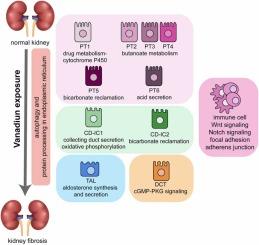
Vanadium (V) exposure is known to induce renal toxicity, yet its specific effects on renal cell types and molecular mechanisms remain incompletely understood. We used single nucleus RNA sequencing (snRNA-seq) to characterize the impact of V on duck kidney cells at a cellular resolution. Following a 44-day exposure, immunofluorescence analysis revealed a significant increase in α-SMC expression in the renal interstitium, indicative of fibrotic response. SnRNA-seq identified 12 major cell types organized into 19 clusters within the kidney. Significant changes in cell composition were observed, notably an increase in proximal tubule cells (PT2 subtype), glomerular endothelial cells, principal cells, and alterations in immune cell proportions, while collecting duct intercalated cells (CD-IC) and thick ascending limb showed decreased percentages. Differential gene expression analysis highlighted pathways implicated in V toxicity across different cell types. Changes in drug metabolism-cytochrome P450, butanoate metabolism, and actin cytoskeleton regulation were exhibited by PT cells. Alterations in collecting duct secretion, oxidative phosphorylation, and bicarbonate reclamation pathways were shown in CD-IC cells. Furthermore, immune cells displayed changes in T cell receptor and chemokine signaling pathways, indicative of altered immune responses. Taken together, these findings contribute to a better shedding light on the pathogenic mechanisms of V induced renal injury.
期刊介绍:
The Journal of Hazardous Materials serves as a global platform for promoting cutting-edge research in the field of Environmental Science and Engineering. Our publication features a wide range of articles, including full-length research papers, review articles, and perspectives, with the aim of enhancing our understanding of the dangers and risks associated with various materials concerning public health and the environment. It is important to note that the term "environmental contaminants" refers specifically to substances that pose hazardous effects through contamination, while excluding those that do not have such impacts on the environment or human health. Moreover, we emphasize the distinction between wastes and hazardous materials in order to provide further clarity on the scope of the journal. We have a keen interest in exploring specific compounds and microbial agents that have adverse effects on the environment.




 京公网安备 11010802042870号
京ICP备2023020795号-1
京公网安备 11010802042870号
京ICP备2023020795号-1

 分享
分享
 求助内容:
求助内容: 应助结果提醒方式:
 扫码关注我们
