Jincheng Zou , Zhenxuan Yang , Junyi Liang , Yifan Xie , Minmin Fan , Xi Zhang
{"title":"Recyclable, high strength and electrical-mechanical self-healing wearable ionic hydrogel sensor","authors":"Jincheng Zou , Zhenxuan Yang , Junyi Liang , Yifan Xie , Minmin Fan , Xi Zhang","doi":"10.1016/j.polymer.2024.127826","DOIUrl":null,"url":null,"abstract":"<div><div>Ionic hydrogels are ideal materials for wearable sensors on the human body, typically requiring excellent mechanical properties, adhesion, self-healing, and sensing capabilities. However, traditional methods to enhance the mechanical properties of ionic hydrogels often compromise their self-healing and sensing performance. Considering this, in this study, we developed a high-strength, recyclable hydrogel with a wide monitoring range, formulated from acrylic acid, hexahydrate aluminum chloride, and polyquaternium-10. By employing a simple freeze-thaw process, the tensile strength of the hydrogel was significantly increased from 0.3 MPa to 1.89 MPa, and the elongation at break was enhanced from 900 % to 1400 %. Additionally, the hydrogel demonstrates exceptional adhesion to various substrates and possesses mechanical-electrical dual self-healing properties. The hydrogel's broad strain detection range (1%–400 %) further underscores its potential for high-performance sensing applications. Furthermore, the reconfigurable, high-density supramolecular network of hydrogels enables the reprocessing of discarded material into value-added products through a straightforward water swelling treatment. We believe that our approach offers a straightforward and efficient strategy for enhancing the mechanical properties of acrylic acid-based hydrogel sensors and, more significantly, contributes to the sustainable utilization of hydrogel materials.</div></div>","PeriodicalId":405,"journal":{"name":"Polymer","volume":"315 ","pages":"Article 127826"},"PeriodicalIF":4.5000,"publicationDate":"2024-11-13","publicationTypes":"Journal Article","fieldsOfStudy":null,"isOpenAccess":false,"openAccessPdf":"","citationCount":"0","resultStr":null,"platform":"Semanticscholar","paperid":null,"PeriodicalName":"Polymer","FirstCategoryId":"92","ListUrlMain":"https://www.sciencedirect.com/science/article/pii/S0032386124011625","RegionNum":2,"RegionCategory":"化学","ArticlePicture":[],"TitleCN":null,"AbstractTextCN":null,"PMCID":null,"EPubDate":"","PubModel":"","JCR":"Q2","JCRName":"POLYMER SCIENCE","Score":null,"Total":0}
引用次数: 0
Abstract
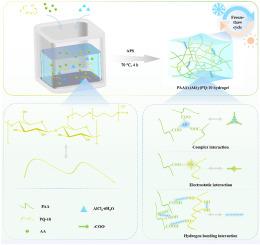
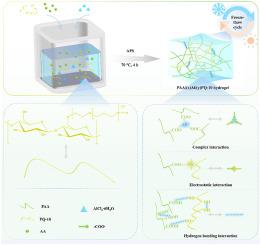
Ionic hydrogels are ideal materials for wearable sensors on the human body, typically requiring excellent mechanical properties, adhesion, self-healing, and sensing capabilities. However, traditional methods to enhance the mechanical properties of ionic hydrogels often compromise their self-healing and sensing performance. Considering this, in this study, we developed a high-strength, recyclable hydrogel with a wide monitoring range, formulated from acrylic acid, hexahydrate aluminum chloride, and polyquaternium-10. By employing a simple freeze-thaw process, the tensile strength of the hydrogel was significantly increased from 0.3 MPa to 1.89 MPa, and the elongation at break was enhanced from 900 % to 1400 %. Additionally, the hydrogel demonstrates exceptional adhesion to various substrates and possesses mechanical-electrical dual self-healing properties. The hydrogel's broad strain detection range (1%–400 %) further underscores its potential for high-performance sensing applications. Furthermore, the reconfigurable, high-density supramolecular network of hydrogels enables the reprocessing of discarded material into value-added products through a straightforward water swelling treatment. We believe that our approach offers a straightforward and efficient strategy for enhancing the mechanical properties of acrylic acid-based hydrogel sensors and, more significantly, contributes to the sustainable utilization of hydrogel materials.
期刊介绍:
Polymer is an interdisciplinary journal dedicated to publishing innovative and significant advances in Polymer Physics, Chemistry and Technology. We welcome submissions on polymer hybrids, nanocomposites, characterisation and self-assembly. Polymer also publishes work on the technological application of polymers in energy and optoelectronics.
The main scope is covered but not limited to the following core areas:
Polymer Materials
Nanocomposites and hybrid nanomaterials
Polymer blends, films, fibres, networks and porous materials
Physical Characterization
Characterisation, modelling and simulation* of molecular and materials properties in bulk, solution, and thin films
Polymer Engineering
Advanced multiscale processing methods
Polymer Synthesis, Modification and Self-assembly
Including designer polymer architectures, mechanisms and kinetics, and supramolecular polymerization
Technological Applications
Polymers for energy generation and storage
Polymer membranes for separation technology
Polymers for opto- and microelectronics.



 京公网安备 11010802042870号
京ICP备2023020795号-1
京公网安备 11010802042870号
京ICP备2023020795号-1

 分享
分享
 求助内容:
求助内容: 应助结果提醒方式:
 扫码关注我们
