Pravin Kavle, Aiden M. Ross, Harikrishnan KP, Peter Meisenheimer, Arvind Dasgupta, Jiyuan Yang, Ching-Che Lin, Hao Pan, Piush Behera, Eric Parsonnet, Xiaoxi Huang, Jacob A. Zorn, Yu-Tsun Shao, Sujit Das, Shi Liu, David A. Muller, Ramamoorthy Ramesh, Long-Qing Chen, Lane W. Martin
{"title":"Highly Responsive Polar Vortices in All-Ferroelectric Heterostructures","authors":"Pravin Kavle, Aiden M. Ross, Harikrishnan KP, Peter Meisenheimer, Arvind Dasgupta, Jiyuan Yang, Ching-Che Lin, Hao Pan, Piush Behera, Eric Parsonnet, Xiaoxi Huang, Jacob A. Zorn, Yu-Tsun Shao, Sujit Das, Shi Liu, David A. Muller, Ramamoorthy Ramesh, Long-Qing Chen, Lane W. Martin","doi":"10.1002/adma.202410146","DOIUrl":null,"url":null,"abstract":"<p>The discovery of polar vortices and skyrmions in ferroelectric-dielectric superlattices [such as (PbTiO<sub>3</sub>)<i><sub>n</sub></i>/(SrTiO<sub>3</sub>)<i><sub>n</sub></i>] has ushered in an era of novel dipolar topologies and corresponding emergent phenomena. The key to creating such emergent features has generally been considered to be related to counterpoising strongly polar and non-polar materials thus creating the appropriate boundary conditions. This limits the utility these materials can have, however, by rendering (effectively) half of the structure unresponsive to applied stimuli. Here, using advanced thin-film deposition and an array of characterization and simulation approaches, polar vortices are realized in all-ferroelectric trilayers, multilayers, and superlattices built from the fundamental building block of (PbTiO<sub>3</sub>)<i><sub>n</sub></i>/(Pb<i><sub>x</sub></i>Sr<sub>1−</sub><i><sub>x</sub></i>TiO<sub>3</sub>)<i><sub>n</sub></i> wherein in-plane ferroelectric polarization in the Pb<i><sub>x</sub></i>Sr<sub>1−</sub><i><sub>x</sub></i>TiO<sub>3</sub> provides the appropriate boundary conditions. These superlattices exhibit substantially enhanced electromechanical and ferroelectric responses in the out-of-plane direction that arise from the ability of the polarization in both layers to rotate to the out-of-plane direction under field. In the in-plane direction, the layers are found to be strongly coupled during switching and when heterostructured with ferroelectric-dielectric building blocks, it is possible to produce multistate switching. This approach expands the realm of systems supporting emergent dipolar texture formation and does so with entirely ferroelectric materials thus greatly improving their responses.</p>","PeriodicalId":114,"journal":{"name":"Advanced Materials","volume":"36 50","pages":""},"PeriodicalIF":26.8000,"publicationDate":"2024-11-13","publicationTypes":"Journal Article","fieldsOfStudy":null,"isOpenAccess":false,"openAccessPdf":"","citationCount":"0","resultStr":null,"platform":"Semanticscholar","paperid":null,"PeriodicalName":"Advanced Materials","FirstCategoryId":"88","ListUrlMain":"https://advanced.onlinelibrary.wiley.com/doi/10.1002/adma.202410146","RegionNum":1,"RegionCategory":"材料科学","ArticlePicture":[],"TitleCN":null,"AbstractTextCN":null,"PMCID":null,"EPubDate":"","PubModel":"","JCR":"Q1","JCRName":"CHEMISTRY, MULTIDISCIPLINARY","Score":null,"Total":0}
引用次数: 0
Abstract
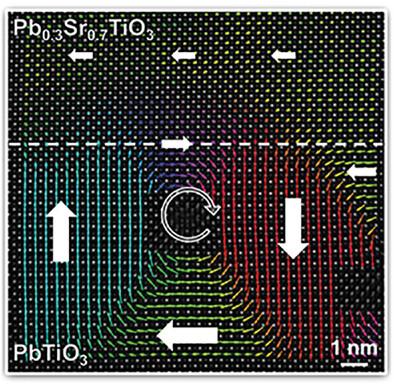
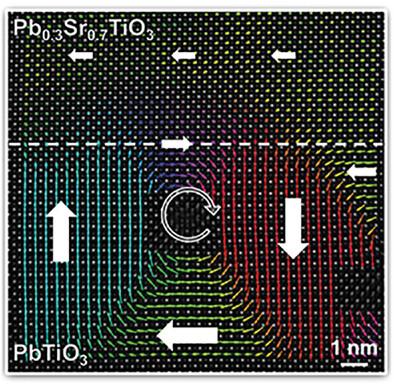
The discovery of polar vortices and skyrmions in ferroelectric-dielectric superlattices [such as (PbTiO3)n/(SrTiO3)n] has ushered in an era of novel dipolar topologies and corresponding emergent phenomena. The key to creating such emergent features has generally been considered to be related to counterpoising strongly polar and non-polar materials thus creating the appropriate boundary conditions. This limits the utility these materials can have, however, by rendering (effectively) half of the structure unresponsive to applied stimuli. Here, using advanced thin-film deposition and an array of characterization and simulation approaches, polar vortices are realized in all-ferroelectric trilayers, multilayers, and superlattices built from the fundamental building block of (PbTiO3)n/(PbxSr1−xTiO3)n wherein in-plane ferroelectric polarization in the PbxSr1−xTiO3 provides the appropriate boundary conditions. These superlattices exhibit substantially enhanced electromechanical and ferroelectric responses in the out-of-plane direction that arise from the ability of the polarization in both layers to rotate to the out-of-plane direction under field. In the in-plane direction, the layers are found to be strongly coupled during switching and when heterostructured with ferroelectric-dielectric building blocks, it is possible to produce multistate switching. This approach expands the realm of systems supporting emergent dipolar texture formation and does so with entirely ferroelectric materials thus greatly improving their responses.
期刊介绍:
Advanced Materials, one of the world's most prestigious journals and the foundation of the Advanced portfolio, is the home of choice for best-in-class materials science for more than 30 years. Following this fast-growing and interdisciplinary field, we are considering and publishing the most important discoveries on any and all materials from materials scientists, chemists, physicists, engineers as well as health and life scientists and bringing you the latest results and trends in modern materials-related research every week.




 京公网安备 11010802042870号
京ICP备2023020795号-1
京公网安备 11010802042870号
京ICP备2023020795号-1

 分享
分享
 求助内容:
求助内容: 应助结果提醒方式:
 扫码关注我们
