Mengmeng Li, Tingting Wu, Zhiyang Zhao, Lei Li, Tongxin Shan, Hui Wu, Robert Zboray, Francesco Bernasconi, Yongjie Cui, Peiying Hu, Wim J. Malfait, Qinghua Zhang, Shanyu Zhao
{"title":"Multiscale Manufacturing of Recyclable Polyimide Composite Aerogels","authors":"Mengmeng Li, Tingting Wu, Zhiyang Zhao, Lei Li, Tongxin Shan, Hui Wu, Robert Zboray, Francesco Bernasconi, Yongjie Cui, Peiying Hu, Wim J. Malfait, Qinghua Zhang, Shanyu Zhao","doi":"10.1002/adma.202411599","DOIUrl":null,"url":null,"abstract":"<p>Mitigating embodied emissions is becoming increasingly crucial as the energy supply shifts toward more sustainable sources. Bio-based materials present a potentially more sustainable alternative to synthetic polymers; however, it often do not yet match the performance of synthetic materials. Given the ongoing reliance on high-performance, high-environmental-impact materials, it is essential to ensure their complete recyclability. Aerogels, recognized by IUPAC as one of the top ten emerging technologies, are witnessing rapid market growth in thermal insulation and thermal protection applications. In certain applications, synthetic and composite aerogels exhibit superior performance, particularly under high temperatures. Here, molecular simulation tools are employed to elucidate the interaction forces between polymers and solvents, develop a recycling strategy for polyimide-based aerogels, and demonstrate their application in thermal protection for firefighter textiles and thermal runaway protection for Li-ion battery packs. These composites are engineered for disassembly, allowing for the complete recovery of starting materials without any degradation of components after multiple recycling cycles. The recyclable composites can be fabricated using various manufacturing techniques to produce fibers (1D), membranes (2D), and complex structures (3D). This unique combination of outstanding performance and excellent recyclability facilitates the sustainable utilization of aerogels in protective clothing, electric mobility, consumer goods, and aeronautics.</p>","PeriodicalId":114,"journal":{"name":"Advanced Materials","volume":"37 5","pages":""},"PeriodicalIF":26.8000,"publicationDate":"2024-11-13","publicationTypes":"Journal Article","fieldsOfStudy":null,"isOpenAccess":false,"openAccessPdf":"https://onlinelibrary.wiley.com/doi/epdf/10.1002/adma.202411599","citationCount":"0","resultStr":null,"platform":"Semanticscholar","paperid":null,"PeriodicalName":"Advanced Materials","FirstCategoryId":"88","ListUrlMain":"https://advanced.onlinelibrary.wiley.com/doi/10.1002/adma.202411599","RegionNum":1,"RegionCategory":"材料科学","ArticlePicture":[],"TitleCN":null,"AbstractTextCN":null,"PMCID":null,"EPubDate":"","PubModel":"","JCR":"Q1","JCRName":"CHEMISTRY, MULTIDISCIPLINARY","Score":null,"Total":0}
引用次数: 0
Abstract
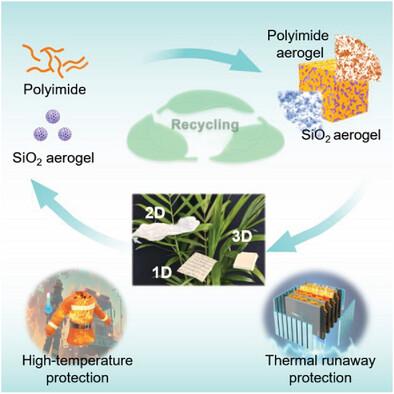
Mitigating embodied emissions is becoming increasingly crucial as the energy supply shifts toward more sustainable sources. Bio-based materials present a potentially more sustainable alternative to synthetic polymers; however, it often do not yet match the performance of synthetic materials. Given the ongoing reliance on high-performance, high-environmental-impact materials, it is essential to ensure their complete recyclability. Aerogels, recognized by IUPAC as one of the top ten emerging technologies, are witnessing rapid market growth in thermal insulation and thermal protection applications. In certain applications, synthetic and composite aerogels exhibit superior performance, particularly under high temperatures. Here, molecular simulation tools are employed to elucidate the interaction forces between polymers and solvents, develop a recycling strategy for polyimide-based aerogels, and demonstrate their application in thermal protection for firefighter textiles and thermal runaway protection for Li-ion battery packs. These composites are engineered for disassembly, allowing for the complete recovery of starting materials without any degradation of components after multiple recycling cycles. The recyclable composites can be fabricated using various manufacturing techniques to produce fibers (1D), membranes (2D), and complex structures (3D). This unique combination of outstanding performance and excellent recyclability facilitates the sustainable utilization of aerogels in protective clothing, electric mobility, consumer goods, and aeronautics.
期刊介绍:
Advanced Materials, one of the world's most prestigious journals and the foundation of the Advanced portfolio, is the home of choice for best-in-class materials science for more than 30 years. Following this fast-growing and interdisciplinary field, we are considering and publishing the most important discoveries on any and all materials from materials scientists, chemists, physicists, engineers as well as health and life scientists and bringing you the latest results and trends in modern materials-related research every week.







 京公网安备 11010802042870号
京ICP备2023020795号-1
京公网安备 11010802042870号
京ICP备2023020795号-1

 分享
分享
 求助内容:
求助内容: 应助结果提醒方式:
 扫码关注我们
