Justus T. Metternich, Sujit K. Patjoshi, Tanuja Kistwal, Sebastian Kruss
{"title":"High-Throughput Approaches to Engineer Fluorescent Nanosensors","authors":"Justus T. Metternich, Sujit K. Patjoshi, Tanuja Kistwal, Sebastian Kruss","doi":"10.1002/adma.202411067","DOIUrl":null,"url":null,"abstract":"<p>Optical sensors are powerful tools to identify and image (biological) molecules. Because of their optoelectronic properties, nanomaterials are often used as building blocks. To transduce the chemical interaction with the analyte into an optical signal, the interplay between surface chemistry and nanomaterial photophysics has to be optimized. Understanding these aspects promises major opportunities for tailored sensors with optimal performance. However, this requires methods to create and explore the many chemical permutations. Indeed, many current approaches are limited in throughput. This affects the chemical design space that can be studied, the application of machine learning approaches as well as fundamental mechanistic understanding. Here, an overview of selection-limited and synthesis-limited approaches is provided to create and identify molecular nanosensors. Bottlenecks are discussed and opportunities of non-classical recognition strategies are highlighted such as corona phase molecular recognition as well as the requirements for high throughput and scalability. Fluorescent carbon nanotubes are powerful building blocks for sensors and their huge chemical design space makes them an ideal platform for high throughput approaches. Therefore, they are the focus of this article, but the insights are transferable to any nanosensor system. Overall, this perspective aims to provide a fresh perspective to overcome current challenges in the nanosensor field.</p>","PeriodicalId":114,"journal":{"name":"Advanced Materials","volume":"37 1","pages":""},"PeriodicalIF":26.8000,"publicationDate":"2024-11-12","publicationTypes":"Journal Article","fieldsOfStudy":null,"isOpenAccess":false,"openAccessPdf":"https://onlinelibrary.wiley.com/doi/epdf/10.1002/adma.202411067","citationCount":"0","resultStr":null,"platform":"Semanticscholar","paperid":null,"PeriodicalName":"Advanced Materials","FirstCategoryId":"88","ListUrlMain":"https://advanced.onlinelibrary.wiley.com/doi/10.1002/adma.202411067","RegionNum":1,"RegionCategory":"材料科学","ArticlePicture":[],"TitleCN":null,"AbstractTextCN":null,"PMCID":null,"EPubDate":"","PubModel":"","JCR":"Q1","JCRName":"CHEMISTRY, MULTIDISCIPLINARY","Score":null,"Total":0}
引用次数: 0
Abstract
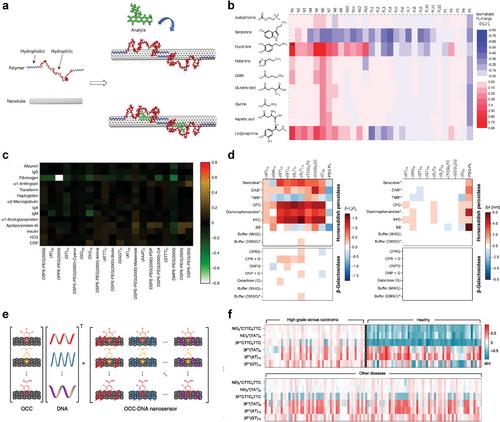
Optical sensors are powerful tools to identify and image (biological) molecules. Because of their optoelectronic properties, nanomaterials are often used as building blocks. To transduce the chemical interaction with the analyte into an optical signal, the interplay between surface chemistry and nanomaterial photophysics has to be optimized. Understanding these aspects promises major opportunities for tailored sensors with optimal performance. However, this requires methods to create and explore the many chemical permutations. Indeed, many current approaches are limited in throughput. This affects the chemical design space that can be studied, the application of machine learning approaches as well as fundamental mechanistic understanding. Here, an overview of selection-limited and synthesis-limited approaches is provided to create and identify molecular nanosensors. Bottlenecks are discussed and opportunities of non-classical recognition strategies are highlighted such as corona phase molecular recognition as well as the requirements for high throughput and scalability. Fluorescent carbon nanotubes are powerful building blocks for sensors and their huge chemical design space makes them an ideal platform for high throughput approaches. Therefore, they are the focus of this article, but the insights are transferable to any nanosensor system. Overall, this perspective aims to provide a fresh perspective to overcome current challenges in the nanosensor field.
期刊介绍:
Advanced Materials, one of the world's most prestigious journals and the foundation of the Advanced portfolio, is the home of choice for best-in-class materials science for more than 30 years. Following this fast-growing and interdisciplinary field, we are considering and publishing the most important discoveries on any and all materials from materials scientists, chemists, physicists, engineers as well as health and life scientists and bringing you the latest results and trends in modern materials-related research every week.






 京公网安备 11010802042870号
京ICP备2023020795号-1
京公网安备 11010802042870号
京ICP备2023020795号-1

 分享
分享
 求助内容:
求助内容: 应助结果提醒方式:
 扫码关注我们
