Xiafei Gao, Yuping Pan, Janghui Qiu, Juan Peng, Shuangyin Wang, Yuqin Zou
{"title":"Enhancing the Stability of Cu-Based Electrocatalyst via Fe Alloy in Electrocatalytic Formaldehyde Oxidation with Long Durability","authors":"Xiafei Gao, Yuping Pan, Janghui Qiu, Juan Peng, Shuangyin Wang, Yuqin Zou","doi":"10.1002/adfm.202417545","DOIUrl":null,"url":null,"abstract":"<p>Electrocatalytic formaldehyde oxidation with metal Cu electrocatalyst has attracted significant interest since it can produce H<sub>2</sub> at the anode and make it possible to construct a bipolar hydrogen production cell with low voltage. However, the activity of the Cu electrocatalyst will be greatly weakened after oxidizing it to Cu<sup>+</sup> or Cu<sup>2+</sup>. Here, a CuFe bimetallic catalyst is developed to efficiently catalyze the electro-oxidation process of HCHO to produce H<sub>2</sub> at a potential of 0.10 V<sub>RHE</sub> with a current density of 100 mA cm<sup>−2</sup>. It is confirmed that introducing Fe in a CuFe catalyst can regulate the electron configuration to prevent Cu<sup>0</sup> oxidation and improve the stability of the catalysts. The introduction of Fe can reduce the energy barrier of the reaction process, and make the C─H bond more easily split on CuFe. A bipolar hydrogen production device is constructed by combining the anodic oxidation of HCHO with the cathodic hydrogen evolution. The current density of 500 mA cm<sup>−2</sup> is achieved at a cell voltage of 0.6 V. The faradaic efficiency is ≈100% and the device is stable for ≈50 h. The research provides a promising path toward the secure, effective, and expandable generation of high-purity H<sub>2</sub> at both anodic and cathodic electrodes.</p>","PeriodicalId":112,"journal":{"name":"Advanced Functional Materials","volume":"35 12","pages":""},"PeriodicalIF":19.0000,"publicationDate":"2024-11-13","publicationTypes":"Journal Article","fieldsOfStudy":null,"isOpenAccess":false,"openAccessPdf":"","citationCount":"0","resultStr":null,"platform":"Semanticscholar","paperid":null,"PeriodicalName":"Advanced Functional Materials","FirstCategoryId":"88","ListUrlMain":"https://advanced.onlinelibrary.wiley.com/doi/10.1002/adfm.202417545","RegionNum":1,"RegionCategory":"材料科学","ArticlePicture":[],"TitleCN":null,"AbstractTextCN":null,"PMCID":null,"EPubDate":"","PubModel":"","JCR":"Q1","JCRName":"CHEMISTRY, MULTIDISCIPLINARY","Score":null,"Total":0}
引用次数: 0
Abstract
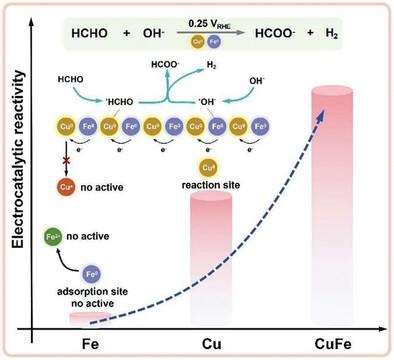
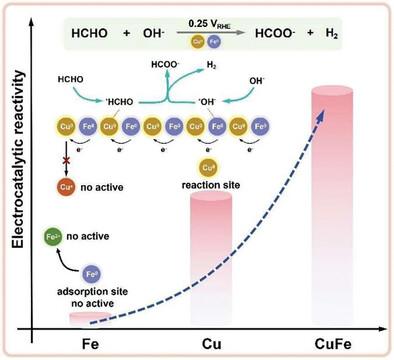
Electrocatalytic formaldehyde oxidation with metal Cu electrocatalyst has attracted significant interest since it can produce H2 at the anode and make it possible to construct a bipolar hydrogen production cell with low voltage. However, the activity of the Cu electrocatalyst will be greatly weakened after oxidizing it to Cu+ or Cu2+. Here, a CuFe bimetallic catalyst is developed to efficiently catalyze the electro-oxidation process of HCHO to produce H2 at a potential of 0.10 VRHE with a current density of 100 mA cm−2. It is confirmed that introducing Fe in a CuFe catalyst can regulate the electron configuration to prevent Cu0 oxidation and improve the stability of the catalysts. The introduction of Fe can reduce the energy barrier of the reaction process, and make the C─H bond more easily split on CuFe. A bipolar hydrogen production device is constructed by combining the anodic oxidation of HCHO with the cathodic hydrogen evolution. The current density of 500 mA cm−2 is achieved at a cell voltage of 0.6 V. The faradaic efficiency is ≈100% and the device is stable for ≈50 h. The research provides a promising path toward the secure, effective, and expandable generation of high-purity H2 at both anodic and cathodic electrodes.
期刊介绍:
Firmly established as a top-tier materials science journal, Advanced Functional Materials reports breakthrough research in all aspects of materials science, including nanotechnology, chemistry, physics, and biology every week.
Advanced Functional Materials is known for its rapid and fair peer review, quality content, and high impact, making it the first choice of the international materials science community.






 京公网安备 11010802042870号
京ICP备2023020795号-1
京公网安备 11010802042870号
京ICP备2023020795号-1

 分享
分享
 求助内容:
求助内容: 应助结果提醒方式:
 扫码关注我们
