Subi Choi, Hongye Guo, Bitgaram Kim, Ji-Hun Seo, Eugene M. Terentjev, Mohand O. Saed, Suk-kyun Ahn
{"title":"Harnessing Extreme Internal Damping in Polyrotaxane-Incorporated Liquid Crystal Elastomers for Pressure-Sensitive Adhesives","authors":"Subi Choi, Hongye Guo, Bitgaram Kim, Ji-Hun Seo, Eugene M. Terentjev, Mohand O. Saed, Suk-kyun Ahn","doi":"10.1002/adfm.202413824","DOIUrl":null,"url":null,"abstract":"<p>Liquid crystal elastomers (LCEs) exhibit extraordinary energy dissipation due to their unique viscoelastic response, resulting from the rotation of mesogens under mechanical stress. While recent studies demonstrate the LCE-based pressure-sensitive adhesives (PSAs) by exploiting the enhanced damping, all previous studies have focused on LCEs with covalent crosslinks. Here, a new class of PSAs is developed by integrating movable polyrotaxane crosslinkers into an LCE matrix (PRx-LCEs). Dynamic viscoelastic measurements reveal that PRx-LCE exhibits a remarkably high energy dissipation, as indicated by a large tan δ. Interestingly, the secondary tan δ peak associated with LCE damping is more pronounced than the primary peak of the glass transition. The exceptional energy dissipation in PRx-LCE results in superior adhesion strength (≈1864 N m<sup>−1</sup>), which is 3.5 times higher than conventional LCEs and 13 times higher than commercial PSAs in the peel test. Additionally, PRx-LCEs demonstrate thermally reversible adhesion, enabling clean removal at elevated temperatures. Furthermore, the sliding effect in PRx-LCE enhances both deformability and stress relaxation under load, resulting in deeper indentation, and superior adhesion during the probe tack test. The combination of LCE and slidable crosslinks provides robust and switchable adhesion, making them promising for applications in biomedical engineering, display, and semiconductor industries.</p>","PeriodicalId":112,"journal":{"name":"Advanced Functional Materials","volume":"35 3","pages":""},"PeriodicalIF":19.0000,"publicationDate":"2024-11-13","publicationTypes":"Journal Article","fieldsOfStudy":null,"isOpenAccess":false,"openAccessPdf":"","citationCount":"0","resultStr":null,"platform":"Semanticscholar","paperid":null,"PeriodicalName":"Advanced Functional Materials","FirstCategoryId":"88","ListUrlMain":"https://advanced.onlinelibrary.wiley.com/doi/10.1002/adfm.202413824","RegionNum":1,"RegionCategory":"材料科学","ArticlePicture":[],"TitleCN":null,"AbstractTextCN":null,"PMCID":null,"EPubDate":"","PubModel":"","JCR":"Q1","JCRName":"CHEMISTRY, MULTIDISCIPLINARY","Score":null,"Total":0}
引用次数: 0
Abstract
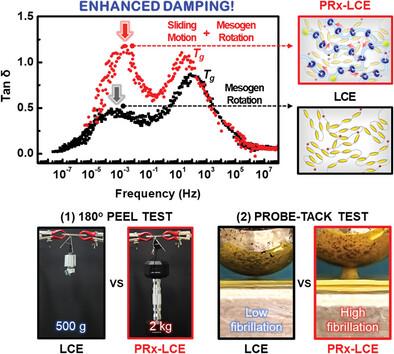
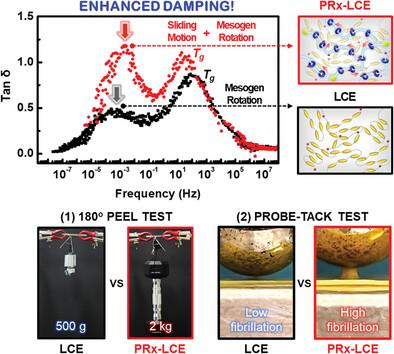
Liquid crystal elastomers (LCEs) exhibit extraordinary energy dissipation due to their unique viscoelastic response, resulting from the rotation of mesogens under mechanical stress. While recent studies demonstrate the LCE-based pressure-sensitive adhesives (PSAs) by exploiting the enhanced damping, all previous studies have focused on LCEs with covalent crosslinks. Here, a new class of PSAs is developed by integrating movable polyrotaxane crosslinkers into an LCE matrix (PRx-LCEs). Dynamic viscoelastic measurements reveal that PRx-LCE exhibits a remarkably high energy dissipation, as indicated by a large tan δ. Interestingly, the secondary tan δ peak associated with LCE damping is more pronounced than the primary peak of the glass transition. The exceptional energy dissipation in PRx-LCE results in superior adhesion strength (≈1864 N m−1), which is 3.5 times higher than conventional LCEs and 13 times higher than commercial PSAs in the peel test. Additionally, PRx-LCEs demonstrate thermally reversible adhesion, enabling clean removal at elevated temperatures. Furthermore, the sliding effect in PRx-LCE enhances both deformability and stress relaxation under load, resulting in deeper indentation, and superior adhesion during the probe tack test. The combination of LCE and slidable crosslinks provides robust and switchable adhesion, making them promising for applications in biomedical engineering, display, and semiconductor industries.
期刊介绍:
Firmly established as a top-tier materials science journal, Advanced Functional Materials reports breakthrough research in all aspects of materials science, including nanotechnology, chemistry, physics, and biology every week.
Advanced Functional Materials is known for its rapid and fair peer review, quality content, and high impact, making it the first choice of the international materials science community.







 京公网安备 11010802042870号
京ICP备2023020795号-1
京公网安备 11010802042870号
京ICP备2023020795号-1

 分享
分享
 求助内容:
求助内容: 应助结果提醒方式:
 扫码关注我们
