Fei Hu, Peiyu Huang, Xu Feng, Changjian Zhou, Xinjuan Zeng, Congcong Liu, Guangjin Wang, Xiaowei Yang and Huawen Hu
{"title":"A porous network of boron-doped IrO2 nanoneedles with enhanced mass activity for acidic oxygen evolution reactions†","authors":"Fei Hu, Peiyu Huang, Xu Feng, Changjian Zhou, Xinjuan Zeng, Congcong Liu, Guangjin Wang, Xiaowei Yang and Huawen Hu","doi":"10.1039/D4MH01358A","DOIUrl":null,"url":null,"abstract":"<p >While proton exchange membrane water electrolyzers (PEMWEs) are essential for realizing practical hydrogen production, the trade-off among activity, stability, and cost of state-of-the-art iridium (Ir)-based oxygen evolution reaction (OER) electrocatalysts for PEMWE implementation is still prohibitively challenging. Ir minimization coupled with mass activity improvement of Ir-based catalysts is a promising strategy to address this challenge. Here, we present a discovery demonstrating that boron doping facilitates the one-dimensional (1D) anisotropic growth of IrO<small><sub>2</sub></small> crystals, as supported by both experimental and theoretical evidence. The synthesized porous network of ultralong boron-doped iridium oxide (B-IrO<small><sub>2</sub></small>) nanoneedles exhibits improved electronic conductivity and reduced charge transfer resistance, thereby increasing the number of active sites. As a result, B-IrO<small><sub>2</sub></small> displays an ultrahigh OER mass activity of 3656.3 A g<small><sub>Ir</sub></small><small><sup>−1</sup></small> with an Ir loading of 0.08 mg<small><sub>Ir</sub></small> cm<small><sup>−2</sup></small>, which is 4.02 and 6.18 times higher than those of the un-doped IrO<small><sub>2</sub></small> nanoneedle network (L-IrO<small><sub>2</sub></small>) and Adams IrO<small><sub>2</sub></small> nanoparticles (A-IrO<small><sub>2</sub></small>), respectively. Density functional theory (DFT) calculations reveal that the B doping moderately increases the d-band center energy level and significantly lowers the free energy barrier for the conversion of *O to *OOH, thereby improving the intrinsic activity. On the other hand, the stability of B-IrO<small><sub>2</sub></small> can be synchronously promoted, primarily attributed to the B-induced strengthening of the Ir bonds, which help resist electrochemical dissolution. More importantly, when the B-IrO<small><sub>2</sub></small> catalysts are applied to the membrane electrode assembly for PEM water electrolysis (PEMWE), they generate a remarkable current density of up to 2.8 A cm<small><sup>−2</sup></small> and maintain operation for at least 160 h at a current density of 1.0 A cm<small><sup>−2</sup></small>. This work provides new insights into promoting intrinsic activity and stability while minimizing the usage of noble-metal-based OER electrocatalysts for critical energy conversion and storage.</p>","PeriodicalId":87,"journal":{"name":"Materials Horizons","volume":" 2","pages":" 630-641"},"PeriodicalIF":10.7000,"publicationDate":"2024-11-01","publicationTypes":"Journal Article","fieldsOfStudy":null,"isOpenAccess":false,"openAccessPdf":"","citationCount":"0","resultStr":null,"platform":"Semanticscholar","paperid":null,"PeriodicalName":"Materials Horizons","FirstCategoryId":"88","ListUrlMain":"https://pubs.rsc.org/en/content/articlelanding/2025/mh/d4mh01358a","RegionNum":2,"RegionCategory":"材料科学","ArticlePicture":[],"TitleCN":null,"AbstractTextCN":null,"PMCID":null,"EPubDate":"","PubModel":"","JCR":"Q1","JCRName":"CHEMISTRY, MULTIDISCIPLINARY","Score":null,"Total":0}
引用次数: 0
Abstract
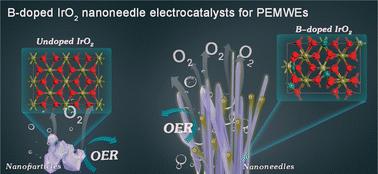
While proton exchange membrane water electrolyzers (PEMWEs) are essential for realizing practical hydrogen production, the trade-off among activity, stability, and cost of state-of-the-art iridium (Ir)-based oxygen evolution reaction (OER) electrocatalysts for PEMWE implementation is still prohibitively challenging. Ir minimization coupled with mass activity improvement of Ir-based catalysts is a promising strategy to address this challenge. Here, we present a discovery demonstrating that boron doping facilitates the one-dimensional (1D) anisotropic growth of IrO2 crystals, as supported by both experimental and theoretical evidence. The synthesized porous network of ultralong boron-doped iridium oxide (B-IrO2) nanoneedles exhibits improved electronic conductivity and reduced charge transfer resistance, thereby increasing the number of active sites. As a result, B-IrO2 displays an ultrahigh OER mass activity of 3656.3 A gIr−1 with an Ir loading of 0.08 mgIr cm−2, which is 4.02 and 6.18 times higher than those of the un-doped IrO2 nanoneedle network (L-IrO2) and Adams IrO2 nanoparticles (A-IrO2), respectively. Density functional theory (DFT) calculations reveal that the B doping moderately increases the d-band center energy level and significantly lowers the free energy barrier for the conversion of *O to *OOH, thereby improving the intrinsic activity. On the other hand, the stability of B-IrO2 can be synchronously promoted, primarily attributed to the B-induced strengthening of the Ir bonds, which help resist electrochemical dissolution. More importantly, when the B-IrO2 catalysts are applied to the membrane electrode assembly for PEM water electrolysis (PEMWE), they generate a remarkable current density of up to 2.8 A cm−2 and maintain operation for at least 160 h at a current density of 1.0 A cm−2. This work provides new insights into promoting intrinsic activity and stability while minimizing the usage of noble-metal-based OER electrocatalysts for critical energy conversion and storage.



 京公网安备 11010802042870号
京ICP备2023020795号-1
京公网安备 11010802042870号
京ICP备2023020795号-1

 分享
分享
 求助内容:
求助内容: 应助结果提醒方式:
 扫码关注我们
