Population pharmacokinetic modeling of paired plasma–breast milk lamivudine data for estimation of infant exposure in breastfeeding mother–infant pairs
Francis Williams Ojara, Aida N. Kawuma, Shadia Nakalema, Isabella Kyohairwe, Ritah Nakijoba, Mohammed Lamorde, Henry Pertinez, Saye Khoo, Catriona Waitt
{"title":"Population pharmacokinetic modeling of paired plasma–breast milk lamivudine data for estimation of infant exposure in breastfeeding mother–infant pairs","authors":"Francis Williams Ojara, Aida N. Kawuma, Shadia Nakalema, Isabella Kyohairwe, Ritah Nakijoba, Mohammed Lamorde, Henry Pertinez, Saye Khoo, Catriona Waitt","doi":"10.1002/psp4.13274","DOIUrl":null,"url":null,"abstract":"<p>Around 1.2 million women living with HIV give birth annually, majority of whom will breastfeed their infants while receiving antiretroviral therapy (ART). Lamivudine, a component of first-line ART regimens crosses from maternal plasma to breast milk, with measurable concentrations in some breastfed infants. Wide variability in plasma-to-breast milk transfer has been reported within- or across studies, probably due to differences in sampling framework. This work sought to characterize the milk-to-plasma transfer of lamivudine, quantify inter-patient variability and associated factors, and predict exposure of a breastfed infant. We explored data from an observational pharmacokinetic study that included 35 Ugandan mothers and their infants. Mothers received lamivudine doses of 150 mg twice daily or 300 mg once daily as part of their antiretroviral regimen. Pharmacokinetic sampling was undertaken across two visits approximately 8 weeks apart, providing 248 maternal plasma, 256 breast milk-, and 151 infant blood concentrations, measured across a 24-h sampling interval. A one-compartmental model best described the plasma disposition of lamivudine, with first-order absorption, interindividual variability on clearance and volume of distribution, and a proportional residual error model. A lag in time of plasma-to-breast milk drug accumulation was described using an effect compartment model with a milk-to-plasma ratio of 1.77. An estimated daily infant dose of 179.3 μg/kg (range: 125.8, 282.3) closely predicted the observed infant steady-state concentrations and translated into 3.34% (2.13, 7.20) and 3.35% (1.10, 7.15) of the standard daily maternal dose in visits 1 and 2, respectively. The established modeling framework can be extended to other drugs.</p>","PeriodicalId":10774,"journal":{"name":"CPT: Pharmacometrics & Systems Pharmacology","volume":"13 11","pages":"1978-1989"},"PeriodicalIF":3.0000,"publicationDate":"2024-11-07","publicationTypes":"Journal Article","fieldsOfStudy":null,"isOpenAccess":false,"openAccessPdf":"https://onlinelibrary.wiley.com/doi/epdf/10.1002/psp4.13274","citationCount":"0","resultStr":null,"platform":"Semanticscholar","paperid":null,"PeriodicalName":"CPT: Pharmacometrics & Systems Pharmacology","FirstCategoryId":"3","ListUrlMain":"https://ascpt.onlinelibrary.wiley.com/doi/10.1002/psp4.13274","RegionNum":3,"RegionCategory":"医学","ArticlePicture":[],"TitleCN":null,"AbstractTextCN":null,"PMCID":null,"EPubDate":"","PubModel":"","JCR":"Q2","JCRName":"PHARMACOLOGY & PHARMACY","Score":null,"Total":0}
引用次数: 0
Abstract
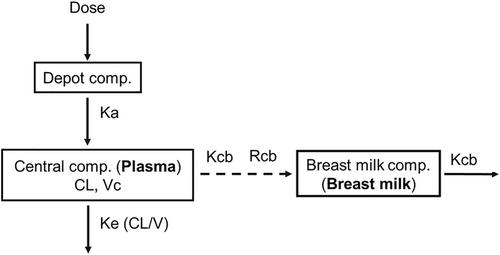
Around 1.2 million women living with HIV give birth annually, majority of whom will breastfeed their infants while receiving antiretroviral therapy (ART). Lamivudine, a component of first-line ART regimens crosses from maternal plasma to breast milk, with measurable concentrations in some breastfed infants. Wide variability in plasma-to-breast milk transfer has been reported within- or across studies, probably due to differences in sampling framework. This work sought to characterize the milk-to-plasma transfer of lamivudine, quantify inter-patient variability and associated factors, and predict exposure of a breastfed infant. We explored data from an observational pharmacokinetic study that included 35 Ugandan mothers and their infants. Mothers received lamivudine doses of 150 mg twice daily or 300 mg once daily as part of their antiretroviral regimen. Pharmacokinetic sampling was undertaken across two visits approximately 8 weeks apart, providing 248 maternal plasma, 256 breast milk-, and 151 infant blood concentrations, measured across a 24-h sampling interval. A one-compartmental model best described the plasma disposition of lamivudine, with first-order absorption, interindividual variability on clearance and volume of distribution, and a proportional residual error model. A lag in time of plasma-to-breast milk drug accumulation was described using an effect compartment model with a milk-to-plasma ratio of 1.77. An estimated daily infant dose of 179.3 μg/kg (range: 125.8, 282.3) closely predicted the observed infant steady-state concentrations and translated into 3.34% (2.13, 7.20) and 3.35% (1.10, 7.15) of the standard daily maternal dose in visits 1 and 2, respectively. The established modeling framework can be extended to other drugs.




 京公网安备 11010802042870号
京ICP备2023020795号-1
京公网安备 11010802042870号
京ICP备2023020795号-1

 分享
分享
 求助内容:
求助内容: 应助结果提醒方式:
 扫码关注我们
