Jie Chen , Lintao Dan , Shuai Yuan , Tian Fu , Jiangwei Sun , Alicja Wolk , Jonas F. Ludvigsson , Xue Li , Xiaoyan Wang , Susanna C. Larsson
{"title":"Dietary Antioxidant Capacity, Genetic Susceptibility and Polymorphism, and Inflammatory Bowel Disease Risk in a Prospective Cohort","authors":"Jie Chen , Lintao Dan , Shuai Yuan , Tian Fu , Jiangwei Sun , Alicja Wolk , Jonas F. Ludvigsson , Xue Li , Xiaoyan Wang , Susanna C. Larsson","doi":"10.1016/j.cgh.2024.09.033","DOIUrl":null,"url":null,"abstract":"<div><h3>Background & Aims</h3><div>Oxidative stress is an essential factor in the pathogenesis of inflammatory bowel disease (IBD). A previous study found protective potential of some antioxidative nutrients against IBD. However, the association between total antioxidant capacity (TAC) of the diet and incident IBD is unclear.</div></div><div><h3>Methods</h3><div>We conducted a prospective cohort study including 186,195 IBD-free participants at baseline from the UK Biobank. We calculated dietary TAC using the oxygen radical absorbance capacity method based on repeated online 24-hour dietary recalls. Crohn’s disease (CD) and ulcerative colitis (UC) were identified via inpatient register and primary care data. Genetic susceptibility for IBD was assessed by a polygenic risk score. Cox proportional hazard models were applied to estimate multivariable-adjusted hazard ratios (aHRs) and 95% confidence intervals (CIs).</div></div><div><h3>Results</h3><div>During a median follow-up of 11.4 years, we identified 396 CD and 809 UC incident cases. Individuals with the highest quintile of dietary TAC had a lower risk of CD (27.0 vs 17.0 cases/100,000 person-years; aHR, 0.66; 95% CI, 0.49–0.90) but not UC (46.7 vs 35.5 cases/100,000 person-years; aHR, 0.85; 95% CI, 0.69–1.06) compared with the lowest group. We observed interactions between TAC and genetic susceptibility at both multiplicative (<em>P</em>-interaction = .008/0.063 for CD/UC) and additive (both <em>P</em> values < .05) scales. Additionally, a polymorphism of the endogenous antioxidant enzyme gene <em>SOD2</em> (rs4880) modified the dietary TAC-UC association (<em>P</em>-interaction = .039).</div></div><div><h3>Conclusion</h3><div>This study suggests that a diet with high TAC may help prevent the development of IBD, particularly in individuals at high genetic risk of IBD and in mutation carriers of rs4880 in <em>SOD2</em>.</div></div>","PeriodicalId":10347,"journal":{"name":"Clinical Gastroenterology and Hepatology","volume":"23 9","pages":"Pages 1623-1632.e16"},"PeriodicalIF":12.0000,"publicationDate":"2025-08-01","publicationTypes":"Journal Article","fieldsOfStudy":null,"isOpenAccess":false,"openAccessPdf":"","citationCount":"0","resultStr":null,"platform":"Semanticscholar","paperid":null,"PeriodicalName":"Clinical Gastroenterology and Hepatology","FirstCategoryId":"3","ListUrlMain":"https://www.sciencedirect.com/science/article/pii/S1542356524009807","RegionNum":1,"RegionCategory":"医学","ArticlePicture":[],"TitleCN":null,"AbstractTextCN":null,"PMCID":null,"EPubDate":"2024/11/5 0:00:00","PubModel":"Epub","JCR":"Q1","JCRName":"GASTROENTEROLOGY & HEPATOLOGY","Score":null,"Total":0}
引用次数: 0
Abstract
Background & Aims
Oxidative stress is an essential factor in the pathogenesis of inflammatory bowel disease (IBD). A previous study found protective potential of some antioxidative nutrients against IBD. However, the association between total antioxidant capacity (TAC) of the diet and incident IBD is unclear.
Methods
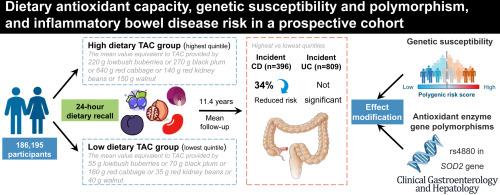
We conducted a prospective cohort study including 186,195 IBD-free participants at baseline from the UK Biobank. We calculated dietary TAC using the oxygen radical absorbance capacity method based on repeated online 24-hour dietary recalls. Crohn’s disease (CD) and ulcerative colitis (UC) were identified via inpatient register and primary care data. Genetic susceptibility for IBD was assessed by a polygenic risk score. Cox proportional hazard models were applied to estimate multivariable-adjusted hazard ratios (aHRs) and 95% confidence intervals (CIs).
Results
During a median follow-up of 11.4 years, we identified 396 CD and 809 UC incident cases. Individuals with the highest quintile of dietary TAC had a lower risk of CD (27.0 vs 17.0 cases/100,000 person-years; aHR, 0.66; 95% CI, 0.49–0.90) but not UC (46.7 vs 35.5 cases/100,000 person-years; aHR, 0.85; 95% CI, 0.69–1.06) compared with the lowest group. We observed interactions between TAC and genetic susceptibility at both multiplicative (P-interaction = .008/0.063 for CD/UC) and additive (both P values < .05) scales. Additionally, a polymorphism of the endogenous antioxidant enzyme gene SOD2 (rs4880) modified the dietary TAC-UC association (P-interaction = .039).
Conclusion
This study suggests that a diet with high TAC may help prevent the development of IBD, particularly in individuals at high genetic risk of IBD and in mutation carriers of rs4880 in SOD2.
期刊介绍:
Clinical Gastroenterology and Hepatology (CGH) is dedicated to offering readers a comprehensive exploration of themes in clinical gastroenterology and hepatology. Encompassing diagnostic, endoscopic, interventional, and therapeutic advances, the journal covers areas such as cancer, inflammatory diseases, functional gastrointestinal disorders, nutrition, absorption, and secretion.
As a peer-reviewed publication, CGH features original articles and scholarly reviews, ensuring immediate relevance to the practice of gastroenterology and hepatology. Beyond peer-reviewed content, the journal includes invited key reviews and articles on endoscopy/practice-based technology, health-care policy, and practice management. Multimedia elements, including images, video abstracts, and podcasts, enhance the reader's experience. CGH remains actively engaged with its audience through updates and commentary shared via platforms such as Facebook and Twitter.



 京公网安备 11010802042870号
京ICP备2023020795号-1
京公网安备 11010802042870号
京ICP备2023020795号-1

 分享
分享
 求助内容:
求助内容: 应助结果提醒方式:
 扫码关注我们
