Ai Lan, Hong Lu, Bin Huang, Fei Chen, Zhikuan Chen, Juan Wang, Liqing Li, Hainam Do
{"title":"Toward Commercial-Scale Perovskite Solar Cells: The Role of ALD-SnO2 Buffer Layers in Performance and Stability","authors":"Ai Lan, Hong Lu, Bin Huang, Fei Chen, Zhikuan Chen, Juan Wang, Liqing Li, Hainam Do","doi":"10.1021/acsami.4c14954","DOIUrl":null,"url":null,"abstract":"Hybrid organic–inorganic perovskite solar cells (PSCs) have shown significant potential in photovoltaic applications due to their superior optoelectronic properties. However, the conventional electron transport layer (ETL) of C<sub>60</sub> in PSCs poses challenges such as incomplete coverage and metal diffusion, leading to reduced performance and stability. This work explores the efficacy of atomic layer deposition (ALD) of SnO<sub>2</sub> as an interlayer between C<sub>60</sub> and electrode to enhance the performance and stability of devices. Devices with varying SnO<sub>2</sub> thicknesses were fabricated, revealing that a 15 nm ALD-SnO<sub>2</sub> layer optimally improved the power conversion efficiency (PCE) to 23.85%, compared to the 22.86% achieved with a BCP layer. Moreover, the SnO<sub>2</sub>-based devices exhibited superior open-circuit voltage (<i>V</i><sub>OC</sub>), short-circuit current density (<i>J</i><sub>SC</sub>), and fill factor (FF). Modules (30 × 30 cm) with ALD-SnO<sub>2</sub> demonstrated notable enhancements in efficiency and uniformity, suggesting the potential for scalable commercial applications. Photoluminescence (PL) and electrochemical impedance spectroscopy (EIS) analyses confirmed the improved charge extraction and reduced recombination with the SnO<sub>2</sub> buffer layer. This research indicates that ALD-SnO<sub>2</sub> is a promising interlayer candidate for PSCs, providing a pathway toward higher efficiency and stability in perovskite solar technology.","PeriodicalId":5,"journal":{"name":"ACS Applied Materials & Interfaces","volume":"20 1","pages":""},"PeriodicalIF":8.2000,"publicationDate":"2024-11-13","publicationTypes":"Journal Article","fieldsOfStudy":null,"isOpenAccess":false,"openAccessPdf":"","citationCount":"0","resultStr":null,"platform":"Semanticscholar","paperid":null,"PeriodicalName":"ACS Applied Materials & Interfaces","FirstCategoryId":"88","ListUrlMain":"https://doi.org/10.1021/acsami.4c14954","RegionNum":2,"RegionCategory":"材料科学","ArticlePicture":[],"TitleCN":null,"AbstractTextCN":null,"PMCID":null,"EPubDate":"","PubModel":"","JCR":"Q1","JCRName":"MATERIALS SCIENCE, MULTIDISCIPLINARY","Score":null,"Total":0}
引用次数: 0
Abstract
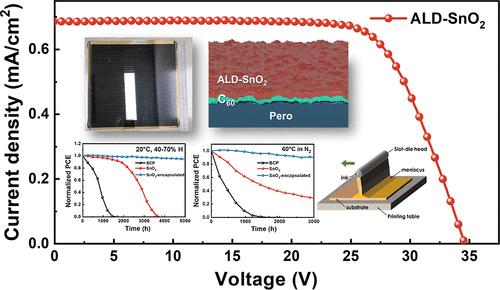
Hybrid organic–inorganic perovskite solar cells (PSCs) have shown significant potential in photovoltaic applications due to their superior optoelectronic properties. However, the conventional electron transport layer (ETL) of C60 in PSCs poses challenges such as incomplete coverage and metal diffusion, leading to reduced performance and stability. This work explores the efficacy of atomic layer deposition (ALD) of SnO2 as an interlayer between C60 and electrode to enhance the performance and stability of devices. Devices with varying SnO2 thicknesses were fabricated, revealing that a 15 nm ALD-SnO2 layer optimally improved the power conversion efficiency (PCE) to 23.85%, compared to the 22.86% achieved with a BCP layer. Moreover, the SnO2-based devices exhibited superior open-circuit voltage (VOC), short-circuit current density (JSC), and fill factor (FF). Modules (30 × 30 cm) with ALD-SnO2 demonstrated notable enhancements in efficiency and uniformity, suggesting the potential for scalable commercial applications. Photoluminescence (PL) and electrochemical impedance spectroscopy (EIS) analyses confirmed the improved charge extraction and reduced recombination with the SnO2 buffer layer. This research indicates that ALD-SnO2 is a promising interlayer candidate for PSCs, providing a pathway toward higher efficiency and stability in perovskite solar technology.
期刊介绍:
ACS Applied Materials & Interfaces is a leading interdisciplinary journal that brings together chemists, engineers, physicists, and biologists to explore the development and utilization of newly-discovered materials and interfacial processes for specific applications. Our journal has experienced remarkable growth since its establishment in 2009, both in terms of the number of articles published and the impact of the research showcased. We are proud to foster a truly global community, with the majority of published articles originating from outside the United States, reflecting the rapid growth of applied research worldwide.



 京公网安备 11010802042870号
京ICP备2023020795号-1
京公网安备 11010802042870号
京ICP备2023020795号-1

 分享
分享
 求助内容:
求助内容: 应助结果提醒方式:
 扫码关注我们
