The investigation of highly efficient chlorinated hydrocarbons removal based on metal nanoparticles carbonaceous synthetic particles: The degradation behavior and selective transformation mechanism
Jia Wang, Shuangrong Wu, Ke Liu, Qi Yang, Haoze Liu, Zhilin Yang
{"title":"The investigation of highly efficient chlorinated hydrocarbons removal based on metal nanoparticles carbonaceous synthetic particles: The degradation behavior and selective transformation mechanism","authors":"Jia Wang, Shuangrong Wu, Ke Liu, Qi Yang, Haoze Liu, Zhilin Yang","doi":"10.1016/j.cej.2024.157387","DOIUrl":null,"url":null,"abstract":"Overconsumption in industrial manufacturing has led to critical emissions of chloroalkanes, posing a significant environmental threat. In this study, the innovative biochar (BC) particles containing nanocrystalline: NZVI, Fe/Pd, Fe/Ni were prepared by impregnation-liquid phase reduction using the pyrolysis of coconut husk as precursors to explore the degradation capabilities of chloroform (CF) via orthogonal experiment. The results indicated that when the pH value was 3, the temperature was 20 ℃, and the reaction time was 60 min, the CF removal efficiency of Fe/Ni-BC reached 80.38 ± 2.08 %, outperforming all other tested synthetic particles. Advanced characterization techniques showed that the abundant dispersed metallic nanoparticle sites would refresh the surface crystal morphology, improve the adsorption enrichment ability of biochar, enhance electron transfer capacity of synthetic particles, and further participate in reductive dechlorination by inducing an electrophilic attack of active hydrogen. Theoretical calculations verified that hydrogen activation and CF facile adsorption would be easily achieved after the introduction of metal nanoparticles, profiting from the multiple synergistic effects between special π-delocalized bond of biochar in carbon layer and multiple nanoparticles docking sites, and thus enhancing the specific CF catalytic selectivity of Fe/Ni as the active center. Collectively, the CF degradation on Fe/Ni-BC was a complex chemisorption process along with reductive hydrogenation decomposition, which achieved the parent CF reduction and promoted the conversion of the low-chlorinated benign products. These findings offer new insights into the developed multifunctional BC and their comprehensive assessment of CF sewage remediation.","PeriodicalId":270,"journal":{"name":"Chemical Engineering Journal","volume":"14 1","pages":""},"PeriodicalIF":13.2000,"publicationDate":"2024-11-14","publicationTypes":"Journal Article","fieldsOfStudy":null,"isOpenAccess":false,"openAccessPdf":"","citationCount":"0","resultStr":null,"platform":"Semanticscholar","paperid":null,"PeriodicalName":"Chemical Engineering Journal","FirstCategoryId":"5","ListUrlMain":"https://doi.org/10.1016/j.cej.2024.157387","RegionNum":1,"RegionCategory":"工程技术","ArticlePicture":[],"TitleCN":null,"AbstractTextCN":null,"PMCID":null,"EPubDate":"","PubModel":"","JCR":"Q1","JCRName":"ENGINEERING, CHEMICAL","Score":null,"Total":0}
引用次数: 0
Abstract
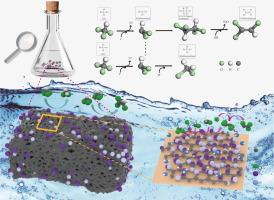
Overconsumption in industrial manufacturing has led to critical emissions of chloroalkanes, posing a significant environmental threat. In this study, the innovative biochar (BC) particles containing nanocrystalline: NZVI, Fe/Pd, Fe/Ni were prepared by impregnation-liquid phase reduction using the pyrolysis of coconut husk as precursors to explore the degradation capabilities of chloroform (CF) via orthogonal experiment. The results indicated that when the pH value was 3, the temperature was 20 ℃, and the reaction time was 60 min, the CF removal efficiency of Fe/Ni-BC reached 80.38 ± 2.08 %, outperforming all other tested synthetic particles. Advanced characterization techniques showed that the abundant dispersed metallic nanoparticle sites would refresh the surface crystal morphology, improve the adsorption enrichment ability of biochar, enhance electron transfer capacity of synthetic particles, and further participate in reductive dechlorination by inducing an electrophilic attack of active hydrogen. Theoretical calculations verified that hydrogen activation and CF facile adsorption would be easily achieved after the introduction of metal nanoparticles, profiting from the multiple synergistic effects between special π-delocalized bond of biochar in carbon layer and multiple nanoparticles docking sites, and thus enhancing the specific CF catalytic selectivity of Fe/Ni as the active center. Collectively, the CF degradation on Fe/Ni-BC was a complex chemisorption process along with reductive hydrogenation decomposition, which achieved the parent CF reduction and promoted the conversion of the low-chlorinated benign products. These findings offer new insights into the developed multifunctional BC and their comprehensive assessment of CF sewage remediation.
期刊介绍:
The Chemical Engineering Journal is an international research journal that invites contributions of original and novel fundamental research. It aims to provide an international platform for presenting original fundamental research, interpretative reviews, and discussions on new developments in chemical engineering. The journal welcomes papers that describe novel theory and its practical application, as well as those that demonstrate the transfer of techniques from other disciplines. It also welcomes reports on carefully conducted experimental work that is soundly interpreted. The main focus of the journal is on original and rigorous research results that have broad significance. The Catalysis section within the Chemical Engineering Journal focuses specifically on Experimental and Theoretical studies in the fields of heterogeneous catalysis, molecular catalysis, and biocatalysis. These studies have industrial impact on various sectors such as chemicals, energy, materials, foods, healthcare, and environmental protection.



 京公网安备 11010802042870号
京ICP备2023020795号-1
京公网安备 11010802042870号
京ICP备2023020795号-1

 分享
分享
 求助内容:
求助内容: 应助结果提醒方式:
 扫码关注我们
