Stefanie Schärli MSc , Fabian Luther PhD , Jeremy Di Domizio PhD , Christina Hillig MSc , Susanne Radonjic-Hoesli MD, PhD , Kathrin Thormann DNP , Dagmar Simon MD , Amalie Thorsti Møller Rønnstad MD , Iben Frier Ruge MD , Blaine G. Fritz PhD , Thomas Bjarnsholt PhD, DMSc , Angela Vallone MSc , Sanja Kezic PhD , Michael P. Menden PhD , Lennart M. Roesner PhD , Thomas Werfel MD , Jacob P. Thyssen MD, PhD, DmSci , Stefanie Eyerich PhD , Michel Gilliet MD , Nicole L. Bertschi PhD , Christoph Schlapbach MD, PhD
{"title":"IL-9 sensitizes human TH2 cells to proinflammatory IL-18 signals in atopic dermatitis","authors":"Stefanie Schärli MSc , Fabian Luther PhD , Jeremy Di Domizio PhD , Christina Hillig MSc , Susanne Radonjic-Hoesli MD, PhD , Kathrin Thormann DNP , Dagmar Simon MD , Amalie Thorsti Møller Rønnstad MD , Iben Frier Ruge MD , Blaine G. Fritz PhD , Thomas Bjarnsholt PhD, DMSc , Angela Vallone MSc , Sanja Kezic PhD , Michael P. Menden PhD , Lennart M. Roesner PhD , Thomas Werfel MD , Jacob P. Thyssen MD, PhD, DmSci , Stefanie Eyerich PhD , Michel Gilliet MD , Nicole L. Bertschi PhD , Christoph Schlapbach MD, PhD","doi":"10.1016/j.jaci.2024.10.027","DOIUrl":null,"url":null,"abstract":"<div><h3>Background</h3><div>T<sub>H</sub>2 cells crucially contribute to the pathogenesis of atopic dermatitis (AD) by secreting high levels of IL-13 and IL-22. Yet the upstream regulators that activate T<sub>H</sub>2 cells in AD skin remain unclear. IL-18 is a putative upstream regulator of T<sub>H</sub>2 cells because it is implicated in AD pathogenesis and has the capacity to activate T cells.</div></div><div><h3>Objective</h3><div>We sought to decipher the role of IL-18 in T<sub>H</sub>2 responses in blood and skin of AD patients.</div></div><div><h3>Methods</h3><div>Peripheral blood mononuclear cells and skin biopsy samples from AD patients and healthy donors were used. Functional assays were performed <em>ex vivo</em> using stimulation or blocking experiments. Analysis was performed by flow cytometry, bead-based multiplex assays, RT-qPCR, RNA-Seq, Western blot, and spatial sequencing.</div></div><div><h3>Results</h3><div>IL-18Rα<sup>+</sup> T<sub>H</sub>2 cells were enriched in blood and lesional skin of AD patients. Of all the cytokines for which T<sub>H</sub>2 cells express the receptor, only IL-9 was able to induce IL-18R via an IL-9R–JAK1/JAK3-STAT1 signaling pathway. Functionally, stimulation of circulating T<sub>H</sub>2 cells with IL-18 induced secretion of IL-13 and IL-22, an effect that was enhanced by costimulation with IL-9. Mechanistically, IL-18 induced T<sub>H</sub>2 cytokines via activation of IRAK4, NF-κB, and AP-1 signaling in T<sub>H</sub>2 cells, and neutralization of IL-18 inhibited these cytokines in cultured explants of AD skin lesions. Finally, IL-18 protein levels correlated positively with disease severity in lesional AD skin.</div></div><div><h3>Conclusion</h3><div>Our data identify a novel IL-9/IL-18 axis that contributes to T<sub>H</sub>2 responses in AD. Our findings suggest that both IL-9 and IL-18 could represent upstream targets for future treatment of AD.</div></div>","PeriodicalId":14936,"journal":{"name":"Journal of Allergy and Clinical Immunology","volume":"155 2","pages":"Pages 491-504.e9"},"PeriodicalIF":11.2000,"publicationDate":"2025-02-01","publicationTypes":"Journal Article","fieldsOfStudy":null,"isOpenAccess":false,"openAccessPdf":"","citationCount":"0","resultStr":null,"platform":"Semanticscholar","paperid":null,"PeriodicalName":"Journal of Allergy and Clinical Immunology","FirstCategoryId":"3","ListUrlMain":"https://www.sciencedirect.com/science/article/pii/S0091674924011710","RegionNum":1,"RegionCategory":"医学","ArticlePicture":[],"TitleCN":null,"AbstractTextCN":null,"PMCID":null,"EPubDate":"2024/11/7 0:00:00","PubModel":"Epub","JCR":"Q1","JCRName":"ALLERGY","Score":null,"Total":0}
引用次数: 0
Abstract
Background
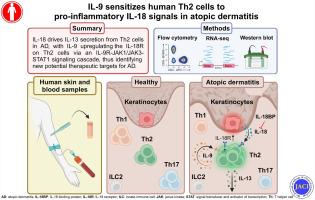
TH2 cells crucially contribute to the pathogenesis of atopic dermatitis (AD) by secreting high levels of IL-13 and IL-22. Yet the upstream regulators that activate TH2 cells in AD skin remain unclear. IL-18 is a putative upstream regulator of TH2 cells because it is implicated in AD pathogenesis and has the capacity to activate T cells.
Objective
We sought to decipher the role of IL-18 in TH2 responses in blood and skin of AD patients.
Methods
Peripheral blood mononuclear cells and skin biopsy samples from AD patients and healthy donors were used. Functional assays were performed ex vivo using stimulation or blocking experiments. Analysis was performed by flow cytometry, bead-based multiplex assays, RT-qPCR, RNA-Seq, Western blot, and spatial sequencing.
Results
IL-18Rα+ TH2 cells were enriched in blood and lesional skin of AD patients. Of all the cytokines for which TH2 cells express the receptor, only IL-9 was able to induce IL-18R via an IL-9R–JAK1/JAK3-STAT1 signaling pathway. Functionally, stimulation of circulating TH2 cells with IL-18 induced secretion of IL-13 and IL-22, an effect that was enhanced by costimulation with IL-9. Mechanistically, IL-18 induced TH2 cytokines via activation of IRAK4, NF-κB, and AP-1 signaling in TH2 cells, and neutralization of IL-18 inhibited these cytokines in cultured explants of AD skin lesions. Finally, IL-18 protein levels correlated positively with disease severity in lesional AD skin.
Conclusion
Our data identify a novel IL-9/IL-18 axis that contributes to TH2 responses in AD. Our findings suggest that both IL-9 and IL-18 could represent upstream targets for future treatment of AD.
期刊介绍:
The Journal of Allergy and Clinical Immunology is a prestigious publication that features groundbreaking research in the fields of Allergy, Asthma, and Immunology. This influential journal publishes high-impact research papers that explore various topics, including asthma, food allergy, allergic rhinitis, atopic dermatitis, primary immune deficiencies, occupational and environmental allergy, and other allergic and immunologic diseases. The articles not only report on clinical trials and mechanistic studies but also provide insights into novel therapies, underlying mechanisms, and important discoveries that contribute to our understanding of these diseases. By sharing this valuable information, the journal aims to enhance the diagnosis and management of patients in the future.




 京公网安备 11010802042870号
京ICP备2023020795号-1
京公网安备 11010802042870号
京ICP备2023020795号-1

 分享
分享
 求助内容:
求助内容: 应助结果提醒方式:
 扫码关注我们
