{"title":"Association Between Maternal Weight Perception Before and During Pregnancy and Postpartum Depression Status in Southern China.","authors":"Qin Zhang, Menglu Qiu, Laidi Guo, Yuanyuan Li, Zhencheng Xie, Wanyi Yang, Lishan Ouyang, Jia Yin, Yun Zhou, Minghan Fu, Ye Ding, Zhixu Wang","doi":"10.3390/nu16213696","DOIUrl":null,"url":null,"abstract":"<p><strong>Objective: </strong>Postpartum depression (PPD) is a common complication after childbirth. Weight misperception can lead to self-esteem issues and mental health problems, especially in women and adolescents. The aim of this study was to investigate the association between weight perception before and during pregnancy and the status of PPD in Southern China.</p><p><strong>Methods: </strong>From October 2021 to November 2023, a multi-stage sampling method was used to recruit 2169 eligible mothers aged 18-49 who had delivered live-born singleton infants within 3 to 180 days postpartum. Anthropometric measurements and face-to-face questionnaire surveys were conducted to collect data. The Kappa test was used to assess the agreement between actual and perceived weight. The generalized linear model incorporating multiplicative interaction analysis was applied to explore the associations among variables.</p><p><strong>Results: </strong>The prevalence of PPD status was 18.0%. Among women, 35.2% perceived their pre-pregnancy weight (PPW) as abnormal, while 33.1% perceived their gestational weight gain (GWG) as inappropriate. There was poor agreement between maternal actual and perceived PPW/GWG (Kappa = 0.366, <i>p</i> < 0.001; Kappa = 0.188, <i>p</i> < 0.001), with 27.8% of women misperceiving their PPW and 52.1% misperceiving their GWG. The results of the general linear model indicated that women who perceived their PPW as underweight (<i>β</i> = 0.70, <i>p</i> = 0.016) or overweight/obese (<i>β</i> = 0.86, <i>p</i> < 0.001), as well as those who perceived their GWG as excessive (<i>β</i> = 0.47, <i>p</i> = 0.028) were more likely to exhibit PPD status. The interaction analysis results showed that those who perceived their PPW as underweight and their GWG as insufficient (<i>β</i> = 1.75, <i>p</i> = 0.020), as well as those who perceived their PPW as overweight/obese and their GWG as excessive (<i>β</i> = 0.90, <i>p</i> = 0.001) had a positive interactive effect on the occurrence of PPD status, while underestimating PPW and GWG may be a protective factor against PPD status (<i>β</i> = -1.03, <i>p</i> = 0.037).</p><p><strong>Conclusion: </strong>These findings support that maternal weight perception plays a role in the development of PPD status. Further improvement is needed in personalized health education for weight management, both prior to and throughout the pregnancy period. This can help women reduce weight anxiety, better understand their body image, and potentially lower the risk of developing PPD.</p>","PeriodicalId":19486,"journal":{"name":"Nutrients","volume":"16 21","pages":""},"PeriodicalIF":5.0000,"publicationDate":"2024-10-30","publicationTypes":"Journal Article","fieldsOfStudy":null,"isOpenAccess":false,"openAccessPdf":"https://www.ncbi.nlm.nih.gov/pmc/articles/PMC11547851/pdf/","citationCount":"0","resultStr":null,"platform":"Semanticscholar","paperid":null,"PeriodicalName":"Nutrients","FirstCategoryId":"3","ListUrlMain":"https://doi.org/10.3390/nu16213696","RegionNum":2,"RegionCategory":"医学","ArticlePicture":[],"TitleCN":null,"AbstractTextCN":null,"PMCID":null,"EPubDate":"","PubModel":"","JCR":"Q1","JCRName":"NUTRITION & DIETETICS","Score":null,"Total":0}
引用次数: 0
Abstract
Objective: Postpartum depression (PPD) is a common complication after childbirth. Weight misperception can lead to self-esteem issues and mental health problems, especially in women and adolescents. The aim of this study was to investigate the association between weight perception before and during pregnancy and the status of PPD in Southern China.
Methods: From October 2021 to November 2023, a multi-stage sampling method was used to recruit 2169 eligible mothers aged 18-49 who had delivered live-born singleton infants within 3 to 180 days postpartum. Anthropometric measurements and face-to-face questionnaire surveys were conducted to collect data. The Kappa test was used to assess the agreement between actual and perceived weight. The generalized linear model incorporating multiplicative interaction analysis was applied to explore the associations among variables.
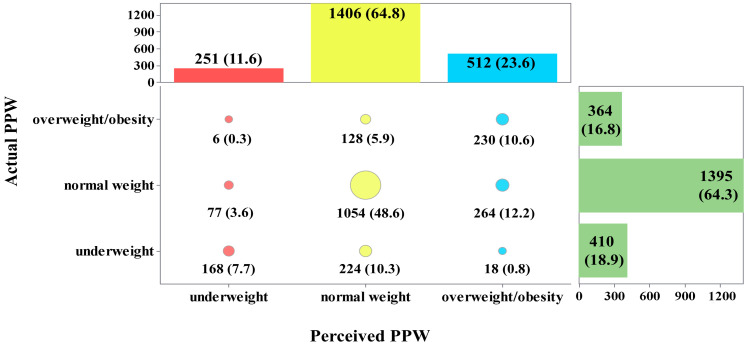
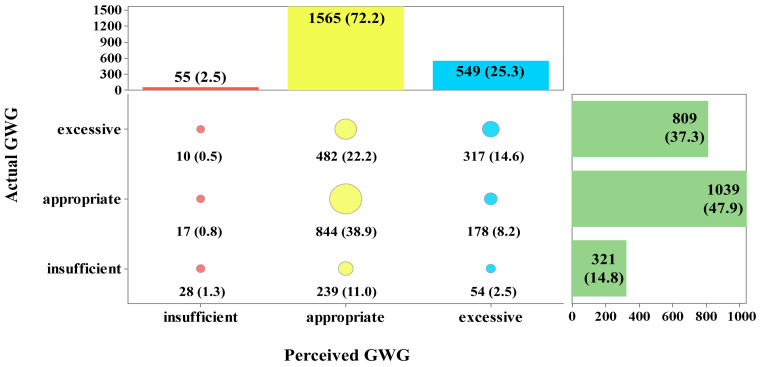
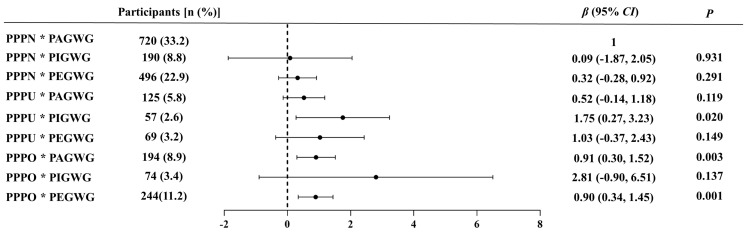
Results: The prevalence of PPD status was 18.0%. Among women, 35.2% perceived their pre-pregnancy weight (PPW) as abnormal, while 33.1% perceived their gestational weight gain (GWG) as inappropriate. There was poor agreement between maternal actual and perceived PPW/GWG (Kappa = 0.366, p < 0.001; Kappa = 0.188, p < 0.001), with 27.8% of women misperceiving their PPW and 52.1% misperceiving their GWG. The results of the general linear model indicated that women who perceived their PPW as underweight (β = 0.70, p = 0.016) or overweight/obese (β = 0.86, p < 0.001), as well as those who perceived their GWG as excessive (β = 0.47, p = 0.028) were more likely to exhibit PPD status. The interaction analysis results showed that those who perceived their PPW as underweight and their GWG as insufficient (β = 1.75, p = 0.020), as well as those who perceived their PPW as overweight/obese and their GWG as excessive (β = 0.90, p = 0.001) had a positive interactive effect on the occurrence of PPD status, while underestimating PPW and GWG may be a protective factor against PPD status (β = -1.03, p = 0.037).
Conclusion: These findings support that maternal weight perception plays a role in the development of PPD status. Further improvement is needed in personalized health education for weight management, both prior to and throughout the pregnancy period. This can help women reduce weight anxiety, better understand their body image, and potentially lower the risk of developing PPD.
期刊介绍:
Nutrients (ISSN 2072-6643) is an international, peer-reviewed open access advanced forum for studies related to Human Nutrition. It publishes reviews, regular research papers and short communications. Our aim is to encourage scientists to publish their experimental and theoretical results in as much detail as possible. There is no restriction on the length of the papers. The full experimental details must be provided so that the results can be reproduced.



 京公网安备 11010802042870号
京ICP备2023020795号-1
京公网安备 11010802042870号
京ICP备2023020795号-1

 分享
分享
 求助内容:
求助内容: 应助结果提醒方式:
 扫码关注我们
