Nazlee Sharmin PhD, MEd, Ida Kornerup DDS, MEd, Ava K Chow PhD
{"title":"Creating simple whiteboard animations to explain complex tooth microanatomy","authors":"Nazlee Sharmin PhD, MEd, Ida Kornerup DDS, MEd, Ava K Chow PhD","doi":"10.1002/jdd.13768","DOIUrl":null,"url":null,"abstract":"<p>The knowledge of tooth microanatomy is essential for dental education.<span><sup>1</sup></span> However, it is challenging for educators to teach the complex organization of hydroxyapatite crystals, rods, and interrods in human teeth solely from photomicrograph and textbook images. To comprehend the complex microanatomy of the tooth from microscopic images, students must integrate the knowledge of angle of the tooth section, magnification, orientation, and composition of the tissue structure. Whiteboard animation, where the content appears to be hand-drawn on a school whiteboard, is a powerful pedagogical tool that can stimulate visual thinking and explain complex concepts in an engaging manner.<span><sup>2, 3</sup></span> Though there are known benefits of these animations,<span><sup>4, 5</sup></span> reports of applying this tool in dental education are scarce.</p><p>We have used a graphics editor, Procreate (Available at: https://procreate.com/) on an iPad, and an animation maker, VideoScribe (Available at: https://www.videoscribe.co/) on a laptop to create whiteboard animations for the students in the Doctor of Dental Surgery (DDS) program at the University of Alberta. Content experts outlined the learning outcomes of the videos. Next, a storyboard consisting of a sequence of rough drawings and directions was developed, outlining the plan of the animated video. The images not available in the image gallery of VideoScribe were hand-drawn in Procreate using textbook images as references. The narrative script was recorded separately. The images and audio were imported into VideoScribe to compile the final whiteboard animation, which takes around 5 hours for each video (Figure 1).</p><p>Two whiteboard animations (tooth microanatomy I and II) were created explaining the internal structure of tooth enamel (Figure 2A–D). The animated videos were posted in the learning management system (LMS) as supplementary learning resources for 1<sup>st</sup> year DDS students. Student interactions with the videos in the LMS were analyzed. An anonymous survey was also conducted to explore students’ experiences with the animations as learning tools. The study design was approved by the University of Alberta Research Ethics Board (ID: Pro00117409).</p><p>LMS data showed that 91% of the class (n = 29) watched tooth microanatomy-I, and 81% (n = 26) watched tooth microanatomy-II (Figure 2E). Fifty-three percent of the DDS class (n = 17) participated in the survey. Forty-seven percent of the survey participants watched the animations between 2 and 5 times, 6% watched for more than 5 times (Figure 2F). Most survey participants (82%) agreed or strongly agreed that the whiteboard animations helped clarify concepts for them. Seventy-six percent recognized them as an effective learning tool. Most survey participants (88%) agreed that these animated videos made learning easier and more enjoyable. Seventy-six percent found these videos engaging and would like similar videos in other areas of their studies (Figure 3A). The features of the whiteboard animations perceived to be the most beneficial by the students were the videos being simple (94%) and concise (88%) (Figure 3B). The free-form student comments also showed their positive attitude and satisfaction with these animated videos (Figure 3C).</p><p>The authors declare no conflicts of interest.</p>","PeriodicalId":50216,"journal":{"name":"Journal of Dental Education","volume":"89 S1","pages":"951-954"},"PeriodicalIF":1.6000,"publicationDate":"2024-11-09","publicationTypes":"Journal Article","fieldsOfStudy":null,"isOpenAccess":false,"openAccessPdf":"https://onlinelibrary.wiley.com/doi/epdf/10.1002/jdd.13768","citationCount":"0","resultStr":null,"platform":"Semanticscholar","paperid":null,"PeriodicalName":"Journal of Dental Education","FirstCategoryId":"3","ListUrlMain":"https://onlinelibrary.wiley.com/doi/10.1002/jdd.13768","RegionNum":4,"RegionCategory":"医学","ArticlePicture":[],"TitleCN":null,"AbstractTextCN":null,"PMCID":null,"EPubDate":"","PubModel":"","JCR":"Q3","JCRName":"DENTISTRY, ORAL SURGERY & MEDICINE","Score":null,"Total":0}
引用次数: 0
Abstract
The knowledge of tooth microanatomy is essential for dental education.1 However, it is challenging for educators to teach the complex organization of hydroxyapatite crystals, rods, and interrods in human teeth solely from photomicrograph and textbook images. To comprehend the complex microanatomy of the tooth from microscopic images, students must integrate the knowledge of angle of the tooth section, magnification, orientation, and composition of the tissue structure. Whiteboard animation, where the content appears to be hand-drawn on a school whiteboard, is a powerful pedagogical tool that can stimulate visual thinking and explain complex concepts in an engaging manner.2, 3 Though there are known benefits of these animations,4, 5 reports of applying this tool in dental education are scarce.
We have used a graphics editor, Procreate (Available at: https://procreate.com/) on an iPad, and an animation maker, VideoScribe (Available at: https://www.videoscribe.co/) on a laptop to create whiteboard animations for the students in the Doctor of Dental Surgery (DDS) program at the University of Alberta. Content experts outlined the learning outcomes of the videos. Next, a storyboard consisting of a sequence of rough drawings and directions was developed, outlining the plan of the animated video. The images not available in the image gallery of VideoScribe were hand-drawn in Procreate using textbook images as references. The narrative script was recorded separately. The images and audio were imported into VideoScribe to compile the final whiteboard animation, which takes around 5 hours for each video (Figure 1).
Two whiteboard animations (tooth microanatomy I and II) were created explaining the internal structure of tooth enamel (Figure 2A–D). The animated videos were posted in the learning management system (LMS) as supplementary learning resources for 1st year DDS students. Student interactions with the videos in the LMS were analyzed. An anonymous survey was also conducted to explore students’ experiences with the animations as learning tools. The study design was approved by the University of Alberta Research Ethics Board (ID: Pro00117409).
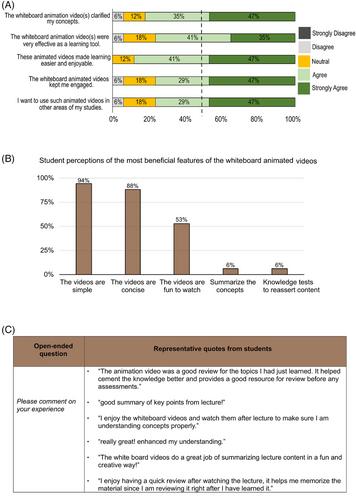
LMS data showed that 91% of the class (n = 29) watched tooth microanatomy-I, and 81% (n = 26) watched tooth microanatomy-II (Figure 2E). Fifty-three percent of the DDS class (n = 17) participated in the survey. Forty-seven percent of the survey participants watched the animations between 2 and 5 times, 6% watched for more than 5 times (Figure 2F). Most survey participants (82%) agreed or strongly agreed that the whiteboard animations helped clarify concepts for them. Seventy-six percent recognized them as an effective learning tool. Most survey participants (88%) agreed that these animated videos made learning easier and more enjoyable. Seventy-six percent found these videos engaging and would like similar videos in other areas of their studies (Figure 3A). The features of the whiteboard animations perceived to be the most beneficial by the students were the videos being simple (94%) and concise (88%) (Figure 3B). The free-form student comments also showed their positive attitude and satisfaction with these animated videos (Figure 3C).
期刊介绍:
The Journal of Dental Education (JDE) is a peer-reviewed monthly journal that publishes a wide variety of educational and scientific research in dental, allied dental and advanced dental education. Published continuously by the American Dental Education Association since 1936 and internationally recognized as the premier journal for academic dentistry, the JDE publishes articles on such topics as curriculum reform, education research methods, innovative educational and assessment methodologies, faculty development, community-based dental education, student recruitment and admissions, professional and educational ethics, dental education around the world and systematic reviews of educational interest. The JDE is one of the top scholarly journals publishing the most important work in oral health education today; it celebrated its 80th anniversary in 2016.



 京公网安备 11010802042870号
京ICP备2023020795号-1
京公网安备 11010802042870号
京ICP备2023020795号-1

 分享
分享
 求助内容:
求助内容: 应助结果提醒方式:
 扫码关注我们
