Roxane Danquigny , Bruno Grassl , Séverine Le Faucheur , Javier Jiménez-Lamana , Marc Metian , Stéphanie Reynaud
{"title":"Use of 2H-labeled nanoplastics to study their accumulation and toxicity in Daphnia magna","authors":"Roxane Danquigny , Bruno Grassl , Séverine Le Faucheur , Javier Jiménez-Lamana , Marc Metian , Stéphanie Reynaud","doi":"10.1016/j.chemosphere.2024.143658","DOIUrl":null,"url":null,"abstract":"<div><div>Understanding the interactions between nanoplastics (NP) and biota is essential for risk assessment. However, NP quantification in complex matrices remains a challenge, especially when they are not labeled. Most labeling strategies consists in adding another compound (fluorophore, metal, lanthanide …) to the polymer, which can alter the NP properties and poses a risk of leaching phenomena. In the present study, we synthesized spherical and monodisperse <sup>2</sup>H-labeling NP (129 nm) with carboxyl groups at their surface (8.7 nm<sup>−2</sup>) using surfactant-free polymerization. A pyrolysis coupled with gas chromatography/mass spectrometry method was developed to enable their quantification (limit of detection = 7.4 ng), without extensive sample preparation or significant matrix effects. The <sup>2</sup>H-labeled NP were then used to study their toxicity and accumulation in the planktonic crustaceans <em>Daphnia magna (D. magna)</em>. Daphnids were exposed for 48 h to the deuterated NP at different concentrations, including environmentally realistic ones (from 0.03 to 36 mg kg<sup>−1</sup>). Little to no acute toxicity were observed in this range of concentration. During the experiment, adsorption on polycarbonate well walls was observed, suggesting that the NP concentration during exposure experiments with organisms should be monitored to take into account possible loss. The NP accumulation (mainly in the digestive tract) increased with the exposure concentration, tending to a plateau at higher concentrations. The depuration was also investigated and was significantly higher (97 % against 59 % in average) when the daphnids have access to algae, which highlight the need to add food in <em>D. magna</em> depuration studies to study the NP fate in these organisms. The present study demonstrated the advantages of stable isotope-labeled NP to better understand the processes controlling NP accumulation and impacts on aquatic biota.</div></div>","PeriodicalId":276,"journal":{"name":"Chemosphere","volume":"368 ","pages":"Article 143658"},"PeriodicalIF":8.1000,"publicationDate":"2024-11-01","publicationTypes":"Journal Article","fieldsOfStudy":null,"isOpenAccess":false,"openAccessPdf":"","citationCount":"0","resultStr":null,"platform":"Semanticscholar","paperid":null,"PeriodicalName":"Chemosphere","FirstCategoryId":"93","ListUrlMain":"https://www.sciencedirect.com/science/article/pii/S004565352402558X","RegionNum":2,"RegionCategory":"环境科学与生态学","ArticlePicture":[],"TitleCN":null,"AbstractTextCN":null,"PMCID":null,"EPubDate":"","PubModel":"","JCR":"Q1","JCRName":"ENVIRONMENTAL SCIENCES","Score":null,"Total":0}
引用次数: 0
Abstract
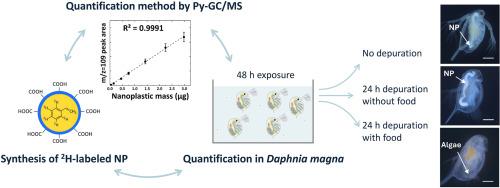
Understanding the interactions between nanoplastics (NP) and biota is essential for risk assessment. However, NP quantification in complex matrices remains a challenge, especially when they are not labeled. Most labeling strategies consists in adding another compound (fluorophore, metal, lanthanide …) to the polymer, which can alter the NP properties and poses a risk of leaching phenomena. In the present study, we synthesized spherical and monodisperse 2H-labeling NP (129 nm) with carboxyl groups at their surface (8.7 nm−2) using surfactant-free polymerization. A pyrolysis coupled with gas chromatography/mass spectrometry method was developed to enable their quantification (limit of detection = 7.4 ng), without extensive sample preparation or significant matrix effects. The 2H-labeled NP were then used to study their toxicity and accumulation in the planktonic crustaceans Daphnia magna (D. magna). Daphnids were exposed for 48 h to the deuterated NP at different concentrations, including environmentally realistic ones (from 0.03 to 36 mg kg−1). Little to no acute toxicity were observed in this range of concentration. During the experiment, adsorption on polycarbonate well walls was observed, suggesting that the NP concentration during exposure experiments with organisms should be monitored to take into account possible loss. The NP accumulation (mainly in the digestive tract) increased with the exposure concentration, tending to a plateau at higher concentrations. The depuration was also investigated and was significantly higher (97 % against 59 % in average) when the daphnids have access to algae, which highlight the need to add food in D. magna depuration studies to study the NP fate in these organisms. The present study demonstrated the advantages of stable isotope-labeled NP to better understand the processes controlling NP accumulation and impacts on aquatic biota.
期刊介绍:
Chemosphere, being an international multidisciplinary journal, is dedicated to publishing original communications and review articles on chemicals in the environment. The scope covers a wide range of topics, including the identification, quantification, behavior, fate, toxicology, treatment, and remediation of chemicals in the bio-, hydro-, litho-, and atmosphere, ensuring the broad dissemination of research in this field.



 京公网安备 11010802042870号
京ICP备2023020795号-1
京公网安备 11010802042870号
京ICP备2023020795号-1

 分享
分享
 求助内容:
求助内容: 应助结果提醒方式:
 扫码关注我们
