{"title":"Enhanced NOx-assisted soot combustion by cobalt doping to weaken mullite Mn-O bonds for lattice oxygen activation","authors":"Qilong Guo, Yaodi Liu, Xinran Zhang, Yupu Xu, Panpan Liu, Changsen Zhang","doi":"10.1016/j.jhazmat.2024.136474","DOIUrl":null,"url":null,"abstract":"<div><div>Catalytic combustion is widely regarded as the most efficient technique for removing soot particulates from diesel engine exhaust, with its efficiency largely dependent on the performance of catalysts. In this study, a series of YMn<sub>1−x</sub>Co<sub>x</sub>O<sub>5-ζ</sub> catalysts were synthesized using a hydrothermal method to investigate their catalytic properties in soot oxidation. Among these catalysts, YMCo-0.2 exhibited the highest catalytic activity, achieving 90 % soot conversion at 392 °C and demonstrating robust tolerance in the presence of water vapor and SO<sub>2</sub>. Structural characterization revealed that Co doping did not alter the fundamental crystal structure of YMn<sub>2</sub>O<sub>5</sub> mullite. Through some characterization comprehensive analysis, and DFT calculations further supported the experimental findings, indicate that Co substitution significantly increased the lattice oxygen mobility and surface active oxygen content. Compared to the surface lattice oxygens at other positions, the weakening of the Mn-O bond results in the lattice oxygens in the Co-O-Mn<sup>4+</sup> sites in the catalysts exhibiting higher reactivity. Additionally, the catalyst displayed strong NO and O<sub>2</sub> adsorption and activation capabilities, indicating its potential for efficient NO<sub>x</sub>-assisted soot combustion. This study provides insights for designing and optimizing mullite catalysts for soot combustion.</div></div>","PeriodicalId":361,"journal":{"name":"Journal of Hazardous Materials","volume":"482 ","pages":"Article 136474"},"PeriodicalIF":11.3000,"publicationDate":"2025-01-15","publicationTypes":"Journal Article","fieldsOfStudy":null,"isOpenAccess":false,"openAccessPdf":"","citationCount":"0","resultStr":null,"platform":"Semanticscholar","paperid":null,"PeriodicalName":"Journal of Hazardous Materials","FirstCategoryId":"93","ListUrlMain":"https://www.sciencedirect.com/science/article/pii/S030438942403053X","RegionNum":1,"RegionCategory":"环境科学与生态学","ArticlePicture":[],"TitleCN":null,"AbstractTextCN":null,"PMCID":null,"EPubDate":"2024/11/16 0:00:00","PubModel":"Epub","JCR":"Q1","JCRName":"ENGINEERING, ENVIRONMENTAL","Score":null,"Total":0}
引用次数: 0
Abstract
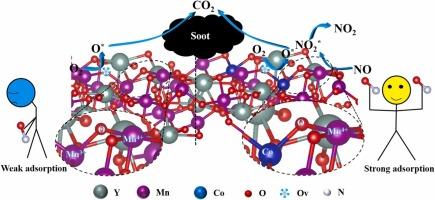
Catalytic combustion is widely regarded as the most efficient technique for removing soot particulates from diesel engine exhaust, with its efficiency largely dependent on the performance of catalysts. In this study, a series of YMn1−xCoxO5-ζ catalysts were synthesized using a hydrothermal method to investigate their catalytic properties in soot oxidation. Among these catalysts, YMCo-0.2 exhibited the highest catalytic activity, achieving 90 % soot conversion at 392 °C and demonstrating robust tolerance in the presence of water vapor and SO2. Structural characterization revealed that Co doping did not alter the fundamental crystal structure of YMn2O5 mullite. Through some characterization comprehensive analysis, and DFT calculations further supported the experimental findings, indicate that Co substitution significantly increased the lattice oxygen mobility and surface active oxygen content. Compared to the surface lattice oxygens at other positions, the weakening of the Mn-O bond results in the lattice oxygens in the Co-O-Mn4+ sites in the catalysts exhibiting higher reactivity. Additionally, the catalyst displayed strong NO and O2 adsorption and activation capabilities, indicating its potential for efficient NOx-assisted soot combustion. This study provides insights for designing and optimizing mullite catalysts for soot combustion.
期刊介绍:
The Journal of Hazardous Materials serves as a global platform for promoting cutting-edge research in the field of Environmental Science and Engineering. Our publication features a wide range of articles, including full-length research papers, review articles, and perspectives, with the aim of enhancing our understanding of the dangers and risks associated with various materials concerning public health and the environment. It is important to note that the term "environmental contaminants" refers specifically to substances that pose hazardous effects through contamination, while excluding those that do not have such impacts on the environment or human health. Moreover, we emphasize the distinction between wastes and hazardous materials in order to provide further clarity on the scope of the journal. We have a keen interest in exploring specific compounds and microbial agents that have adverse effects on the environment.



 京公网安备 11010802042870号
京ICP备2023020795号-1
京公网安备 11010802042870号
京ICP备2023020795号-1

 分享
分享
 求助内容:
求助内容: 应助结果提醒方式:
 扫码关注我们
