Md Mamunur Rahaman , Ewan K.A. Millar , Erik Meijering
{"title":"Generalized deep learning for histopathology image classification using supervised contrastive learning","authors":"Md Mamunur Rahaman , Ewan K.A. Millar , Erik Meijering","doi":"10.1016/j.jare.2024.11.013","DOIUrl":null,"url":null,"abstract":"<div><h3><strong>Introduction</strong></h3><div>Cancer is a leading cause of death worldwide, necessitating effective diagnostic tools for early detection and treatment. Histopathological image analysis is crucial for cancer diagnosis but is often hindered by human error and variability. This study introduces HistopathAI, a hybrid network designed for histopathology image classification, aimed at enhancing diagnostic precision and efficiency in clinical pathology.</div></div><div><h3><strong>Objectives</strong></h3><div>The primary goal of this study is to demonstrate that HistopathAI, leveraging supervised contrastive learning (SCL) and hybrid deep feature fusion (HDFF), can significantly improve the accuracy of histopathological image classification, including scenarios involving imbalanced datasets.</div></div><div><h3><strong>Methods</strong></h3><div>HistopathAI integrates features from EfficientNetB3 and ResNet50, using HDFF to provide a rich representation of histopathology images. The framework employs a sequential methodology, transitioning from feature learning to classifier learning, mirroring the essence of contrastive learning with the aim of producing superior feature representations. The model combines SCL for feature representation with cross-entropy (CE) loss for classification. We evaluated HistopathAI across seven publicly available datasets and one private dataset, covering various histopathology domains.</div></div><div><h3><strong>Results</strong></h3><div>HistopathAI achieved state-of-the-art classification accuracy across all datasets, demonstrating superior performance in both binary and multiclass classification tasks. Statistical testing confirmed that HistopathAI’s performance is significantly better than baseline models, ensuring robust and reliable improvements.</div></div><div><h3><strong>Conclusion</strong></h3><div>HistopathAI offers a robust tool for histopathology image classification, enhancing diagnostic accuracy and supporting the transition to digital pathology. This framework has the potential to improve cancer diagnosis and patient outcomes, paving the way for broader clinical application. The code is available on <span><span>https://github.com/Mamunur-20/HistopathAI</span><svg><path></path></svg></span>.</div></div>","PeriodicalId":14952,"journal":{"name":"Journal of Advanced Research","volume":"75 ","pages":"Pages 389-404"},"PeriodicalIF":13.0000,"publicationDate":"2025-09-01","publicationTypes":"Journal Article","fieldsOfStudy":null,"isOpenAccess":false,"openAccessPdf":"","citationCount":"0","resultStr":null,"platform":"Semanticscholar","paperid":null,"PeriodicalName":"Journal of Advanced Research","FirstCategoryId":"103","ListUrlMain":"https://www.sciencedirect.com/science/article/pii/S2090123224005320","RegionNum":1,"RegionCategory":"综合性期刊","ArticlePicture":[],"TitleCN":null,"AbstractTextCN":null,"PMCID":null,"EPubDate":"2024/11/16 0:00:00","PubModel":"Epub","JCR":"Q1","JCRName":"MULTIDISCIPLINARY SCIENCES","Score":null,"Total":0}
引用次数: 0
Abstract
Introduction
Cancer is a leading cause of death worldwide, necessitating effective diagnostic tools for early detection and treatment. Histopathological image analysis is crucial for cancer diagnosis but is often hindered by human error and variability. This study introduces HistopathAI, a hybrid network designed for histopathology image classification, aimed at enhancing diagnostic precision and efficiency in clinical pathology.
Objectives
The primary goal of this study is to demonstrate that HistopathAI, leveraging supervised contrastive learning (SCL) and hybrid deep feature fusion (HDFF), can significantly improve the accuracy of histopathological image classification, including scenarios involving imbalanced datasets.
Methods
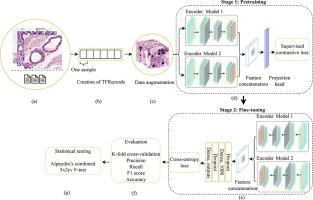
HistopathAI integrates features from EfficientNetB3 and ResNet50, using HDFF to provide a rich representation of histopathology images. The framework employs a sequential methodology, transitioning from feature learning to classifier learning, mirroring the essence of contrastive learning with the aim of producing superior feature representations. The model combines SCL for feature representation with cross-entropy (CE) loss for classification. We evaluated HistopathAI across seven publicly available datasets and one private dataset, covering various histopathology domains.
Results
HistopathAI achieved state-of-the-art classification accuracy across all datasets, demonstrating superior performance in both binary and multiclass classification tasks. Statistical testing confirmed that HistopathAI’s performance is significantly better than baseline models, ensuring robust and reliable improvements.
Conclusion
HistopathAI offers a robust tool for histopathology image classification, enhancing diagnostic accuracy and supporting the transition to digital pathology. This framework has the potential to improve cancer diagnosis and patient outcomes, paving the way for broader clinical application. The code is available on https://github.com/Mamunur-20/HistopathAI.
期刊介绍:
Journal of Advanced Research (J. Adv. Res.) is an applied/natural sciences, peer-reviewed journal that focuses on interdisciplinary research. The journal aims to contribute to applied research and knowledge worldwide through the publication of original and high-quality research articles in the fields of Medicine, Pharmaceutical Sciences, Dentistry, Physical Therapy, Veterinary Medicine, and Basic and Biological Sciences.
The following abstracting and indexing services cover the Journal of Advanced Research: PubMed/Medline, Essential Science Indicators, Web of Science, Scopus, PubMed Central, PubMed, Science Citation Index Expanded, Directory of Open Access Journals (DOAJ), and INSPEC.




 京公网安备 11010802042870号
京ICP备2023020795号-1
京公网安备 11010802042870号
京ICP备2023020795号-1

 分享
分享
 求助内容:
求助内容: 应助结果提醒方式:
 扫码关注我们
