{"title":"Field-Programmable Topographic-Morphing Array for General-Purpose Lab-on-a-Chip Systems","authors":"Yangyang Fan, Huimin Wu, Jiao Wang, Jiu-an Lv","doi":"10.1002/adma.202410604","DOIUrl":null,"url":null,"abstract":"<p>Lab-on-a-chip systems seek to leverage microfluidic chips to enable small-scale fluid manipulation, holding significant potential to revolutionize science and industry. However, existing microfluidic chips have been largely designed with static fluid structures for specific single-purpose applications, which lack adaptability and flexibility for diverse applications. Inspired by the general-purpose design strategy of the customizable chip of integrated circuit <b>–</b> field programmable gate array whose hardware can be reconfigured via software programming for multifunctionality after manufacturing, a conceptual-new reconfigurable microfluidic chip — field programmable topographic morphing array (<i>FPTMA</i>) is devised with exceptional structural reconfiguration, field programmability, and function scalability for general-purpose lab-on-a-chip systems that beyond the reach of current state-of-art lab-on-chip systems. <i>FPTMA</i> can be software programmed to dynamically shape an elastic meta-interface from the initial smooth structure into desired time-varying topographic structures and thus generate spatiotemporal topographic-morphing-induced capillary forces to actively manipulate multidroplets in parallel and enable real-time reconfiguring diverse microfluidic operations/functions/flow networks as well as workflows. It is envisioned that the development of the <i>FPTMA-driven</i> lab-on-a-chip systems that leverage dynamic interfacial topographies to digitally handle microfluidics would significantly stimulate numerous technological innovations in biology/medicine/chemistry.</p>","PeriodicalId":114,"journal":{"name":"Advanced Materials","volume":"37 7","pages":""},"PeriodicalIF":26.8000,"publicationDate":"2024-11-18","publicationTypes":"Journal Article","fieldsOfStudy":null,"isOpenAccess":false,"openAccessPdf":"","citationCount":"0","resultStr":null,"platform":"Semanticscholar","paperid":null,"PeriodicalName":"Advanced Materials","FirstCategoryId":"88","ListUrlMain":"https://advanced.onlinelibrary.wiley.com/doi/10.1002/adma.202410604","RegionNum":1,"RegionCategory":"材料科学","ArticlePicture":[],"TitleCN":null,"AbstractTextCN":null,"PMCID":null,"EPubDate":"","PubModel":"","JCR":"Q1","JCRName":"CHEMISTRY, MULTIDISCIPLINARY","Score":null,"Total":0}
引用次数: 0
Abstract
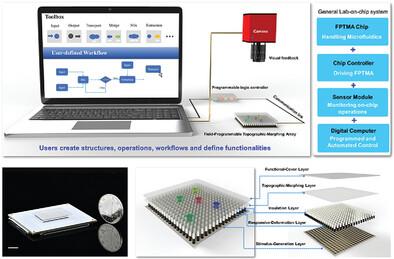
Lab-on-a-chip systems seek to leverage microfluidic chips to enable small-scale fluid manipulation, holding significant potential to revolutionize science and industry. However, existing microfluidic chips have been largely designed with static fluid structures for specific single-purpose applications, which lack adaptability and flexibility for diverse applications. Inspired by the general-purpose design strategy of the customizable chip of integrated circuit – field programmable gate array whose hardware can be reconfigured via software programming for multifunctionality after manufacturing, a conceptual-new reconfigurable microfluidic chip — field programmable topographic morphing array (FPTMA) is devised with exceptional structural reconfiguration, field programmability, and function scalability for general-purpose lab-on-a-chip systems that beyond the reach of current state-of-art lab-on-chip systems. FPTMA can be software programmed to dynamically shape an elastic meta-interface from the initial smooth structure into desired time-varying topographic structures and thus generate spatiotemporal topographic-morphing-induced capillary forces to actively manipulate multidroplets in parallel and enable real-time reconfiguring diverse microfluidic operations/functions/flow networks as well as workflows. It is envisioned that the development of the FPTMA-driven lab-on-a-chip systems that leverage dynamic interfacial topographies to digitally handle microfluidics would significantly stimulate numerous technological innovations in biology/medicine/chemistry.
期刊介绍:
Advanced Materials, one of the world's most prestigious journals and the foundation of the Advanced portfolio, is the home of choice for best-in-class materials science for more than 30 years. Following this fast-growing and interdisciplinary field, we are considering and publishing the most important discoveries on any and all materials from materials scientists, chemists, physicists, engineers as well as health and life scientists and bringing you the latest results and trends in modern materials-related research every week.





 京公网安备 11010802042870号
京ICP备2023020795号-1
京公网安备 11010802042870号
京ICP备2023020795号-1

 分享
分享
 求助内容:
求助内容: 应助结果提醒方式:
 扫码关注我们
