Eyasu Bamlaku Golla, Dawit Denano Leta, Alegntaw Abate, Habtamu Geremew, Samuel Abdisa Kuse
{"title":"Factors associated with hygiene practices among primary school children in southern Ethiopia.","authors":"Eyasu Bamlaku Golla, Dawit Denano Leta, Alegntaw Abate, Habtamu Geremew, Samuel Abdisa Kuse","doi":"10.3389/fpubh.2024.1402455","DOIUrl":null,"url":null,"abstract":"<p><strong>Background: </strong>Eight years into the Sustainable Development Goal period, Ethiopia is not on track to achieve good hygiene practices among school children. Ensuring good hygiene practices among primary school children to prevent the spread of communicable diseases remains a challenge in most primary schools in Ethiopia. Therefore, the aim of this study was to identify factors associated with hygiene practices among primary school children in southern Ethiopia.</p><p><strong>Methods: </strong>A school-based cross-sectional study was conducted from June 3 to July 28, 2022, in five primary schools. The simple random sampling technique was used to select the school. Subsequently, 640 students were selected from the proportionally allocated sample size. Pretested semi-structured interviewer-administered questionnaires and observational checklists were utilized to collect data. The data was then entered into EpiData version 4.6 and analyzed using SPSS version 25. Variables with a <i>p</i> ≤ 0.25 at bivariate analysis were used to develop a multivariable logistic model to identify factors associated with hygiene practices. <i>P</i> < 0.05 with a 95% confidence interval was considered statistically significant.</p><p><strong>Results: </strong>The magnitude of overall good hygiene practices was 29.2% (95% CI: 25.81-32.59). Urban residence (AOR = 3.4, 95% CI 2.1-5.55), knowledge of handwashing (AOR = 4.5, 95% CI 2.8-7.36), being a member of a hygiene and sanitation club (AOR = 3.7, 95% CI 2.4-6.86), and experience of visiting a model school (AOR = 3.1, 95% CI 2.1-5.55) were found to be significantly associated with hygiene practices.</p><p><strong>Conclusion: </strong>The overall level of good hygiene practices in Kedida district was low. Therefore, it is essential to enhance health education on handwashing, establish sanitation and hygiene clubs, and conduct visits to district model elementary schools.</p>","PeriodicalId":12548,"journal":{"name":"Frontiers in Public Health","volume":"12 ","pages":"1402455"},"PeriodicalIF":3.4000,"publicationDate":"2024-11-01","publicationTypes":"Journal Article","fieldsOfStudy":null,"isOpenAccess":false,"openAccessPdf":"https://www.ncbi.nlm.nih.gov/pmc/articles/PMC11566448/pdf/","citationCount":"0","resultStr":null,"platform":"Semanticscholar","paperid":null,"PeriodicalName":"Frontiers in Public Health","FirstCategoryId":"3","ListUrlMain":"https://doi.org/10.3389/fpubh.2024.1402455","RegionNum":3,"RegionCategory":"医学","ArticlePicture":[],"TitleCN":null,"AbstractTextCN":null,"PMCID":null,"EPubDate":"2024/1/1 0:00:00","PubModel":"eCollection","JCR":"Q2","JCRName":"PUBLIC, ENVIRONMENTAL & OCCUPATIONAL HEALTH","Score":null,"Total":0}
引用次数: 0
Abstract
Background: Eight years into the Sustainable Development Goal period, Ethiopia is not on track to achieve good hygiene practices among school children. Ensuring good hygiene practices among primary school children to prevent the spread of communicable diseases remains a challenge in most primary schools in Ethiopia. Therefore, the aim of this study was to identify factors associated with hygiene practices among primary school children in southern Ethiopia.
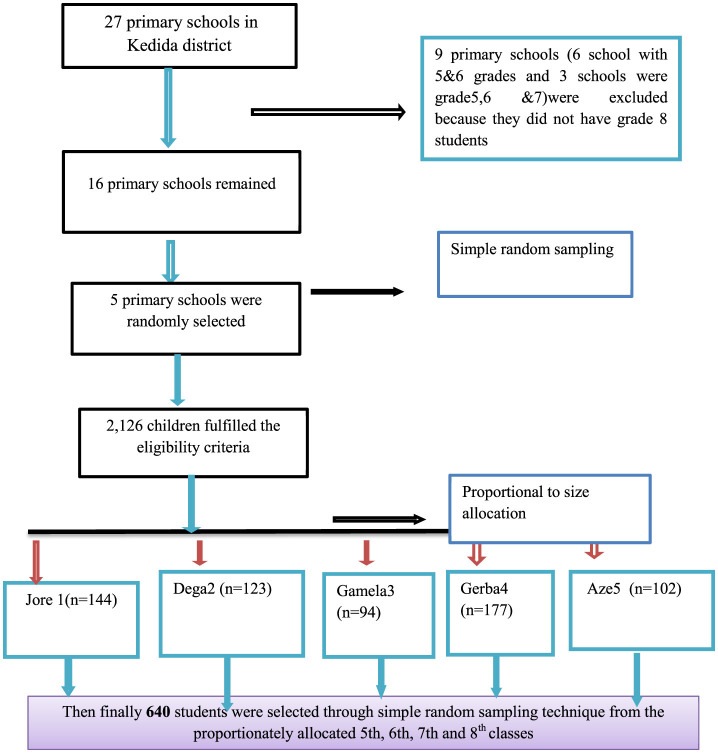
Methods: A school-based cross-sectional study was conducted from June 3 to July 28, 2022, in five primary schools. The simple random sampling technique was used to select the school. Subsequently, 640 students were selected from the proportionally allocated sample size. Pretested semi-structured interviewer-administered questionnaires and observational checklists were utilized to collect data. The data was then entered into EpiData version 4.6 and analyzed using SPSS version 25. Variables with a p ≤ 0.25 at bivariate analysis were used to develop a multivariable logistic model to identify factors associated with hygiene practices. P < 0.05 with a 95% confidence interval was considered statistically significant.
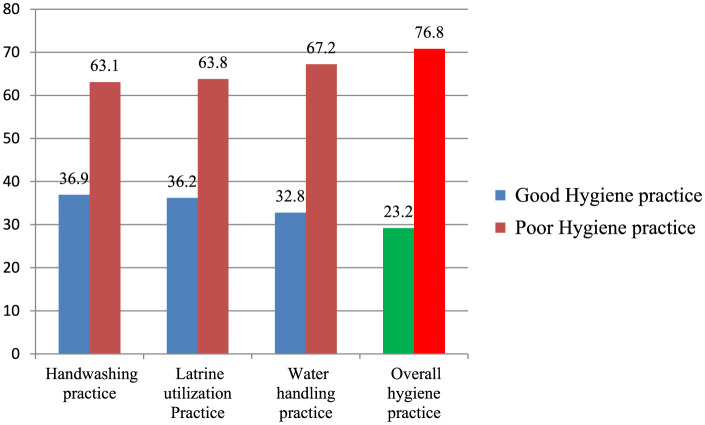
Results: The magnitude of overall good hygiene practices was 29.2% (95% CI: 25.81-32.59). Urban residence (AOR = 3.4, 95% CI 2.1-5.55), knowledge of handwashing (AOR = 4.5, 95% CI 2.8-7.36), being a member of a hygiene and sanitation club (AOR = 3.7, 95% CI 2.4-6.86), and experience of visiting a model school (AOR = 3.1, 95% CI 2.1-5.55) were found to be significantly associated with hygiene practices.
Conclusion: The overall level of good hygiene practices in Kedida district was low. Therefore, it is essential to enhance health education on handwashing, establish sanitation and hygiene clubs, and conduct visits to district model elementary schools.
期刊介绍:
Frontiers in Public Health is a multidisciplinary open-access journal which publishes rigorously peer-reviewed research and is at the forefront of disseminating and communicating scientific knowledge and impactful discoveries to researchers, academics, clinicians, policy makers and the public worldwide. The journal aims at overcoming current fragmentation in research and publication, promoting consistency in pursuing relevant scientific themes, and supporting finding dissemination and translation into practice.
Frontiers in Public Health is organized into Specialty Sections that cover different areas of research in the field. Please refer to the author guidelines for details on article types and the submission process.



 京公网安备 11010802042870号
京ICP备2023020795号-1
京公网安备 11010802042870号
京ICP备2023020795号-1

 分享
分享
 求助内容:
求助内容: 应助结果提醒方式:
 扫码关注我们
