Elif Avcu Altiparmak, Güneş Özen Eroğlu, Namık Özdemir, Serap Erdem Kuruca and Tülay Bal Demirci
{"title":"Synthesis, cytotoxicities, structural properties and comparison of dihalogeno-substituted-thiosemicarbazone ligands and mixed-ligand Ni(ii) complexes†","authors":"Elif Avcu Altiparmak, Güneş Özen Eroğlu, Namık Özdemir, Serap Erdem Kuruca and Tülay Bal Demirci","doi":"10.1039/D4DT02774D","DOIUrl":null,"url":null,"abstract":"<p >Three novel mixed-ligand Ni(ıı) complexes were synthesized from a 3,5-dihalogenosalicylaldehyde-<em>S</em>-methyl isothiosemicarbazone ligand (3,5-dichloro for <strong>Complex I</strong>, 3,5-dibromo for <strong>Complex II</strong>, and 3,5-diiodo for <strong>Complex III</strong>) and diethanolamine. The synthesized compounds were characterized by elemental analysis, FT-IR, UV-Vis and <small><sup>1</sup></small>H-NMR spectroscopy. Solid-state structures of <strong>Complex I</strong> and <strong>Complex II</strong> were determined by the single-crystal X-ray diffraction technique. Both the complexes were found to have a distorted square planar geometry, with coordination of azomethine nitrogen, phenolate oxygen, terminal amine of the thiosemicarbazone ligand and amine nitrogen of diethanolamine. The cytotoxic effects of the ligands and the complexes were evaluated against two different types of cancer cells (THP-1 human leukaemia monocytic cell line and MDA-MB-231 aggressive breast cancer cell line) and healthy cells (HUVEC human umbilical vein endothelial cell line) by using the MTT method. The findings demonstrated that the chloro-derivatives exhibited better efficacy compared to cisplatin in targeting the monocytic leukemia cell line while displaying reduced toxicity towards healthy cells.</p>","PeriodicalId":71,"journal":{"name":"Dalton Transactions","volume":" 4","pages":" 1454-1467"},"PeriodicalIF":3.3000,"publicationDate":"2024-11-18","publicationTypes":"Journal Article","fieldsOfStudy":null,"isOpenAccess":false,"openAccessPdf":"https://pubs.rsc.org/en/content/articlepdf/2025/dt/d4dt02774d?page=search","citationCount":"0","resultStr":null,"platform":"Semanticscholar","paperid":null,"PeriodicalName":"Dalton Transactions","FirstCategoryId":"92","ListUrlMain":"https://pubs.rsc.org/en/content/articlelanding/2025/dt/d4dt02774d","RegionNum":3,"RegionCategory":"化学","ArticlePicture":[],"TitleCN":null,"AbstractTextCN":null,"PMCID":null,"EPubDate":"","PubModel":"","JCR":"Q2","JCRName":"CHEMISTRY, INORGANIC & NUCLEAR","Score":null,"Total":0}
引用次数: 0
Abstract
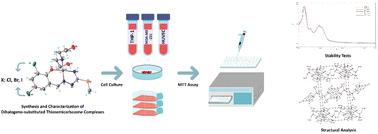
Three novel mixed-ligand Ni(ıı) complexes were synthesized from a 3,5-dihalogenosalicylaldehyde-S-methyl isothiosemicarbazone ligand (3,5-dichloro for Complex I, 3,5-dibromo for Complex II, and 3,5-diiodo for Complex III) and diethanolamine. The synthesized compounds were characterized by elemental analysis, FT-IR, UV-Vis and 1H-NMR spectroscopy. Solid-state structures of Complex I and Complex II were determined by the single-crystal X-ray diffraction technique. Both the complexes were found to have a distorted square planar geometry, with coordination of azomethine nitrogen, phenolate oxygen, terminal amine of the thiosemicarbazone ligand and amine nitrogen of diethanolamine. The cytotoxic effects of the ligands and the complexes were evaluated against two different types of cancer cells (THP-1 human leukaemia monocytic cell line and MDA-MB-231 aggressive breast cancer cell line) and healthy cells (HUVEC human umbilical vein endothelial cell line) by using the MTT method. The findings demonstrated that the chloro-derivatives exhibited better efficacy compared to cisplatin in targeting the monocytic leukemia cell line while displaying reduced toxicity towards healthy cells.
期刊介绍:
Dalton Transactions is a journal for all areas of inorganic chemistry, which encompasses the organometallic, bioinorganic and materials chemistry of the elements, with applications including synthesis, catalysis, energy conversion/storage, electrical devices and medicine. Dalton Transactions welcomes high-quality, original submissions in all of these areas and more, where the advancement of knowledge in inorganic chemistry is significant.



 京公网安备 11010802042870号
京ICP备2023020795号-1
京公网安备 11010802042870号
京ICP备2023020795号-1

 分享
分享
 求助内容:
求助内容: 应助结果提醒方式:
 扫码关注我们
