{"title":"Editorial: Updated COVID-19 Boosters—Tailoring Protection for Patients With IBD. Authors' Reply","authors":"Simon Woelfel, Stephan Brand","doi":"10.1111/apt.18401","DOIUrl":null,"url":null,"abstract":"<p>We thank Drs. Alexander and Caldera for their stimulating and compelling editorial that excellently contextualised our study evaluating the immunogenicity of original and variant-adapted COVID-19 mRNA vaccines in patients with inflammatory bowel disease (IBD) and healthy controls [<span>1, 2</span>].</p><p>To date, the STAR SIGN study has evaluated immunity against wild-type SARS-CoV-2 and the omicron BA.1, BA5, BQ.1.1, XBB.1.5 and the JN.1 variants in a cohort of healthy individuals and patients with IBD (Figure 1) [<span>1, 3-5</span>]. Three doses of original mRNA vaccines induced robust neutralisation against wild-type SARS-CoV-2, but the tested omicron lineages displayed an increasing level of resistance against vaccine-induced neutralising.</p><p>Vaccine adaptation is an effective strategy to boost variant-specific immunity [<span>6</span>]. However, the currently recommended vaccines targeting the JN.1 and KP.2 variants are already the third generation of variant-adapted COVID-19 vaccines. Throughout the last years, variant-adapted vaccines were unable to prevent COVID-19 surges with millions of infections worldwide. The rise of the JN.1 variant shortly after the start of XBB.1.5 vaccine roll-out has shown that immunity elicited by variant-adapted vaccines—while efficient against the targeted variant—is not immune to being evaded. In our current study, vaccines encoding the spike protein of the XBB.1.5 variant failed to induce JN.1 neutralisation in 44% of patients with IBD, highlighting the need to develop strategies to induce escape-resistant immune responses. This might be achieved by enhancing the breadth of systemic antibodies to enhance their cross-reactivity with emerging SARS-CoV-2 variants. Previous immunisations with original vaccines may impair the immunogenicity of XBB.1.5-adapted COVID-19 mRNA vaccines via immune imprinting, which might partially explain the success of the JN.1 variant [<span>7</span>]. However, repeated vaccination with adapted COVID-19 vaccines may override original vaccine-mediated immune imprinting and drive the expansion of antibodies that cross-neutralise emerging SARS-CoV-2 variants [<span>7, 8</span>]. These studies highlight an additional benefit of frequent booster immunisation with adapted vaccines for patients with IBD.</p><p>As the authors pointed out in the editorial, the conservative COVID-19 vaccination guidelines in many European countries have resulted in vaccine hesitancy. Many believe that frequent COVID-19 infections with circulating variants are an adequate and safe strategy to boost immunity against circulating variants which is a deceitful notion. The continuing threat of post-acute sequelae of COVID-19 that increases with every SARS-CoV-2 infection mandates the maintenance of high immunoprotection. Ours and other studies have demonstrated that this requires frequent COVID-19 vaccination in patients with IBD, especially in those treated with anti-TNF agents [<span>1, 3, 4, 9, 10</span>]. It is the responsibility of gastroenterologists to emphasise the critical advantages of vaccines regarding both safety and efficacy to their patients and convince them to keep up to date with variant-adapted COVID-19 vaccines.</p><p><b>Simon Woelfel:</b> visualization, writing – review and editing, writing – original draft, data curation, conceptualization. <b>Stephan Brand:</b> writing – review and editing, supervision, resources, conceptualization, visualization.</p><p>This article is linked to Woelfel et al papers. To view these articles, visit https://doi.org/10.1111/apt.18349 and https://doi.org/10.1111/apt.18379.</p>","PeriodicalId":121,"journal":{"name":"Alimentary Pharmacology & Therapeutics","volume":"61 2","pages":"382-383"},"PeriodicalIF":6.7000,"publicationDate":"2024-11-19","publicationTypes":"Journal Article","fieldsOfStudy":null,"isOpenAccess":false,"openAccessPdf":"https://onlinelibrary.wiley.com/doi/epdf/10.1111/apt.18401","citationCount":"0","resultStr":null,"platform":"Semanticscholar","paperid":null,"PeriodicalName":"Alimentary Pharmacology & Therapeutics","FirstCategoryId":"3","ListUrlMain":"https://onlinelibrary.wiley.com/doi/10.1111/apt.18401","RegionNum":1,"RegionCategory":"医学","ArticlePicture":[],"TitleCN":null,"AbstractTextCN":null,"PMCID":null,"EPubDate":"","PubModel":"","JCR":"Q1","JCRName":"GASTROENTEROLOGY & HEPATOLOGY","Score":null,"Total":0}
引用次数: 0
Abstract
We thank Drs. Alexander and Caldera for their stimulating and compelling editorial that excellently contextualised our study evaluating the immunogenicity of original and variant-adapted COVID-19 mRNA vaccines in patients with inflammatory bowel disease (IBD) and healthy controls [1, 2].
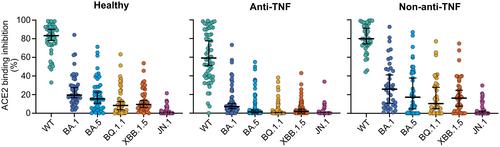
To date, the STAR SIGN study has evaluated immunity against wild-type SARS-CoV-2 and the omicron BA.1, BA5, BQ.1.1, XBB.1.5 and the JN.1 variants in a cohort of healthy individuals and patients with IBD (Figure 1) [1, 3-5]. Three doses of original mRNA vaccines induced robust neutralisation against wild-type SARS-CoV-2, but the tested omicron lineages displayed an increasing level of resistance against vaccine-induced neutralising.
Vaccine adaptation is an effective strategy to boost variant-specific immunity [6]. However, the currently recommended vaccines targeting the JN.1 and KP.2 variants are already the third generation of variant-adapted COVID-19 vaccines. Throughout the last years, variant-adapted vaccines were unable to prevent COVID-19 surges with millions of infections worldwide. The rise of the JN.1 variant shortly after the start of XBB.1.5 vaccine roll-out has shown that immunity elicited by variant-adapted vaccines—while efficient against the targeted variant—is not immune to being evaded. In our current study, vaccines encoding the spike protein of the XBB.1.5 variant failed to induce JN.1 neutralisation in 44% of patients with IBD, highlighting the need to develop strategies to induce escape-resistant immune responses. This might be achieved by enhancing the breadth of systemic antibodies to enhance their cross-reactivity with emerging SARS-CoV-2 variants. Previous immunisations with original vaccines may impair the immunogenicity of XBB.1.5-adapted COVID-19 mRNA vaccines via immune imprinting, which might partially explain the success of the JN.1 variant [7]. However, repeated vaccination with adapted COVID-19 vaccines may override original vaccine-mediated immune imprinting and drive the expansion of antibodies that cross-neutralise emerging SARS-CoV-2 variants [7, 8]. These studies highlight an additional benefit of frequent booster immunisation with adapted vaccines for patients with IBD.
As the authors pointed out in the editorial, the conservative COVID-19 vaccination guidelines in many European countries have resulted in vaccine hesitancy. Many believe that frequent COVID-19 infections with circulating variants are an adequate and safe strategy to boost immunity against circulating variants which is a deceitful notion. The continuing threat of post-acute sequelae of COVID-19 that increases with every SARS-CoV-2 infection mandates the maintenance of high immunoprotection. Ours and other studies have demonstrated that this requires frequent COVID-19 vaccination in patients with IBD, especially in those treated with anti-TNF agents [1, 3, 4, 9, 10]. It is the responsibility of gastroenterologists to emphasise the critical advantages of vaccines regarding both safety and efficacy to their patients and convince them to keep up to date with variant-adapted COVID-19 vaccines.
Simon Woelfel: visualization, writing – review and editing, writing – original draft, data curation, conceptualization. Stephan Brand: writing – review and editing, supervision, resources, conceptualization, visualization.
This article is linked to Woelfel et al papers. To view these articles, visit https://doi.org/10.1111/apt.18349 and https://doi.org/10.1111/apt.18379.
期刊介绍:
Alimentary Pharmacology & Therapeutics is a global pharmacology journal focused on the impact of drugs on the human gastrointestinal and hepato-biliary systems. It covers a diverse range of topics, often with immediate clinical relevance to its readership.



 京公网安备 11010802042870号
京ICP备2023020795号-1
京公网安备 11010802042870号
京ICP备2023020795号-1

 分享
分享
 求助内容:
求助内容: 应助结果提醒方式:
 扫码关注我们
