Flavor formation mechanisms based on phospholipid fermentation simulation system in oyster juice co-fermented by Lactiplantibacillus plantarum and Saccharomyces cerevisiae
Ke Li , Guixin Han , Li Liu , Yuanhui Zhao , Tianhong Liu , Hongjiang Wang , Xinxing Xu
{"title":"Flavor formation mechanisms based on phospholipid fermentation simulation system in oyster juice co-fermented by Lactiplantibacillus plantarum and Saccharomyces cerevisiae","authors":"Ke Li , Guixin Han , Li Liu , Yuanhui Zhao , Tianhong Liu , Hongjiang Wang , Xinxing Xu","doi":"10.1016/j.foodchem.2024.142109","DOIUrl":null,"url":null,"abstract":"<div><div>Oyster juice was co-fermented with <em>Lactiplantibacillus plantarum</em> 3-B and <em>Saccharomyces cerevisiae</em> 7-C, and the quality of the oyster juice and the relationships between phospholipids and flavor formation were investigated. The olfactory odor intensities of (<em>E</em>,<em>E</em>)-2,4-heptadienal and (<em>E</em>,<em>Z</em>)-2,6-nonadienal, which impart off-flavors, were reduced in the co-fermented oyster juice in comparison with the unfermented juice. Co-fermentation resulted in an increase of 5.34 % in docosahexaenoic acid and 20.22 % in eicosapentaenoic acid. The flavor formation mechanisms were explored using a phospholipid-based fermentation simulation system. The levels of the differential phospholipids lysophosphatidylcholine 15:0, lysophosphatidylcholine 16:0, and phosphatidylethanolamine 20:0/16:0 in the co-fermented system decreased by 25.13 μg/mL, 6.87 μg/mL, and 0.30 μg/mL, respectively. Hexanal, (<em>E</em>,<em>E</em>)-2,4-heptadienal, and (<em>E</em>)-2-octenal were not detected in the co-fermented system. This study provides a novel approach to the processing of oyster juice and examines the phospholipid-related pathways involved in flavor formation.</div></div>","PeriodicalId":318,"journal":{"name":"Food Chemistry","volume":"465 ","pages":"Article 142109"},"PeriodicalIF":9.8000,"publicationDate":"2025-02-15","publicationTypes":"Journal Article","fieldsOfStudy":null,"isOpenAccess":false,"openAccessPdf":"","citationCount":"0","resultStr":null,"platform":"Semanticscholar","paperid":null,"PeriodicalName":"Food Chemistry","FirstCategoryId":"97","ListUrlMain":"https://www.sciencedirect.com/science/article/pii/S0308814624037592","RegionNum":1,"RegionCategory":"农林科学","ArticlePicture":[],"TitleCN":null,"AbstractTextCN":null,"PMCID":null,"EPubDate":"2024/11/19 0:00:00","PubModel":"Epub","JCR":"Q1","JCRName":"CHEMISTRY, APPLIED","Score":null,"Total":0}
引用次数: 0
Abstract
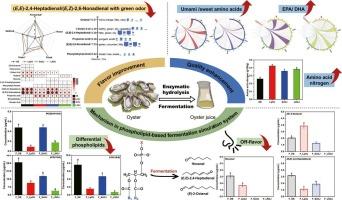
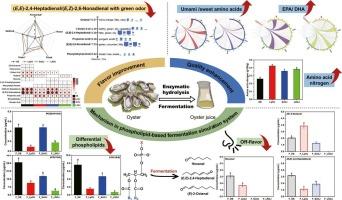
Oyster juice was co-fermented with Lactiplantibacillus plantarum 3-B and Saccharomyces cerevisiae 7-C, and the quality of the oyster juice and the relationships between phospholipids and flavor formation were investigated. The olfactory odor intensities of (E,E)-2,4-heptadienal and (E,Z)-2,6-nonadienal, which impart off-flavors, were reduced in the co-fermented oyster juice in comparison with the unfermented juice. Co-fermentation resulted in an increase of 5.34 % in docosahexaenoic acid and 20.22 % in eicosapentaenoic acid. The flavor formation mechanisms were explored using a phospholipid-based fermentation simulation system. The levels of the differential phospholipids lysophosphatidylcholine 15:0, lysophosphatidylcholine 16:0, and phosphatidylethanolamine 20:0/16:0 in the co-fermented system decreased by 25.13 μg/mL, 6.87 μg/mL, and 0.30 μg/mL, respectively. Hexanal, (E,E)-2,4-heptadienal, and (E)-2-octenal were not detected in the co-fermented system. This study provides a novel approach to the processing of oyster juice and examines the phospholipid-related pathways involved in flavor formation.
期刊介绍:
Food Chemistry publishes original research papers dealing with the advancement of the chemistry and biochemistry of foods or the analytical methods/ approach used. All papers should focus on the novelty of the research carried out.





 京公网安备 11010802042870号
京ICP备2023020795号-1
京公网安备 11010802042870号
京ICP备2023020795号-1

 分享
分享
 求助内容:
求助内容: 应助结果提醒方式:
 扫码关注我们
