Effects of sacubitril/valsartan according to background beta-blocker therapy in patients with heart failure and reduced ejection fraction: Insights from PARADIGM-HF
Sharmistha Datta Gupta, Jawad H. Butt, Eoghan G.M. McMurray, Atefeh Talebi, Shingo Matsumoto, Adel R. Rizkala, Alasdair D. Henderson, Akshay S. Desai, Martin Lefkowitz, Milton Packer, Jean L. Rouleau, Scott D. Solomon, Karl Swedberg, Michael R. Zile, Pardeep S. Jhund, John J.V. McMurray, for the PARADIGM-HF Investigators and Committees
{"title":"Effects of sacubitril/valsartan according to background beta-blocker therapy in patients with heart failure and reduced ejection fraction: Insights from PARADIGM-HF","authors":"Sharmistha Datta Gupta, Jawad H. Butt, Eoghan G.M. McMurray, Atefeh Talebi, Shingo Matsumoto, Adel R. Rizkala, Alasdair D. Henderson, Akshay S. Desai, Martin Lefkowitz, Milton Packer, Jean L. Rouleau, Scott D. Solomon, Karl Swedberg, Michael R. Zile, Pardeep S. Jhund, John J.V. McMurray, for the PARADIGM-HF Investigators and Committees","doi":"10.1002/ejhf.3515","DOIUrl":null,"url":null,"abstract":"<div>\n \n <section>\n \n <h3> Aims</h3>\n \n <p>Beta-blockers may inhibit neprilysin activity and conversely, neprilysin inhibition may have a sympatho-inhibitory action. Consequently, sacubitril/valsartan may have a greater effect in patients not receiving a beta-blocker compared to those treated with a beta-blocker.</p>\n </section>\n \n <section>\n \n <h3> Methods and results</h3>\n \n <p>We examined the effect of sacubitril/valsartan compared to enalapril on outcomes according to background beta-blocker treatment in the 8399 patients with heart failure with reduced ejection fraction enrolled in PARADIGM-HF. The primary outcome was time to first heart failure hospitalization or cardiovascular death. Compared to the 7811 patients taking a beta-blocker, the 588 patients not receiving a beta-blocker were older, more frequently female, but had a similar mean left ventricular ejection fraction and New York Heart Association class distribution, with little difference in N-terminal pro-B-type natriuretic peptide. Patients not taking beta-blockers had a higher rate of the primary endpoint than those taking beta-blockers. The benefit of sacubitril/valsartan on the primary endpoint was evident in both the no beta-blocker subgroup (hazard ratio [HR] 0.61, 95% confidence interval [CI] 0.45–0.82) and the beta-blocker subgroup (HR 0.82, 95% CI 0.75–0.90; <i>p</i>-interaction = 0.06). The respective HRs for cardiovascular death were 0.47 (95% CI 0.32–0.69) versus 0.84 (95% CI 0.75–0.95; <i>p</i>-interaction <0.01) and for HF hospitalization 0.76 (95% CI 0.51–1.12) versus 0.80 (95% CI 0.71–0.90; <i>p</i>-interaction = 0.73). For all-cause death, the HR in the no beta-blocker group was 0.50 (95% CI 0.36–0.71) compared to 0.89 (95% CI 0.80–0.99) in the beta-blocker group (<i>p</i>-interaction <0.01). Safety outcomes related to sacubitril/valsartan versus enalapril did not differ according to background beta-blocker use.</p>\n </section>\n \n <section>\n \n <h3> Conclusion</h3>\n \n <p>Sacubitril/valsartan may be more effective than enalapril in reducing the risk of death in patients not treated with a beta-blocker compared to those treated with a beta-blocker, but is effective regardless of beta-blocker use.</p>\n \n <p>Clinical Trial Registration: ClinicalTrials.gov NCT01035255.</p>\n </section>\n </div>","PeriodicalId":164,"journal":{"name":"European Journal of Heart Failure","volume":"27 5","pages":"779-787"},"PeriodicalIF":10.8000,"publicationDate":"2024-11-19","publicationTypes":"Journal Article","fieldsOfStudy":null,"isOpenAccess":false,"openAccessPdf":"","citationCount":"0","resultStr":null,"platform":"Semanticscholar","paperid":null,"PeriodicalName":"European Journal of Heart Failure","FirstCategoryId":"3","ListUrlMain":"https://onlinelibrary.wiley.com/doi/10.1002/ejhf.3515","RegionNum":1,"RegionCategory":"医学","ArticlePicture":[],"TitleCN":null,"AbstractTextCN":null,"PMCID":null,"EPubDate":"","PubModel":"","JCR":"Q1","JCRName":"CARDIAC & CARDIOVASCULAR SYSTEMS","Score":null,"Total":0}
引用次数: 0
Abstract
Aims
Beta-blockers may inhibit neprilysin activity and conversely, neprilysin inhibition may have a sympatho-inhibitory action. Consequently, sacubitril/valsartan may have a greater effect in patients not receiving a beta-blocker compared to those treated with a beta-blocker.
Methods and results
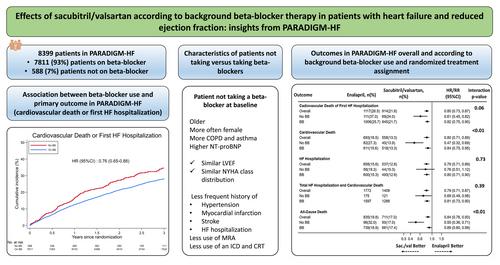
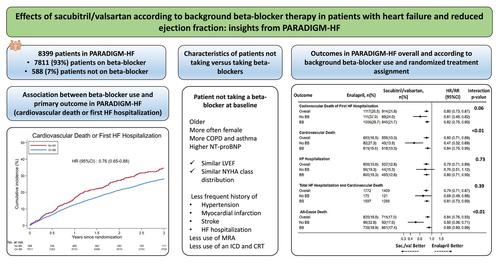
We examined the effect of sacubitril/valsartan compared to enalapril on outcomes according to background beta-blocker treatment in the 8399 patients with heart failure with reduced ejection fraction enrolled in PARADIGM-HF. The primary outcome was time to first heart failure hospitalization or cardiovascular death. Compared to the 7811 patients taking a beta-blocker, the 588 patients not receiving a beta-blocker were older, more frequently female, but had a similar mean left ventricular ejection fraction and New York Heart Association class distribution, with little difference in N-terminal pro-B-type natriuretic peptide. Patients not taking beta-blockers had a higher rate of the primary endpoint than those taking beta-blockers. The benefit of sacubitril/valsartan on the primary endpoint was evident in both the no beta-blocker subgroup (hazard ratio [HR] 0.61, 95% confidence interval [CI] 0.45–0.82) and the beta-blocker subgroup (HR 0.82, 95% CI 0.75–0.90; p-interaction = 0.06). The respective HRs for cardiovascular death were 0.47 (95% CI 0.32–0.69) versus 0.84 (95% CI 0.75–0.95; p-interaction <0.01) and for HF hospitalization 0.76 (95% CI 0.51–1.12) versus 0.80 (95% CI 0.71–0.90; p-interaction = 0.73). For all-cause death, the HR in the no beta-blocker group was 0.50 (95% CI 0.36–0.71) compared to 0.89 (95% CI 0.80–0.99) in the beta-blocker group (p-interaction <0.01). Safety outcomes related to sacubitril/valsartan versus enalapril did not differ according to background beta-blocker use.
Conclusion
Sacubitril/valsartan may be more effective than enalapril in reducing the risk of death in patients not treated with a beta-blocker compared to those treated with a beta-blocker, but is effective regardless of beta-blocker use.
期刊介绍:
European Journal of Heart Failure is an international journal dedicated to advancing knowledge in the field of heart failure management. The journal publishes reviews and editorials aimed at improving understanding, prevention, investigation, and treatment of heart failure. It covers various disciplines such as molecular and cellular biology, pathology, physiology, electrophysiology, pharmacology, clinical sciences, social sciences, and population sciences. The journal welcomes submissions of manuscripts on basic, clinical, and population sciences, as well as original contributions on nursing, care of the elderly, primary care, health economics, and other related specialist fields. It is published monthly and has a readership that includes cardiologists, emergency room physicians, intensivists, internists, general physicians, cardiac nurses, diabetologists, epidemiologists, basic scientists focusing on cardiovascular research, and those working in rehabilitation. The journal is abstracted and indexed in various databases such as Academic Search, Embase, MEDLINE/PubMed, and Science Citation Index.