Wang Yang, Wanchen Xie, Chongtao Zhang, Fang Duan, Shuanglong Lu and Mingliang Du
{"title":"Nanofibers decorated with high-entropy alloy particles for the detection of nitrites†","authors":"Wang Yang, Wanchen Xie, Chongtao Zhang, Fang Duan, Shuanglong Lu and Mingliang Du","doi":"10.1039/D4AN01246A","DOIUrl":null,"url":null,"abstract":"<p >Excessive residues of nitrite can pose a serious threat to human health, making the establishment of an efficient and effective electrochemical sensor for nitrite detection highly necessary. Herein, we report on a sensor based on nitrogen-doped carbon nanofibers, with FeCoNiCuAl high-entropy alloy (HEAs) nanoparticles <em>in situ</em> grown on the carbon fibers through a confinement effect. The FeCoNiCuAl/CNF sensor is capable of electrochemically detecting nitrite using both differential pulse voltammetry (DPV) and amperometric (<em>I</em>–<em>t</em>) methods. The DPV detection offers a linear range of 0.1–5000 μM and 5000–18 000 μM, with sensitivities of 150.6 μA mM<small><sup>−1</sup></small> cm<small><sup>−2</sup></small> and 80.1 μA mM<small><sup>−1</sup></small> cm<small><sup>−2</sup></small> and a detection limit of 0.023 μM (S/N = 3). The <em>I</em>–<em>t</em> detection covers a range of 1–10 000 μM, with a sensitivity of 337.84 μA mM<small><sup>−1</sup></small> cm<small><sup>−2</sup></small> and a detection limit of 0.12 μM. Moreover, the sensor exhibits excellent anti-interference properties, stability, and reproducibility, providing feasibility for nitrite detection in real-world environments.</p>","PeriodicalId":63,"journal":{"name":"Analyst","volume":" 1","pages":" 177-184"},"PeriodicalIF":3.3000,"publicationDate":"2024-11-20","publicationTypes":"Journal Article","fieldsOfStudy":null,"isOpenAccess":false,"openAccessPdf":"","citationCount":"0","resultStr":null,"platform":"Semanticscholar","paperid":null,"PeriodicalName":"Analyst","FirstCategoryId":"92","ListUrlMain":"https://pubs.rsc.org/en/content/articlelanding/2025/an/d4an01246a","RegionNum":3,"RegionCategory":"化学","ArticlePicture":[],"TitleCN":null,"AbstractTextCN":null,"PMCID":null,"EPubDate":"","PubModel":"","JCR":"Q2","JCRName":"CHEMISTRY, ANALYTICAL","Score":null,"Total":0}
引用次数: 0
Abstract
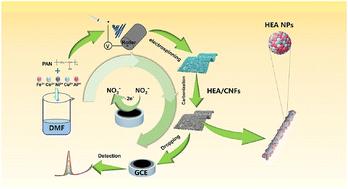
Excessive residues of nitrite can pose a serious threat to human health, making the establishment of an efficient and effective electrochemical sensor for nitrite detection highly necessary. Herein, we report on a sensor based on nitrogen-doped carbon nanofibers, with FeCoNiCuAl high-entropy alloy (HEAs) nanoparticles in situ grown on the carbon fibers through a confinement effect. The FeCoNiCuAl/CNF sensor is capable of electrochemically detecting nitrite using both differential pulse voltammetry (DPV) and amperometric (I–t) methods. The DPV detection offers a linear range of 0.1–5000 μM and 5000–18 000 μM, with sensitivities of 150.6 μA mM−1 cm−2 and 80.1 μA mM−1 cm−2 and a detection limit of 0.023 μM (S/N = 3). The I–t detection covers a range of 1–10 000 μM, with a sensitivity of 337.84 μA mM−1 cm−2 and a detection limit of 0.12 μM. Moreover, the sensor exhibits excellent anti-interference properties, stability, and reproducibility, providing feasibility for nitrite detection in real-world environments.



 京公网安备 11010802042870号
京ICP备2023020795号-1
京公网安备 11010802042870号
京ICP备2023020795号-1

 分享
分享
 求助内容:
求助内容: 应助结果提醒方式:
 扫码关注我们
