Eco-friendly synchronous spectrofluorimetry coupled with chemometrics for simultaneous determination of ezetimibe and propranolol in pharmaceutical formulations and spiked plasma samples
Ali Alqahtani , Taha Alqahtani , Adel Al Fatease , Adil Alshehri , Ahmed A. Almrasy
{"title":"Eco-friendly synchronous spectrofluorimetry coupled with chemometrics for simultaneous determination of ezetimibe and propranolol in pharmaceutical formulations and spiked plasma samples","authors":"Ali Alqahtani , Taha Alqahtani , Adel Al Fatease , Adil Alshehri , Ahmed A. Almrasy","doi":"10.1016/j.saa.2024.125447","DOIUrl":null,"url":null,"abstract":"<div><div>In this study, synchronous fluorescence spectroscopic methods coupled with chemometric techniques were developed and evaluated for the simultaneous quantification of ezetimibe and propranolol, two commonly prescribed cardiovascular drugs. Both drugs exhibit overlapping native fluorescence, posing a challenge for their selective determination. To address this, chemometric models including partial least squares (PLS) and genetic algorithm-based variable selection (GA) were constructed using a calibration dataset based on a 5<sup>2</sup> factorial design resulting in 25 synthetic mixtures. The developed method has been optimized to account for factors such as solvent composition, micellar systems, and excitation/emission wavelengths that affect the fluorescence signals. The PLS and GA-PLS models were validated using an independent test set of 13 samples based on central composite design revealing the GA-PLS model provided improved quantitative performance with relative root mean square error of prediction (RRMSEP) values of 1.3939 and 1.0005 % for ezetimibe and propranolol, respectively, compared to 2.2502 and 2.3526 % for the PLS models. Hence, the GA-PLS models were successfully applied for the determination of ezetimibe and propranolol in pharmaceutical formulations and spiked plasma samples. Furthermore, the greenness and blueness of the proposed methods were compared against reported HPLC procedures using the AGREE and BAGI tools, revealing a greener analytical footprint for the developed method and higher analytical practicability posing as an environmental-friendly alternative to the standard HPLC technique.</div></div>","PeriodicalId":433,"journal":{"name":"Spectrochimica Acta Part A: Molecular and Biomolecular Spectroscopy","volume":"328 ","pages":"Article 125447"},"PeriodicalIF":4.8000,"publicationDate":"2025-03-05","publicationTypes":"Journal Article","fieldsOfStudy":null,"isOpenAccess":false,"openAccessPdf":"","citationCount":"0","resultStr":null,"platform":"Semanticscholar","paperid":null,"PeriodicalName":"Spectrochimica Acta Part A: Molecular and Biomolecular Spectroscopy","FirstCategoryId":"92","ListUrlMain":"https://www.sciencedirect.com/science/article/pii/S1386142524016135","RegionNum":2,"RegionCategory":"化学","ArticlePicture":[],"TitleCN":null,"AbstractTextCN":null,"PMCID":null,"EPubDate":"2024/11/16 0:00:00","PubModel":"Epub","JCR":"Q1","JCRName":"SPECTROSCOPY","Score":null,"Total":0}
引用次数: 0
Abstract
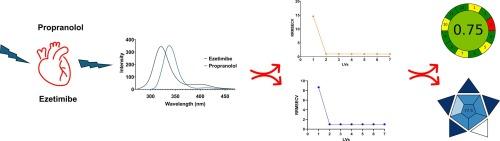
In this study, synchronous fluorescence spectroscopic methods coupled with chemometric techniques were developed and evaluated for the simultaneous quantification of ezetimibe and propranolol, two commonly prescribed cardiovascular drugs. Both drugs exhibit overlapping native fluorescence, posing a challenge for their selective determination. To address this, chemometric models including partial least squares (PLS) and genetic algorithm-based variable selection (GA) were constructed using a calibration dataset based on a 52 factorial design resulting in 25 synthetic mixtures. The developed method has been optimized to account for factors such as solvent composition, micellar systems, and excitation/emission wavelengths that affect the fluorescence signals. The PLS and GA-PLS models were validated using an independent test set of 13 samples based on central composite design revealing the GA-PLS model provided improved quantitative performance with relative root mean square error of prediction (RRMSEP) values of 1.3939 and 1.0005 % for ezetimibe and propranolol, respectively, compared to 2.2502 and 2.3526 % for the PLS models. Hence, the GA-PLS models were successfully applied for the determination of ezetimibe and propranolol in pharmaceutical formulations and spiked plasma samples. Furthermore, the greenness and blueness of the proposed methods were compared against reported HPLC procedures using the AGREE and BAGI tools, revealing a greener analytical footprint for the developed method and higher analytical practicability posing as an environmental-friendly alternative to the standard HPLC technique.
期刊介绍:
Spectrochimica Acta, Part A: Molecular and Biomolecular Spectroscopy (SAA) is an interdisciplinary journal which spans from basic to applied aspects of optical spectroscopy in chemistry, medicine, biology, and materials science.
The journal publishes original scientific papers that feature high-quality spectroscopic data and analysis. From the broad range of optical spectroscopies, the emphasis is on electronic, vibrational or rotational spectra of molecules, rather than on spectroscopy based on magnetic moments.
Criteria for publication in SAA are novelty, uniqueness, and outstanding quality. Routine applications of spectroscopic techniques and computational methods are not appropriate.
Topics of particular interest of Spectrochimica Acta Part A include, but are not limited to:
Spectroscopy and dynamics of bioanalytical, biomedical, environmental, and atmospheric sciences,
Novel experimental techniques or instrumentation for molecular spectroscopy,
Novel theoretical and computational methods,
Novel applications in photochemistry and photobiology,
Novel interpretational approaches as well as advances in data analysis based on electronic or vibrational spectroscopy.




 京公网安备 11010802042870号
京ICP备2023020795号-1
京公网安备 11010802042870号
京ICP备2023020795号-1

 分享
分享
 求助内容:
求助内容: 应助结果提醒方式:
 扫码关注我们
