{"title":"Cafe-Mpc: A Cascaded-Fidelity Model Predictive Control Framework With Tuning-Free Whole-Body Control","authors":"He Li;Patrick M. Wensing","doi":"10.1109/TRO.2024.3504132","DOIUrl":null,"url":null,"abstract":"This work introduces an optimization-based planning and control framework for real-time synthesis of whole-body motions for legged robots. At the core of the proposed framework is a cascaded-fidelity model predictive controller (\n<sc>Cafe-Mpc</small>\n). \n<sc>Cafe-Mpc</small>\n strategically relaxes the planning problem along the prediction horizon (i.e., with descending model fidelity, increasingly coarse time steps, and relaxed constraints) for computational and performance gains. This problem is numerically solved with an efficient customized multiple-shooting iLQR solver that is tailored for hybrid systems. The action-value function from \n<sc>Cafe-Mpc</small>\n is then used as the basis for a new value-function-based whole-body control (VWBC) technique that avoids additional tuning. In this respect, the proposed framework unifies whole-body MPC and more conventional whole-body quadratic programming, which have been treated as separate components in previous works. We study the effects of the cascaded relaxations in \n<sc>Cafe-Mpc</small>\n on the tracking performance and required computation time. We also show that \n<sc>Cafe-Mpc</small>\n, if configured appropriately, advances the performance of whole-body MPC without necessarily increasing computational cost. Furthermore, we show the superior performance of VWBC over a conventional Riccati feedback controller in terms of constraint handling. The proposed framework enables accomplishing a gymnastic-style running barrel roll for the first time on quadruped hardware, where \n<sc>Cafe-Mpc</small>\n runs at 50 Hz, and the solver spends on average 5.3 ms per iteration. Results are demonstrated in the accompanying video.","PeriodicalId":50388,"journal":{"name":"IEEE Transactions on Robotics","volume":"41 ","pages":"837-856"},"PeriodicalIF":10.5000,"publicationDate":"2024-11-21","publicationTypes":"Journal Article","fieldsOfStudy":null,"isOpenAccess":false,"openAccessPdf":"","citationCount":"0","resultStr":null,"platform":"Semanticscholar","paperid":null,"PeriodicalName":"IEEE Transactions on Robotics","FirstCategoryId":"94","ListUrlMain":"https://ieeexplore.ieee.org/document/10759808/","RegionNum":1,"RegionCategory":"计算机科学","ArticlePicture":[],"TitleCN":null,"AbstractTextCN":null,"PMCID":null,"EPubDate":"","PubModel":"","JCR":"Q1","JCRName":"ROBOTICS","Score":null,"Total":0}
引用次数: 0
Abstract
This work introduces an optimization-based planning and control framework for real-time synthesis of whole-body motions for legged robots. At the core of the proposed framework is a cascaded-fidelity model predictive controller (
Cafe-Mpc
).
Cafe-Mpc
strategically relaxes the planning problem along the prediction horizon (i.e., with descending model fidelity, increasingly coarse time steps, and relaxed constraints) for computational and performance gains. This problem is numerically solved with an efficient customized multiple-shooting iLQR solver that is tailored for hybrid systems. The action-value function from
Cafe-Mpc
is then used as the basis for a new value-function-based whole-body control (VWBC) technique that avoids additional tuning. In this respect, the proposed framework unifies whole-body MPC and more conventional whole-body quadratic programming, which have been treated as separate components in previous works. We study the effects of the cascaded relaxations in
Cafe-Mpc
on the tracking performance and required computation time. We also show that
Cafe-Mpc
, if configured appropriately, advances the performance of whole-body MPC without necessarily increasing computational cost. Furthermore, we show the superior performance of VWBC over a conventional Riccati feedback controller in terms of constraint handling. The proposed framework enables accomplishing a gymnastic-style running barrel roll for the first time on quadruped hardware, where
Cafe-Mpc
runs at 50 Hz, and the solver spends on average 5.3 ms per iteration. Results are demonstrated in the accompanying video.
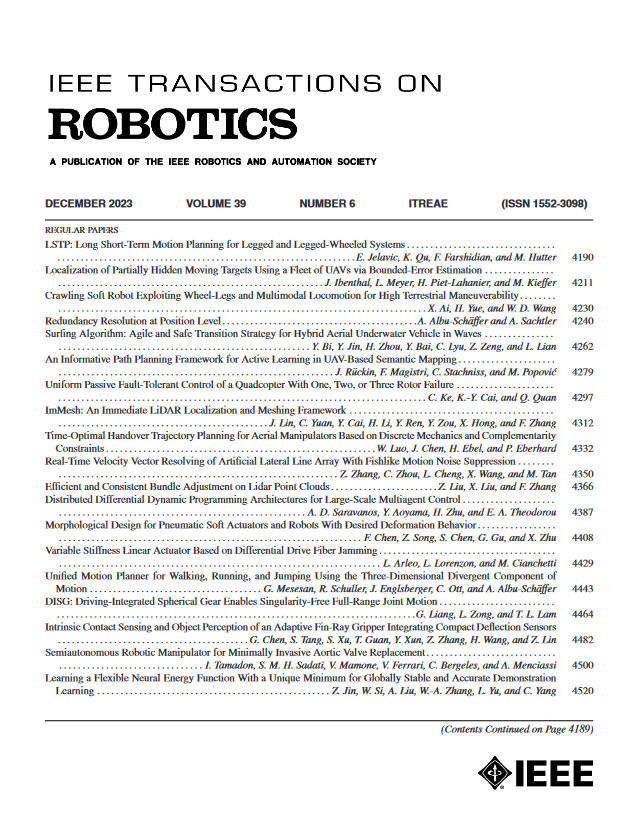
期刊介绍:
The IEEE Transactions on Robotics (T-RO) is dedicated to publishing fundamental papers covering all facets of robotics, drawing on interdisciplinary approaches from computer science, control systems, electrical engineering, mathematics, mechanical engineering, and beyond. From industrial applications to service and personal assistants, surgical operations to space, underwater, and remote exploration, robots and intelligent machines play pivotal roles across various domains, including entertainment, safety, search and rescue, military applications, agriculture, and intelligent vehicles.
Special emphasis is placed on intelligent machines and systems designed for unstructured environments, where a significant portion of the environment remains unknown and beyond direct sensing or control.



 京公网安备 11010802042870号
京ICP备2023020795号-1
京公网安备 11010802042870号
京ICP备2023020795号-1

 分享
分享
 求助内容:
求助内容: 应助结果提醒方式:
 扫码关注我们
