Maida Murtaza, Laiba Saleem, Waqas Ali Shah, Iftikhar Ahmad, Hussain Alawadhi, Amir Waseem
{"title":"Delaminated Vanadium Carbide MXene Supported Two-Dimensional (2D) CoNH2BDC MOF Hybrid for Enhanced Water Splitting","authors":"Maida Murtaza, Laiba Saleem, Waqas Ali Shah, Iftikhar Ahmad, Hussain Alawadhi, Amir Waseem","doi":"10.1021/acs.iecr.4c03583","DOIUrl":null,"url":null,"abstract":"Water splitting has been regarded as one of the most favorable practices in sustainable energy production technologies. Metal organic frameworks (MOFs) have been recognized as potent candidates as electrocatalysts due to their high porosity, faster charge transfer, tunable structure, and large surface area. MOFs with electrically conductive 2D MXene nanosheets can significantly result in enhanced electrocatalytic activity for both the OER and HER. In this work, cobalt aminoterephthalic acid MOF (CoNH<sub>2</sub>BDC) was combined with vanadium carbide (V<sub>2</sub>C) MXene via a one-step solvothermal reaction strategy. Credit goes to the high porosity and large surface area of CoNH<sub>2</sub>BDC; high electrical conductivity and hydrophilicity of V<sub>2</sub>C for enhanced electrocatalytic activity of CoNH<sub>2</sub>BDC/V<sub>2</sub>C, and faster charge transfer across the CoNH<sub>2</sub>BDC-V<sub>2</sub>C interface. Among the series of catalysts with varying ratios of V<sub>2</sub>C and MOF, the catalyst that showed best OER and HER activity in alkaline medium was CoNBDC/VC3, it attained a current density of 10 mA cm<sup>–2</sup> at 145 mV for OER and 102 mV Vs. RHE for HER, and a Tafel slope value of 50 mV/dec for OER and 55 mV/dec for HER. We believe that this work is demonstration of highly efficient electrocatalytic performance and construction of such hybrid materials can pave new pathways with regard to developing efficient electrocatalysts for green energy production.","PeriodicalId":39,"journal":{"name":"Industrial & Engineering Chemistry Research","volume":"34 1","pages":""},"PeriodicalIF":3.9000,"publicationDate":"2024-11-21","publicationTypes":"Journal Article","fieldsOfStudy":null,"isOpenAccess":false,"openAccessPdf":"","citationCount":"0","resultStr":null,"platform":"Semanticscholar","paperid":null,"PeriodicalName":"Industrial & Engineering Chemistry Research","FirstCategoryId":"5","ListUrlMain":"https://doi.org/10.1021/acs.iecr.4c03583","RegionNum":3,"RegionCategory":"工程技术","ArticlePicture":[],"TitleCN":null,"AbstractTextCN":null,"PMCID":null,"EPubDate":"","PubModel":"","JCR":"Q2","JCRName":"ENGINEERING, CHEMICAL","Score":null,"Total":0}
引用次数: 0
Abstract
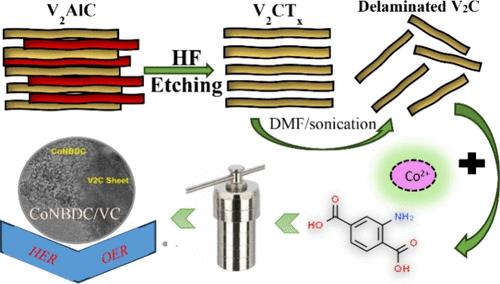
Water splitting has been regarded as one of the most favorable practices in sustainable energy production technologies. Metal organic frameworks (MOFs) have been recognized as potent candidates as electrocatalysts due to their high porosity, faster charge transfer, tunable structure, and large surface area. MOFs with electrically conductive 2D MXene nanosheets can significantly result in enhanced electrocatalytic activity for both the OER and HER. In this work, cobalt aminoterephthalic acid MOF (CoNH2BDC) was combined with vanadium carbide (V2C) MXene via a one-step solvothermal reaction strategy. Credit goes to the high porosity and large surface area of CoNH2BDC; high electrical conductivity and hydrophilicity of V2C for enhanced electrocatalytic activity of CoNH2BDC/V2C, and faster charge transfer across the CoNH2BDC-V2C interface. Among the series of catalysts with varying ratios of V2C and MOF, the catalyst that showed best OER and HER activity in alkaline medium was CoNBDC/VC3, it attained a current density of 10 mA cm–2 at 145 mV for OER and 102 mV Vs. RHE for HER, and a Tafel slope value of 50 mV/dec for OER and 55 mV/dec for HER. We believe that this work is demonstration of highly efficient electrocatalytic performance and construction of such hybrid materials can pave new pathways with regard to developing efficient electrocatalysts for green energy production.
期刊介绍:
ndustrial & Engineering Chemistry, with variations in title and format, has been published since 1909 by the American Chemical Society. Industrial & Engineering Chemistry Research is a weekly publication that reports industrial and academic research in the broad fields of applied chemistry and chemical engineering with special focus on fundamentals, processes, and products.




 京公网安备 11010802042870号
京ICP备2023020795号-1
京公网安备 11010802042870号
京ICP备2023020795号-1

 分享
分享
 求助内容:
求助内容: 应助结果提醒方式:
 扫码关注我们
