Chang Liu , Lu Ren , Xiudong Yang , Yanqi Liu , Huihong Zhang , Wanru Jia , Dawei Zhang
{"title":"Colorimetric fluorescence of the 1,10-phenantholineyl-imidazole sensor probe for the selective detection of Zn2+ and Cd2+ ions","authors":"Chang Liu , Lu Ren , Xiudong Yang , Yanqi Liu , Huihong Zhang , Wanru Jia , Dawei Zhang","doi":"10.1016/j.saa.2024.125436","DOIUrl":null,"url":null,"abstract":"<div><div>A colorimetric fluorescent probe, 4-(1H-imidazolo[4,5-f][1,10]phenanthroline-2-yl)-N, N-diphenylaniline (PIN), was designed, synthesized and characterized for the sensitive and selective detection of Zn<sup>2+</sup> and Cd<sup>2+</sup>. The color of the solution changed from blue to yellow visible to the naked eye with the addition of Zn<sup>2+</sup> and Cd<sup>2+</sup>. The probe PIN showed good anti-interference to Zn<sup>2+</sup> and Cd<sup>2+</sup> in the presence of a variety of metal ions, and the fluorescence intensity showed a good linear relationship with the concentrations of Zn<sup>2+</sup> and Cd<sup>2+</sup>, with detection limits of 34.84 nM and 35.76 nM, respectively. The probe PIN complexed 2:1 with Zn<sup>2+</sup> and Cd<sup>2+</sup>, and the complexation constants were 1.03 × 10<sup>4</sup> M<sup>−1</sup> (PIN − Zn<sup>2+</sup>, R<sup>2</sup> = 0.9971) and 1.50 × 10<sup>4</sup> M<sup>−1</sup> (PIN − Cd<sup>2+</sup>, R<sup>2</sup> = 0.9981), respectively. In addition, the PIN could be recovered by EDTA and could be effectively monitored for Zn<sup>2+</sup> and Cd<sup>2+</sup> at pH 4–11, with good results in actual water samples. The HepG-2 cells maintained over 95 % of viability after 24 h exposure to PIN, which identified the extremely low toxic of PIN and could be used for in vivo cell imaging.</div></div>","PeriodicalId":433,"journal":{"name":"Spectrochimica Acta Part A: Molecular and Biomolecular Spectroscopy","volume":"328 ","pages":"Article 125436"},"PeriodicalIF":4.6000,"publicationDate":"2025-03-05","publicationTypes":"Journal Article","fieldsOfStudy":null,"isOpenAccess":false,"openAccessPdf":"","citationCount":"0","resultStr":null,"platform":"Semanticscholar","paperid":null,"PeriodicalName":"Spectrochimica Acta Part A: Molecular and Biomolecular Spectroscopy","FirstCategoryId":"92","ListUrlMain":"https://www.sciencedirect.com/science/article/pii/S1386142524016020","RegionNum":2,"RegionCategory":"化学","ArticlePicture":[],"TitleCN":null,"AbstractTextCN":null,"PMCID":null,"EPubDate":"2024/11/17 0:00:00","PubModel":"Epub","JCR":"Q1","JCRName":"SPECTROSCOPY","Score":null,"Total":0}
引用次数: 0
Abstract
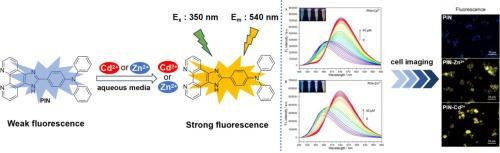
A colorimetric fluorescent probe, 4-(1H-imidazolo[4,5-f][1,10]phenanthroline-2-yl)-N, N-diphenylaniline (PIN), was designed, synthesized and characterized for the sensitive and selective detection of Zn2+ and Cd2+. The color of the solution changed from blue to yellow visible to the naked eye with the addition of Zn2+ and Cd2+. The probe PIN showed good anti-interference to Zn2+ and Cd2+ in the presence of a variety of metal ions, and the fluorescence intensity showed a good linear relationship with the concentrations of Zn2+ and Cd2+, with detection limits of 34.84 nM and 35.76 nM, respectively. The probe PIN complexed 2:1 with Zn2+ and Cd2+, and the complexation constants were 1.03 × 10⁴ M−1 (PIN − Zn2+, R2 = 0.9971) and 1.50 × 10⁴ M−1 (PIN − Cd2+, R2 = 0.9981), respectively. In addition, the PIN could be recovered by EDTA and could be effectively monitored for Zn2+ and Cd2+ at pH 4–11, with good results in actual water samples. The HepG-2 cells maintained over 95 % of viability after 24 h exposure to PIN, which identified the extremely low toxic of PIN and could be used for in vivo cell imaging.
期刊介绍:
Spectrochimica Acta, Part A: Molecular and Biomolecular Spectroscopy (SAA) is an interdisciplinary journal which spans from basic to applied aspects of optical spectroscopy in chemistry, medicine, biology, and materials science.
The journal publishes original scientific papers that feature high-quality spectroscopic data and analysis. From the broad range of optical spectroscopies, the emphasis is on electronic, vibrational or rotational spectra of molecules, rather than on spectroscopy based on magnetic moments.
Criteria for publication in SAA are novelty, uniqueness, and outstanding quality. Routine applications of spectroscopic techniques and computational methods are not appropriate.
Topics of particular interest of Spectrochimica Acta Part A include, but are not limited to:
Spectroscopy and dynamics of bioanalytical, biomedical, environmental, and atmospheric sciences,
Novel experimental techniques or instrumentation for molecular spectroscopy,
Novel theoretical and computational methods,
Novel applications in photochemistry and photobiology,
Novel interpretational approaches as well as advances in data analysis based on electronic or vibrational spectroscopy.



 京公网安备 11010802042870号
京ICP备2023020795号-1
京公网安备 11010802042870号
京ICP备2023020795号-1

 分享
分享
 求助内容:
求助内容: 应助结果提醒方式:
 扫码关注我们
