{"title":"Piecing together oomycete effector processing and host translocation","authors":"Claudia-Nicole Meisrimler, Sophie Eccersall","doi":"10.1111/nph.20291","DOIUrl":null,"url":null,"abstract":"<p>The gene-for-gene hypothesis, proposed by Flor in 1942, postulates that for each dominant avirulence (Avr) protein in a pathogen, there is a corresponding resistance (R) gene in the host. This interaction triggers host defense mechanisms, such as the hypersensitive response, which effectively limits biotrophic pathogen growth (Flor, <span>1942</span>). Decades later, the term ‘effector protein’ was introduced to describe proteins secreted or translocated by pathogens to manipulate the host. Understanding how pathogens process and secrete these effectors is crucial for deciphering their pathogenicity.</p><p>The zigzag model has been classically used to describe plant immune responses through a dynamic interaction between pathogen-associated molecular patterns (PAMPs) and effectors. This model is readily applied for oomycetes, where plants detect oomycete PAMPs, such as β-1,3- and β-1,6-glucans, or cellulose-binding protein and XEG1 endoglucanase (Judelson & Ah-Fong, <span>2019</span>) via pattern recognition receptors (PRRs), leading to PAMP-triggered immunity (PTI). In response, oomycetes evolved effectors to suppress PTI, causing effector-triggered susceptibility (ETS), but plants counter this by recognizing specific effectors through R proteins, activating effector-triggered immunity (ETI), which again is thought to be more robust (Jones & Dangl, <span>2006</span>). Though still holding true for evolution, the zigzag model has been critiqued for oversimplification when it comes to the molecular plant–oomycete interaction. This critique is based on data showing that effector proteins are secreted by oomycetes and sometimes recognized by the host before physical contact even occurs; PTI, ETS and ETI are rather parallel than separate mechanisms.</p><p>Despite the crucial role of effector proteins in plant infection, surprisingly little is known about their processing and secretion mechanisms in oomycetes. In other eukaryotic systems, it is well established that conventional secretion follows the classical secretory pathway, where proteins are directed to the endoplasmic reticulum (ER) via an N-terminal signal peptide. From there, proteins are processed and transported to the Golgi apparatus before being secreted out of the cell. Unconventional secretion, on the other hand, bypasses the classical ER–Golgi pathway and involves alternative mechanisms, such as direct translocation across the plasma membrane or via endosomal or vesicular pathways (Wang <i>et al</i>., <span>2017</span>).</p><p>It is expected that some eukaryotic clades have evolved new pathways or variations. In Xu <i>et al</i>. (<span>2025</span>), the cleavage of RXLR and EER motifs in <i>P. infestans</i> effectors provide important insights into how these motifs function in effector processing and secretion. While conventional secretion mechanisms remain central, the possibility of alternative processing routes, influenced by the structural positioning of these motifs, highlights the complex posttranslational modifications that occur before these effectors are delivered into the host plant. In the case of RXLR effectors, the signal peptide (SP) is cleaved off during or after translocation into the ER. This is followed by additional posttranslational modifications, including proteolytic cleavage at the RXLR motif, as shown in Xu <i>et al</i>.'s (<span>2025</span>) study. The general rule is that these effectors follow this conventional pathway, dependent on cellular machinery for proper processing and delivery into the host.</p><p>Proteolytic cleavage at the RXLR motif in <i>P. infestans</i> mirrors a similar mechanism seen in other eukaryotic pathogens. The RXLR motif bears a striking resemblance to the RXLXE/D/Q motif, also known as the <i>Plasmodium</i> export element (PEXEL), which is found in malaria parasite effectors. These effectors, like those from <i>P. infestans</i>, are delivered into host cells – in this case, the red blood cells of the human host (Gabriela <i>et al</i>., <span>2024</span>). Just as the RXLR motif is spatially constrained to within 40 amino acids after the signal peptide cleavage site, so is the PEXEL motif. In <i>Plasmodium</i>, this constraint is crucial for correct cleavage and subsequent effector processing (Gabriela <i>et al</i>., <span>2024</span>). After cleavage, the N-terminal residue is acetylated, an essential modification for secretion through the specialized export machinery (Boddey <i>et al</i>., <span>2016</span>). This spatial and functional conservation suggests that both motifs share a fundamental role in ensuring that effectors are processed and secreted correctly into host cells, albeit in different organisms.</p><p>In <i>Phytophthora</i> species, many RXLR effectors also contain an adjacent Glu-Glu-Arg (EER) motif, which has similarly been implicated in effector translocation into host plant cells (Whisson <i>et al</i>., <span>2007</span>). Xu <i>et al</i>. (<span>2025</span>) build upon this by demonstrating for the first time that the EER motif, like the RXLR motif, can also be proteolytically cleaved within <i>Phytophthora</i> (Fig. 1). Their findings challenge previous assumptions that the EER motif is solely involved in host cell delivery, showing instead that it serves as an additional site for processing before secretion. In contrast to <i>Phytophthora</i>, plants lack the necessary molecular machinery to cleave effector proteins at the RXLR or EER motifs. Beyond the RXLR and EER motifs themselves, the structural context of these effectors also plays a critical role in their function. The conserved WY domain, which is commonly found in the C-terminal region of many RXLR effectors, contributes to host target specificity and stability (Bentham <i>et al</i>., <span>2024</span>; Li <i>et al</i>., <span>2023</span>). The presence of the WY (Trp-Tyr) domain suggests that effector processing and translocation are closely coordinated with the structural elements that mediate interactions with host plant targets. Interestingly, some effectors from <i>Bremia lactucae</i> – a pathogen of lettuce – contain the WY domain but only the EER motif, raising the possibility that the EER motif alone may serve as a processing site in these proteins (Wood <i>et al</i>., <span>2020</span>). This further reinforces the idea, as discussed by Wang <i>et al</i>. (<span>2023</span>), that RXLR and EER motifs function as general processing sites in diverse oomycete effectors. Gabriela <i>et al</i>. (<span>2024</span>) provided evidence that in PEXEL proteins, certain amino acids serve dual functions. Mutations in these residues can significantly reduce cleavage, leading to increased retention in the ER and decreased export. In other proteins, similar mutations have a lesser effect, allowing PEXEL proteins to reach the parasitophorous vacuole, though with reduced translocation efficiency. We can learn from the <i>Plasmodium</i> experiments that amino acids within the RXLR and EER motif may contribute differently to the processing and secretion in dependents of the effector function and the amino acid characteristics within the motifs. However, this hypothesis will need further testing, for example, using single point mutations leading to degenerate RXLR motifs such as [KHGQ][X][LMYFIV][RNK] commonly observed in downy mildews (Wood <i>et al</i>., <span>2020</span>).</p><p>Xu <i>et al</i>. (<span>2025</span>) expand our understanding by providing experimental evidence that proteolytic cleavage at both the RXLR and EER motifs is a widespread phenomenon. This not only supports the idea of functional conservation across oomycete pathogens, but also opens avenues for exploring how similar motifs may be processed in other eukaryotic pathogens, such as <i>Plasmodium</i>, highlighting evolutionary parallels in effector secretion mechanisms. Furthermore, it raises questions about the evolution and conservation of secretory pathways in pathogens in the context of their host infection strategies, given that not all oomycetes possess RXLR(-like) effectors. The discovery of dual cleavage sites adds complexity to our understanding of effector biology in <i>P. infestans</i>. Combined with recent findings on effector uptake via endocytosis (Oliveira-Garcia <i>et al</i>., <span>2023</span>; Wang <i>et al</i>., <span>2023</span>), this research points toward an exciting direction in fully understanding how these essential proteins are delivered in plant–oomycete interactions and beyond.</p>","PeriodicalId":214,"journal":{"name":"New Phytologist","volume":"245 4","pages":"1338-1340"},"PeriodicalIF":8.1000,"publicationDate":"2024-11-23","publicationTypes":"Journal Article","fieldsOfStudy":null,"isOpenAccess":false,"openAccessPdf":"https://onlinelibrary.wiley.com/doi/epdf/10.1111/nph.20291","citationCount":"0","resultStr":null,"platform":"Semanticscholar","paperid":null,"PeriodicalName":"New Phytologist","FirstCategoryId":"99","ListUrlMain":"https://nph.onlinelibrary.wiley.com/doi/10.1111/nph.20291","RegionNum":1,"RegionCategory":"生物学","ArticlePicture":[],"TitleCN":null,"AbstractTextCN":null,"PMCID":null,"EPubDate":"","PubModel":"","JCR":"Q1","JCRName":"PLANT SCIENCES","Score":null,"Total":0}
引用次数: 0
Abstract
The gene-for-gene hypothesis, proposed by Flor in 1942, postulates that for each dominant avirulence (Avr) protein in a pathogen, there is a corresponding resistance (R) gene in the host. This interaction triggers host defense mechanisms, such as the hypersensitive response, which effectively limits biotrophic pathogen growth (Flor, 1942). Decades later, the term ‘effector protein’ was introduced to describe proteins secreted or translocated by pathogens to manipulate the host. Understanding how pathogens process and secrete these effectors is crucial for deciphering their pathogenicity.
The zigzag model has been classically used to describe plant immune responses through a dynamic interaction between pathogen-associated molecular patterns (PAMPs) and effectors. This model is readily applied for oomycetes, where plants detect oomycete PAMPs, such as β-1,3- and β-1,6-glucans, or cellulose-binding protein and XEG1 endoglucanase (Judelson & Ah-Fong, 2019) via pattern recognition receptors (PRRs), leading to PAMP-triggered immunity (PTI). In response, oomycetes evolved effectors to suppress PTI, causing effector-triggered susceptibility (ETS), but plants counter this by recognizing specific effectors through R proteins, activating effector-triggered immunity (ETI), which again is thought to be more robust (Jones & Dangl, 2006). Though still holding true for evolution, the zigzag model has been critiqued for oversimplification when it comes to the molecular plant–oomycete interaction. This critique is based on data showing that effector proteins are secreted by oomycetes and sometimes recognized by the host before physical contact even occurs; PTI, ETS and ETI are rather parallel than separate mechanisms.
Despite the crucial role of effector proteins in plant infection, surprisingly little is known about their processing and secretion mechanisms in oomycetes. In other eukaryotic systems, it is well established that conventional secretion follows the classical secretory pathway, where proteins are directed to the endoplasmic reticulum (ER) via an N-terminal signal peptide. From there, proteins are processed and transported to the Golgi apparatus before being secreted out of the cell. Unconventional secretion, on the other hand, bypasses the classical ER–Golgi pathway and involves alternative mechanisms, such as direct translocation across the plasma membrane or via endosomal or vesicular pathways (Wang et al., 2017).
It is expected that some eukaryotic clades have evolved new pathways or variations. In Xu et al. (2025), the cleavage of RXLR and EER motifs in P. infestans effectors provide important insights into how these motifs function in effector processing and secretion. While conventional secretion mechanisms remain central, the possibility of alternative processing routes, influenced by the structural positioning of these motifs, highlights the complex posttranslational modifications that occur before these effectors are delivered into the host plant. In the case of RXLR effectors, the signal peptide (SP) is cleaved off during or after translocation into the ER. This is followed by additional posttranslational modifications, including proteolytic cleavage at the RXLR motif, as shown in Xu et al.'s (2025) study. The general rule is that these effectors follow this conventional pathway, dependent on cellular machinery for proper processing and delivery into the host.
Proteolytic cleavage at the RXLR motif in P. infestans mirrors a similar mechanism seen in other eukaryotic pathogens. The RXLR motif bears a striking resemblance to the RXLXE/D/Q motif, also known as the Plasmodium export element (PEXEL), which is found in malaria parasite effectors. These effectors, like those from P. infestans, are delivered into host cells – in this case, the red blood cells of the human host (Gabriela et al., 2024). Just as the RXLR motif is spatially constrained to within 40 amino acids after the signal peptide cleavage site, so is the PEXEL motif. In Plasmodium, this constraint is crucial for correct cleavage and subsequent effector processing (Gabriela et al., 2024). After cleavage, the N-terminal residue is acetylated, an essential modification for secretion through the specialized export machinery (Boddey et al., 2016). This spatial and functional conservation suggests that both motifs share a fundamental role in ensuring that effectors are processed and secreted correctly into host cells, albeit in different organisms.
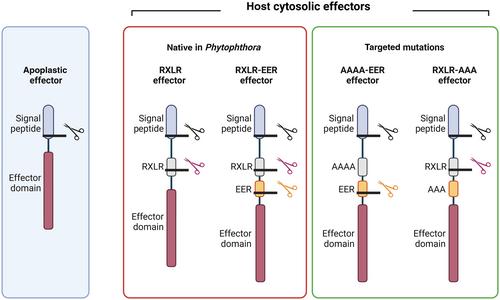
In Phytophthora species, many RXLR effectors also contain an adjacent Glu-Glu-Arg (EER) motif, which has similarly been implicated in effector translocation into host plant cells (Whisson et al., 2007). Xu et al. (2025) build upon this by demonstrating for the first time that the EER motif, like the RXLR motif, can also be proteolytically cleaved within Phytophthora (Fig. 1). Their findings challenge previous assumptions that the EER motif is solely involved in host cell delivery, showing instead that it serves as an additional site for processing before secretion. In contrast to Phytophthora, plants lack the necessary molecular machinery to cleave effector proteins at the RXLR or EER motifs. Beyond the RXLR and EER motifs themselves, the structural context of these effectors also plays a critical role in their function. The conserved WY domain, which is commonly found in the C-terminal region of many RXLR effectors, contributes to host target specificity and stability (Bentham et al., 2024; Li et al., 2023). The presence of the WY (Trp-Tyr) domain suggests that effector processing and translocation are closely coordinated with the structural elements that mediate interactions with host plant targets. Interestingly, some effectors from Bremia lactucae – a pathogen of lettuce – contain the WY domain but only the EER motif, raising the possibility that the EER motif alone may serve as a processing site in these proteins (Wood et al., 2020). This further reinforces the idea, as discussed by Wang et al. (2023), that RXLR and EER motifs function as general processing sites in diverse oomycete effectors. Gabriela et al. (2024) provided evidence that in PEXEL proteins, certain amino acids serve dual functions. Mutations in these residues can significantly reduce cleavage, leading to increased retention in the ER and decreased export. In other proteins, similar mutations have a lesser effect, allowing PEXEL proteins to reach the parasitophorous vacuole, though with reduced translocation efficiency. We can learn from the Plasmodium experiments that amino acids within the RXLR and EER motif may contribute differently to the processing and secretion in dependents of the effector function and the amino acid characteristics within the motifs. However, this hypothesis will need further testing, for example, using single point mutations leading to degenerate RXLR motifs such as [KHGQ][X][LMYFIV][RNK] commonly observed in downy mildews (Wood et al., 2020).
Xu et al. (2025) expand our understanding by providing experimental evidence that proteolytic cleavage at both the RXLR and EER motifs is a widespread phenomenon. This not only supports the idea of functional conservation across oomycete pathogens, but also opens avenues for exploring how similar motifs may be processed in other eukaryotic pathogens, such as Plasmodium, highlighting evolutionary parallels in effector secretion mechanisms. Furthermore, it raises questions about the evolution and conservation of secretory pathways in pathogens in the context of their host infection strategies, given that not all oomycetes possess RXLR(-like) effectors. The discovery of dual cleavage sites adds complexity to our understanding of effector biology in P. infestans. Combined with recent findings on effector uptake via endocytosis (Oliveira-Garcia et al., 2023; Wang et al., 2023), this research points toward an exciting direction in fully understanding how these essential proteins are delivered in plant–oomycete interactions and beyond.
Flor于1942年提出的基因换基因假说认为,对于病原体中的每一种优势无毒(Avr)蛋白,宿主中都存在相应的抗性(R)基因。这种相互作用触发了宿主防御机制,如超敏反应,有效地限制了生物营养病原体的生长(Flor, 1942)。几十年后,“效应蛋白”一词被引入来描述病原体分泌或易位以操纵宿主的蛋白质。了解病原体如何加工和分泌这些效应物对于破译它们的致病性至关重要。之字形模型被经典地用于描述植物通过病原体相关分子模式(pathogen-associated molecular patterns, PAMPs)和效应物之间的动态相互作用而产生的免疫反应。该模型很容易应用于卵菌,其中植物检测卵菌PAMPs,如β-1,3-和β-1,6-葡聚糖,或纤维素结合蛋白和XEG1内切葡聚糖酶(Judelson &;Ah-Fong, 2019)通过模式识别受体(PRRs),导致pamp触发的免疫(PTI)。作为回应,卵菌进化出效应物来抑制PTI,导致效应触发敏感性(ETS),但植物通过R蛋白识别特定的效应物来对抗这种情况,激活效应触发免疫(ETI),这再次被认为是更强大的(Jones &;Dangl, 2006)。尽管对于进化来说仍然是正确的,但当涉及到分子植物与卵菌的相互作用时,之字形模型被批评为过于简单化。这一批评是基于数据表明,效应蛋白是由卵菌分泌的,有时甚至在发生身体接触之前就被宿主识别出来;PTI、ETS和ETI是平行的,而不是独立的机制。尽管效应蛋白在植物侵染中起着至关重要的作用,但令人惊讶的是,人们对其在卵菌中的加工和分泌机制知之甚少。在其他真核生物系统中,常规分泌遵循经典分泌途径,其中蛋白质通过n端信号肽被定向到内质网(ER)。从那里,蛋白质被加工并运输到高尔基体,然后被分泌出细胞。另一方面,非常规分泌绕过经典的er -高尔基体途径,涉及其他机制,如通过质膜或内体或囊泡途径直接易位(Wang et al., 2017)。预计一些真核进化枝已经进化出新的途径或变异。在Xu等人(2025)中,疟原虫效应体中RXLR和EER基序的裂解为了解这些基序在效应体加工和分泌中如何发挥作用提供了重要的见解。虽然传统的分泌机制仍然是核心,但受这些基序结构定位影响的其他加工途径的可能性,强调了在这些效应物被递送到宿主植物之前发生的复杂的翻译后修饰。在RXLR效应物的情况下,信号肽(SP)在转运到内质网期间或之后被切断。随后是额外的翻译后修饰,包括RXLR基序的蛋白水解裂解,如Xu等人(2025)的研究所示。一般来说,这些效应物遵循这一常规途径,依赖于细胞机制进行适当的加工和传递到宿主。在P. infestans中RXLR基序的蛋白水解裂解反映了在其他真核病原体中看到的类似机制。RXLR基序与RXLXE/D/Q基序有着惊人的相似之处,RXLXE/D/Q基序也被称为疟原虫输出元件(PEXEL),在疟原虫效应物中发现。这些效应器,如来自感染假单胞菌的效应器,被递送到宿主细胞中——在这种情况下,是人类宿主的红细胞(Gabriela et al., 2024)。正如RXLR基序在空间上被限制在信号肽切割位点后的40个氨基酸内一样,peexel基序也是如此。在疟原虫中,这种约束对于正确切割和随后的效应物处理至关重要(Gabriela et al., 2024)。裂解后,n端残基乙酰化,这是通过专门出口机制分泌的必要修饰(Boddey et al., 2016)。这种空间和功能上的守恒表明,尽管在不同的生物体中,这两种基序在确保效应器被正确地加工和分泌到宿主细胞中有着共同的基本作用。在疫霉菌物种中,许多RXLR效应物也包含一个相邻的Glu-Glu-Arg (EER)基元,该基元同样与效应物转运到寄主植物细胞中有关(Whisson等,2007)。Xu等人(2025)在此基础上首次证明EER基序与RXLR基序一样,也可以在疫霉菌中进行蛋白水解裂解(图1)。 他们的发现挑战了先前关于EER基序仅参与宿主细胞传递的假设,表明它在分泌前作为一个额外的加工位点。与疫霉菌相比,植物缺乏必要的分子机制来切割RXLR或EER基序上的效应蛋白。除了RXLR和EER基序本身,这些效应器的结构背景也在其功能中起着关键作用。保守的WY结构域通常存在于许多RXLR效应物的c端区域,有助于宿主靶标特异性和稳定性(Bentham et al., 2024;Li et al., 2023)。WY (Trp-Tyr)结构域的存在表明,效应加工和易位与介导与宿主植物靶点相互作用的结构元件密切协调。有趣的是,莴苣病原菌Bremia lactucae的一些效应物含有WY结构域,但只有EER基元,这提高了EER基元单独作为这些蛋白质加工位点的可能性(Wood et al., 2020)。正如Wang等人(2023)所讨论的那样,这进一步强化了RXLR和EER基元在各种卵菌效应物中作为一般加工位点起作用的观点。Gabriela et al.(2024)提供的证据表明,在PEXEL蛋白中,某些氨基酸具有双重功能。这些残基的突变可以显著减少卵裂,导致内质网的保留增加和出口减少。在其他蛋白质中,类似的突变影响较小,允许PEXEL蛋白到达寄生物液泡,尽管易位效率降低。我们可以从疟原虫的实验中了解到,RXLR和EER基序内的氨基酸可能依赖于效应子功能和基序内的氨基酸特征,对加工和分泌有不同的贡献。然而,这一假设需要进一步的测试,例如,使用单点突变导致退化的RXLR基序,如霜霉病中常见的[KHGQ][X][LMYFIV][RNK] (Wood et al., 2020)。Xu等人(2025)通过提供实验证据扩展了我们的理解,证明RXLR和EER基序的蛋白水解裂解是一种普遍现象。这不仅支持了卵菌病原体之间功能守恒的观点,而且为探索类似基序在其他真核生物病原体(如疟原虫)中如何加工开辟了道路,突出了效应分泌机制的进化相似性。此外,考虑到并非所有卵菌都具有RXLR(样)效应物,它提出了关于病原体在宿主感染策略背景下分泌途径的进化和保护的问题。双切割位点的发现增加了我们对病原菌效应生物学的理解的复杂性。结合最近关于通过内吞作用摄取效应器的发现(Oliveira-Garcia等,2023;Wang et al., 2023),这项研究指出了一个令人兴奋的方向,即充分了解这些必需蛋白质如何在植物-卵菌相互作用及其他作用中传递。
期刊介绍:
New Phytologist is an international electronic journal published 24 times a year. It is owned by the New Phytologist Foundation, a non-profit-making charitable organization dedicated to promoting plant science. The journal publishes excellent, novel, rigorous, and timely research and scholarship in plant science and its applications. The articles cover topics in five sections: Physiology & Development, Environment, Interaction, Evolution, and Transformative Plant Biotechnology. These sections encompass intracellular processes, global environmental change, and encourage cross-disciplinary approaches. The journal recognizes the use of techniques from molecular and cell biology, functional genomics, modeling, and system-based approaches in plant science. Abstracting and Indexing Information for New Phytologist includes Academic Search, AgBiotech News & Information, Agroforestry Abstracts, Biochemistry & Biophysics Citation Index, Botanical Pesticides, CAB Abstracts®, Environment Index, Global Health, and Plant Breeding Abstracts, and others.






 京公网安备 11010802042870号
京ICP备2023020795号-1
京公网安备 11010802042870号
京ICP备2023020795号-1

 分享
分享
 求助内容:
求助内容: 应助结果提醒方式:
 扫码关注我们
