Guilong Li , Ke Leng , Wenjing Qin , Xiaofen Chen , Yongxin Lin , Ming Liu , Meng Wu , Jianbo Fan , Xiaoyue Wang , Yuji Jiang , Jia Liu
{"title":"Litter quality regulates cover crop litter decay alongside altered microbial facets","authors":"Guilong Li , Ke Leng , Wenjing Qin , Xiaofen Chen , Yongxin Lin , Ming Liu , Meng Wu , Jianbo Fan , Xiaoyue Wang , Yuji Jiang , Jia Liu","doi":"10.1016/j.apsoil.2024.105761","DOIUrl":null,"url":null,"abstract":"<div><div>Cover crops litter decay is a vital component of nutrient cycling in agroecosystems; however, how litter quality affect decay process via microbial facets at different decay stage remains unclear. Here, we performed a 112-d decay experiment using the litter of two winter cover crop species (a legume and a grass) to clarify the relationship between the temporal dynamics of litter-inhabiting microbes and litter decay in agroecosystems. Legume litter decayed faster (<em>k</em> = 0.064 ± 0.002 days<sup>−1</sup>) than grass litter (<em>k</em> = 0.053 ± 0.003 days<sup>−1</sup>) during the early stage (0–28 D) of decay. Wood saprotrophs and bacteria, capable of performing lignin degradation, were generally more abundant in legume litter (0.003 % and 47.77 %, respectively) than in grass litter (0.002 % and 39.24 %, respectively) during the early stage of decay. Litter quality affected the decay process through its effects on microbial functional profiles and interactions; legume litter decay increased as the abundance of specific functional guilds increased and network complexity decreased. Overall, our findings indicated that litter quality affected litter decay process and relevant litter-inhabiting microbial facets is restricted to the early stage of decay.</div></div>","PeriodicalId":8099,"journal":{"name":"Applied Soil Ecology","volume":"204 ","pages":"Article 105761"},"PeriodicalIF":5.0000,"publicationDate":"2024-11-20","publicationTypes":"Journal Article","fieldsOfStudy":null,"isOpenAccess":false,"openAccessPdf":"","citationCount":"0","resultStr":null,"platform":"Semanticscholar","paperid":null,"PeriodicalName":"Applied Soil Ecology","FirstCategoryId":"97","ListUrlMain":"https://www.sciencedirect.com/science/article/pii/S092913932400492X","RegionNum":2,"RegionCategory":"农林科学","ArticlePicture":[],"TitleCN":null,"AbstractTextCN":null,"PMCID":null,"EPubDate":"","PubModel":"","JCR":"Q1","JCRName":"SOIL SCIENCE","Score":null,"Total":0}
引用次数: 0
Abstract
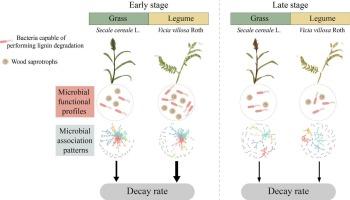
Cover crops litter decay is a vital component of nutrient cycling in agroecosystems; however, how litter quality affect decay process via microbial facets at different decay stage remains unclear. Here, we performed a 112-d decay experiment using the litter of two winter cover crop species (a legume and a grass) to clarify the relationship between the temporal dynamics of litter-inhabiting microbes and litter decay in agroecosystems. Legume litter decayed faster (k = 0.064 ± 0.002 days−1) than grass litter (k = 0.053 ± 0.003 days−1) during the early stage (0–28 D) of decay. Wood saprotrophs and bacteria, capable of performing lignin degradation, were generally more abundant in legume litter (0.003 % and 47.77 %, respectively) than in grass litter (0.002 % and 39.24 %, respectively) during the early stage of decay. Litter quality affected the decay process through its effects on microbial functional profiles and interactions; legume litter decay increased as the abundance of specific functional guilds increased and network complexity decreased. Overall, our findings indicated that litter quality affected litter decay process and relevant litter-inhabiting microbial facets is restricted to the early stage of decay.
期刊介绍:
Applied Soil Ecology addresses the role of soil organisms and their interactions in relation to: sustainability and productivity, nutrient cycling and other soil processes, the maintenance of soil functions, the impact of human activities on soil ecosystems and bio(techno)logical control of soil-inhabiting pests, diseases and weeds.



 京公网安备 11010802042870号
京ICP备2023020795号-1
京公网安备 11010802042870号
京ICP备2023020795号-1

 分享
分享
 求助内容:
求助内容: 应助结果提醒方式:
 扫码关注我们
