Zighed Hanna , Huguenin Yoann , Blanc Laurence , Valentin Jean-Baptiste , Babuty Antoine , Cussac Vincent , Heritier Sebastien , Biron-Andreani Christine , Jeziorski Eric , Moulis Lionel , Harroche Annie , Theron Alexandre
{"title":"Lupus-associated hypoprothrombinemia syndrome in children: Differences between post-infectious and autoimmune forms","authors":"Zighed Hanna , Huguenin Yoann , Blanc Laurence , Valentin Jean-Baptiste , Babuty Antoine , Cussac Vincent , Heritier Sebastien , Biron-Andreani Christine , Jeziorski Eric , Moulis Lionel , Harroche Annie , Theron Alexandre","doi":"10.1016/j.thromres.2024.109231","DOIUrl":null,"url":null,"abstract":"<div><h3>Introduction</h3><div>Lupus-anticoagulant hypoprothrombinemia syndrome (LAHS) is a rare but potentially serious condition. LAHS can be of post-infectious (PI) or autoimmune (AI) origin. However, there is currently no clear data available on the differences between these two forms.</div></div><div><h3>Method</h3><div>A retrospective multicenter study of cases in France was performed, followed by a review of cases in the literature.</div></div><div><h3>Result</h3><div>A total of 84 patients were included in the study. Seventeen patients were selected from the French cohort, and 67 were selected from a systematic review of the literature. 95 % of patients presented with hemorrhagic symptoms, with nearly half of these cases being severe. PI or AI context was identified in 33 % and 53 % of cases. 54 % of patients were treated with corticosteroids, and 30 % received immunomodulatory therapy. Thrombopenia and lower factor V were associated with a higher risk of bleeding. The AI group consisted of older children and exhibited significantly more severe bleeding (<em>p</em> < 0.001). The treatment was more frequent and intensive, and the relapse rate was higher in the AI group (p < 0.001).</div></div><div><h3>Conclusion</h3><div>Post-infectious forms are transient and associated with a low risk of serious hemorrhage. The treatment must be adapted according to the clinical and biological context.</div></div>","PeriodicalId":23064,"journal":{"name":"Thrombosis research","volume":"245 ","pages":"Article 109231"},"PeriodicalIF":3.4000,"publicationDate":"2025-01-01","publicationTypes":"Journal Article","fieldsOfStudy":null,"isOpenAccess":false,"openAccessPdf":"","citationCount":"0","resultStr":null,"platform":"Semanticscholar","paperid":null,"PeriodicalName":"Thrombosis research","FirstCategoryId":"3","ListUrlMain":"https://www.sciencedirect.com/science/article/pii/S0049384824003633","RegionNum":3,"RegionCategory":"医学","ArticlePicture":[],"TitleCN":null,"AbstractTextCN":null,"PMCID":null,"EPubDate":"2024/11/24 0:00:00","PubModel":"Epub","JCR":"Q1","JCRName":"HEMATOLOGY","Score":null,"Total":0}
引用次数: 0
Abstract
Introduction
Lupus-anticoagulant hypoprothrombinemia syndrome (LAHS) is a rare but potentially serious condition. LAHS can be of post-infectious (PI) or autoimmune (AI) origin. However, there is currently no clear data available on the differences between these two forms.
Method
A retrospective multicenter study of cases in France was performed, followed by a review of cases in the literature.
Result
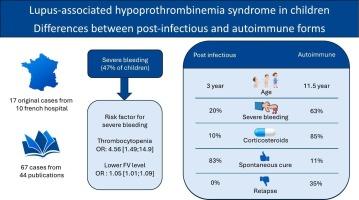
A total of 84 patients were included in the study. Seventeen patients were selected from the French cohort, and 67 were selected from a systematic review of the literature. 95 % of patients presented with hemorrhagic symptoms, with nearly half of these cases being severe. PI or AI context was identified in 33 % and 53 % of cases. 54 % of patients were treated with corticosteroids, and 30 % received immunomodulatory therapy. Thrombopenia and lower factor V were associated with a higher risk of bleeding. The AI group consisted of older children and exhibited significantly more severe bleeding (p < 0.001). The treatment was more frequent and intensive, and the relapse rate was higher in the AI group (p < 0.001).
Conclusion
Post-infectious forms are transient and associated with a low risk of serious hemorrhage. The treatment must be adapted according to the clinical and biological context.
期刊介绍:
Thrombosis Research is an international journal dedicated to the swift dissemination of new information on thrombosis, hemostasis, and vascular biology, aimed at advancing both science and clinical care. The journal publishes peer-reviewed original research, reviews, editorials, opinions, and critiques, covering both basic and clinical studies. Priority is given to research that promises novel approaches in the diagnosis, therapy, prognosis, and prevention of thrombotic and hemorrhagic diseases.



 京公网安备 11010802042870号
京ICP备2023020795号-1
京公网安备 11010802042870号
京ICP备2023020795号-1

 分享
分享
 求助内容:
求助内容: 应助结果提醒方式:
 扫码关注我们
