{"title":"Explainable tuned machine learning models for assessing the impact of corrosion on bond strength in concrete","authors":"Maryam Bypour , Alireza Mahmoudian , Mohammad Yekrangnia , Mahdi Kioumarsi","doi":"10.1016/j.clet.2024.100834","DOIUrl":null,"url":null,"abstract":"<div><div>This study mainly aims to evaluate the bond strength of corroded reinforcements in reinforced concrete members. In this regard, a comprehensive dataset containing a total of 285 specimens was collected from previous experiments. All collected specimens, including normal concrete, were subjected to pull-out tests to ensure consistent results. The features evaluated are associated with both concrete and rebar characteristics, corrosion rate, and duration. Six machine learning (ML) models were used to assess the dataset: Decision Tree, Random Forest, Light Gradient-Boosting Machine, Gradient Boosting, Extreme Gradient Boosting, and Extra Tree. Hyperparameter tuning was conducted using grid search to optimize model performance and enhance predictive accuracy. Additionally, the Shapley Values technique was utilized to interpret the significance of the features on bond strength.</div><div>The results show that Extreme Gradient Boosting and Extra tree methods outperformed the other models, with <span><math><mrow><msup><mi>R</mi><mn>2</mn></msup></mrow></math></span> score of 0.9 each and RSME of 2.21 and 1.87, respectively. Furthermore, tuned models resulted in more accurate performance than the default models. Evaluating the significance of studied features indicated that the elevated levels of corrosion were associated with a negative impact on bond strength. In addition, the corrosion rate is considered to be the most influential factor affecting the bond strength.</div></div>","PeriodicalId":34618,"journal":{"name":"Cleaner Engineering and Technology","volume":"23 ","pages":"Article 100834"},"PeriodicalIF":6.5000,"publicationDate":"2024-12-01","publicationTypes":"Journal Article","fieldsOfStudy":null,"isOpenAccess":false,"openAccessPdf":"","citationCount":"0","resultStr":null,"platform":"Semanticscholar","paperid":null,"PeriodicalName":"Cleaner Engineering and Technology","FirstCategoryId":"1085","ListUrlMain":"https://www.sciencedirect.com/science/article/pii/S2666790824001149","RegionNum":0,"RegionCategory":null,"ArticlePicture":[],"TitleCN":null,"AbstractTextCN":null,"PMCID":null,"EPubDate":"2024/11/12 0:00:00","PubModel":"Epub","JCR":"Q2","JCRName":"ENGINEERING, ENVIRONMENTAL","Score":null,"Total":0}
引用次数: 0
Abstract
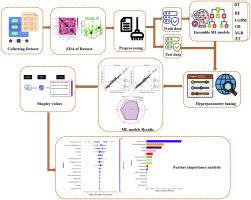
This study mainly aims to evaluate the bond strength of corroded reinforcements in reinforced concrete members. In this regard, a comprehensive dataset containing a total of 285 specimens was collected from previous experiments. All collected specimens, including normal concrete, were subjected to pull-out tests to ensure consistent results. The features evaluated are associated with both concrete and rebar characteristics, corrosion rate, and duration. Six machine learning (ML) models were used to assess the dataset: Decision Tree, Random Forest, Light Gradient-Boosting Machine, Gradient Boosting, Extreme Gradient Boosting, and Extra Tree. Hyperparameter tuning was conducted using grid search to optimize model performance and enhance predictive accuracy. Additionally, the Shapley Values technique was utilized to interpret the significance of the features on bond strength.
The results show that Extreme Gradient Boosting and Extra tree methods outperformed the other models, with score of 0.9 each and RSME of 2.21 and 1.87, respectively. Furthermore, tuned models resulted in more accurate performance than the default models. Evaluating the significance of studied features indicated that the elevated levels of corrosion were associated with a negative impact on bond strength. In addition, the corrosion rate is considered to be the most influential factor affecting the bond strength.





 京公网安备 11010802042870号
京ICP备2023020795号-1
京公网安备 11010802042870号
京ICP备2023020795号-1

 分享
分享
 求助内容:
求助内容: 应助结果提醒方式:
 扫码关注我们
