Sainta Jostar T. , G. Johnsy Arputhavalli , Nithyadharseni Palaniyandy , S. Jebasingh , Mohammad Y. Alshahrani , G.S. Divya , P. Muthu Vijayalakshmi
{"title":"Analyzing the synergistic effect of Mg on Mentha spicata L. mediated Mn2O3 nanoparticles for energy storage and bio-medical applications","authors":"Sainta Jostar T. , G. Johnsy Arputhavalli , Nithyadharseni Palaniyandy , S. Jebasingh , Mohammad Y. Alshahrani , G.S. Divya , P. Muthu Vijayalakshmi","doi":"10.1016/j.inoche.2024.113539","DOIUrl":null,"url":null,"abstract":"<div><div>This article describes the facile preparation of cubic structured pure and Mg-doped Mn<sub>2</sub>O<sub>3</sub> nanoparticles by green synthesis method. The prepared pure and Mg-doped Mn<sub>2</sub>O<sub>3</sub> nanoparticles were investigated to determine their structure, functional group, band gap, morphology and composition. The cubic structured Mn<sub>2</sub>O<sub>3</sub> and Mg-doped Mn<sub>2</sub>O<sub>3</sub> nanoparticles were clearly confirmed by X-Ray Diffraction (XRD) and Field Emission Scanning Electron Microscope (FE-SEM) micrographs. Fourier transform infrared (FTIR) spectroscopy spectra revealed two distinct vibration peaks corresponding to the symmetric stretching Mn–O and Mn–O–Mn, which was well supported by the UV and PL outcomes. A Cyclic Voltammetry study was explored for the prepared pure and Mg-doped samples at different scan rates (mV/s). Apparently, Mg-doped Mn<sub>2</sub>O<sub>3</sub> <!-->nanoparticles exhibited the highest specific capacitance value of 266 F/g with an energy density of 430 Wh/kg. The prepared sample also exhibited antimicrobial activity by showing variation in the zone of inhibition with respect to selected bacteria and fungi. The results of the study suggest that the prepared Mg-doped nanoparticles could act as a promising supercapacitor, anti-biofilm, anti-oxidant agent and water purifier.</div></div>","PeriodicalId":13609,"journal":{"name":"Inorganic Chemistry Communications","volume":"171 ","pages":"Article 113539"},"PeriodicalIF":5.4000,"publicationDate":"2024-11-14","publicationTypes":"Journal Article","fieldsOfStudy":null,"isOpenAccess":false,"openAccessPdf":"","citationCount":"0","resultStr":null,"platform":"Semanticscholar","paperid":null,"PeriodicalName":"Inorganic Chemistry Communications","FirstCategoryId":"92","ListUrlMain":"https://www.sciencedirect.com/science/article/pii/S1387700324015296","RegionNum":3,"RegionCategory":"化学","ArticlePicture":[],"TitleCN":null,"AbstractTextCN":null,"PMCID":null,"EPubDate":"","PubModel":"","JCR":"Q1","JCRName":"CHEMISTRY, INORGANIC & NUCLEAR","Score":null,"Total":0}
引用次数: 0
Abstract
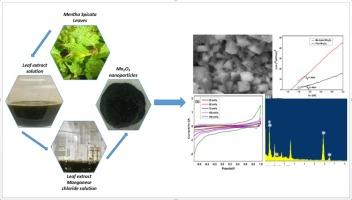
This article describes the facile preparation of cubic structured pure and Mg-doped Mn2O3 nanoparticles by green synthesis method. The prepared pure and Mg-doped Mn2O3 nanoparticles were investigated to determine their structure, functional group, band gap, morphology and composition. The cubic structured Mn2O3 and Mg-doped Mn2O3 nanoparticles were clearly confirmed by X-Ray Diffraction (XRD) and Field Emission Scanning Electron Microscope (FE-SEM) micrographs. Fourier transform infrared (FTIR) spectroscopy spectra revealed two distinct vibration peaks corresponding to the symmetric stretching Mn–O and Mn–O–Mn, which was well supported by the UV and PL outcomes. A Cyclic Voltammetry study was explored for the prepared pure and Mg-doped samples at different scan rates (mV/s). Apparently, Mg-doped Mn2O3 nanoparticles exhibited the highest specific capacitance value of 266 F/g with an energy density of 430 Wh/kg. The prepared sample also exhibited antimicrobial activity by showing variation in the zone of inhibition with respect to selected bacteria and fungi. The results of the study suggest that the prepared Mg-doped nanoparticles could act as a promising supercapacitor, anti-biofilm, anti-oxidant agent and water purifier.
期刊介绍:
Launched in January 1998, Inorganic Chemistry Communications is an international journal dedicated to the rapid publication of short communications in the major areas of inorganic, organometallic and supramolecular chemistry. Topics include synthetic and reaction chemistry, kinetics and mechanisms of reactions, bioinorganic chemistry, photochemistry and the use of metal and organometallic compounds in stoichiometric and catalytic synthesis or organic compounds.



 京公网安备 11010802042870号
京ICP备2023020795号-1
京公网安备 11010802042870号
京ICP备2023020795号-1

 分享
分享
 求助内容:
求助内容: 应助结果提醒方式:
 扫码关注我们
