Stefanni S. Everton, Martina C. C. Pinto, Thalita Neves, Eliane Pereira Cipolatti, Evelin Andrade Manoel, Denise Maria Guimarães Freire, Martin Schmal, José Carlos Pinto
{"title":"Synthesis of polymeric nanoparticles with different functionalities to produce new biocatalysts","authors":"Stefanni S. Everton, Martina C. C. Pinto, Thalita Neves, Eliane Pereira Cipolatti, Evelin Andrade Manoel, Denise Maria Guimarães Freire, Martin Schmal, José Carlos Pinto","doi":"10.1002/app.56306","DOIUrl":null,"url":null,"abstract":"<p>This study aimed to synthesize functionalized nanosupports via emulsion polymerization to develop new promising nanobiocatalyts via enzyme immobilizations. The co-monomers methyl methacrylate, divinylbenzene and the epoxy monomer glycidyl methacrylate (GMA) were used. The performance of the nanobiocatlysts was evaluated in hydrolysis and esterification reactions after the immobilization of lipase B from <i>Candida antarctica</i> (CAL B). Firstly, the nanosupports functionalized in situ with 25% and 50% w/w of GMA were successfully synthesized. In esterification reactions, the nanobiocatalysts containing 25% (w/w) of GMA were more active, achieving 254 U.g<sup>−1</sup>, or an enzyme activity per area of 2.8 U.m<sup>−2</sup>; such value was higher than the one obtained when the commercial matrix Octadecyl Sepabeads was used (328 U.g<sup>−1</sup>, 2.4 U.m<sup>−2</sup>). Such results point out that there is an optimum concentration of GMA epoxide groups that should be incorporated into the supports. The greater enzymatic activity obtained for 25% of GMA nanobiocatalyst was achieved not only because of their textural properties, but also due to a favorable interaction between the epoxide groups and CAL B. These results highlight the potential use of the heterofunctional matrices for the synthesis of new market-competitive biocatalysts.</p>","PeriodicalId":183,"journal":{"name":"Journal of Applied Polymer Science","volume":"142 1","pages":""},"PeriodicalIF":2.8000,"publicationDate":"2024-10-08","publicationTypes":"Journal Article","fieldsOfStudy":null,"isOpenAccess":false,"openAccessPdf":"","citationCount":"0","resultStr":null,"platform":"Semanticscholar","paperid":null,"PeriodicalName":"Journal of Applied Polymer Science","FirstCategoryId":"92","ListUrlMain":"https://onlinelibrary.wiley.com/doi/10.1002/app.56306","RegionNum":3,"RegionCategory":"化学","ArticlePicture":[],"TitleCN":null,"AbstractTextCN":null,"PMCID":null,"EPubDate":"","PubModel":"","JCR":"Q2","JCRName":"POLYMER SCIENCE","Score":null,"Total":0}
引用次数: 0
Abstract
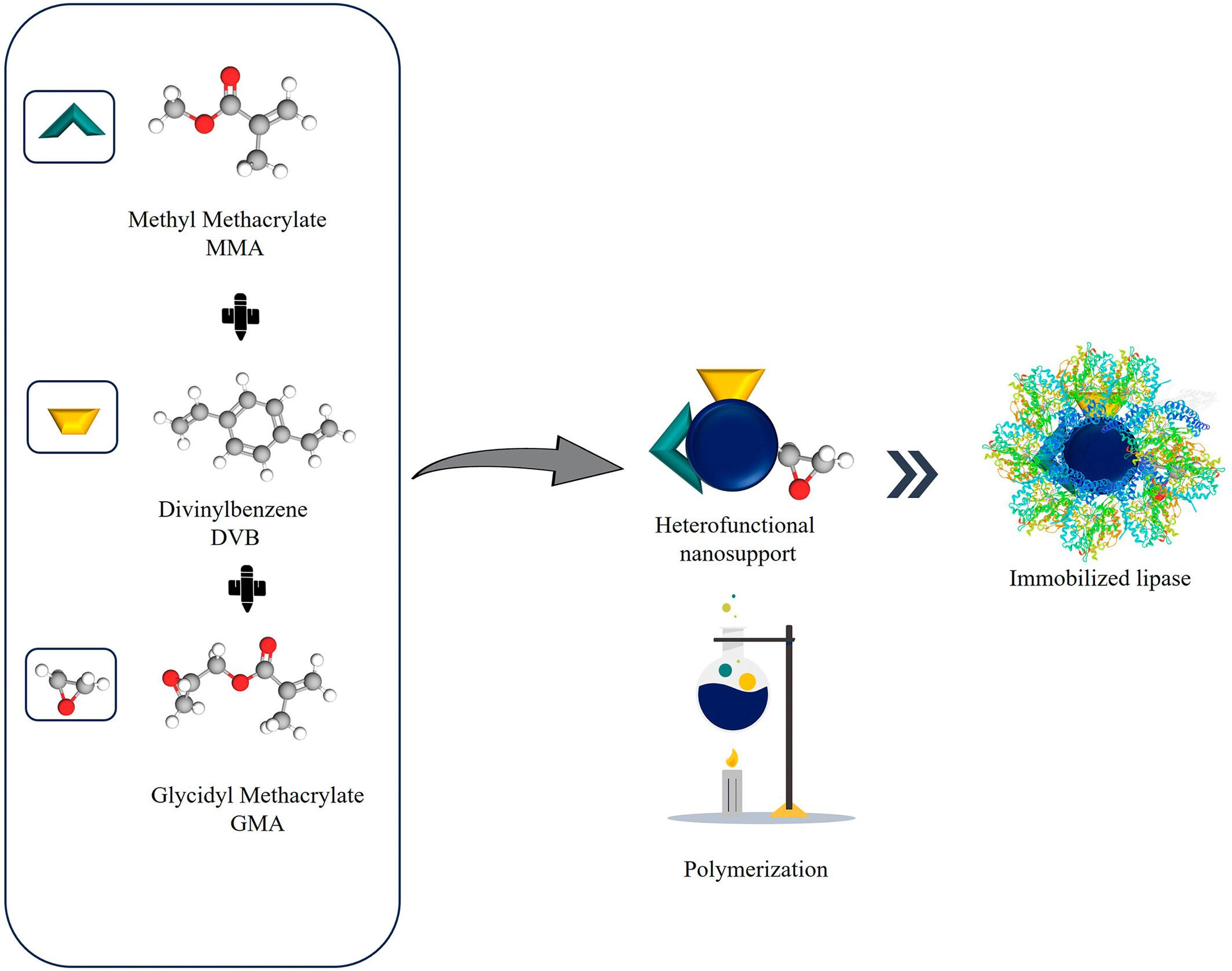
This study aimed to synthesize functionalized nanosupports via emulsion polymerization to develop new promising nanobiocatalyts via enzyme immobilizations. The co-monomers methyl methacrylate, divinylbenzene and the epoxy monomer glycidyl methacrylate (GMA) were used. The performance of the nanobiocatlysts was evaluated in hydrolysis and esterification reactions after the immobilization of lipase B from Candida antarctica (CAL B). Firstly, the nanosupports functionalized in situ with 25% and 50% w/w of GMA were successfully synthesized. In esterification reactions, the nanobiocatalysts containing 25% (w/w) of GMA were more active, achieving 254 U.g−1, or an enzyme activity per area of 2.8 U.m−2; such value was higher than the one obtained when the commercial matrix Octadecyl Sepabeads was used (328 U.g−1, 2.4 U.m−2). Such results point out that there is an optimum concentration of GMA epoxide groups that should be incorporated into the supports. The greater enzymatic activity obtained for 25% of GMA nanobiocatalyst was achieved not only because of their textural properties, but also due to a favorable interaction between the epoxide groups and CAL B. These results highlight the potential use of the heterofunctional matrices for the synthesis of new market-competitive biocatalysts.
期刊介绍:
The Journal of Applied Polymer Science is the largest peer-reviewed publication in polymers, #3 by total citations, and features results with real-world impact on membranes, polysaccharides, and much more.



 京公网安备 11010802042870号
京ICP备2023020795号-1
京公网安备 11010802042870号
京ICP备2023020795号-1

 分享
分享
 求助内容:
求助内容: 应助结果提醒方式:
 扫码关注我们
