Kaaja Mareile Baaske, Cord Sunderkötter, Andreas Montag
{"title":"Grouped vesicles from the Middle East","authors":"Kaaja Mareile Baaske, Cord Sunderkötter, Andreas Montag","doi":"10.1111/ddg.15594","DOIUrl":null,"url":null,"abstract":"<p>Dear Editors,</p><p>A 59-year-old female patient presented to our clinic at the end of April immediately after her return from the United Arab Emirates (UAE). One week earlier, she had fallen ill there with an itchy but painless, blistering rash on her extremities and occasionally on her trunk. After the first night in the hotel and a morning swim in the sea, the patient had felt a tingling and burning sensation on her skin. She had not noticed any suspicious sea creatures and, according to the local beach warden, it was not ‘jellyfish season’ anyway. Our patient had worn a swimsuit and a full-face mask. The next morning, the skin burning worsened after her swim, again without any recognizable cause, despite an increased search for jellyfish or other sea creatures. The accompanying husband (who had also swum in the sea) showed no dermatosis. The findings on admission consisted of bulging vesicles and bullae, each surrounded by a narrow, rich red erythema, in a mostly linear, often suggestive double-row grouping, predominantly localized on the neck and upper extremities, but also on the trunk and legs (Figure 1). The patient was also known to have atopy (Erlanger Atopy Score: 12 points).</p><p>Based on the clinical picture, we rejected the external referral diagnosis of ‘bullous pemphigoid’ and primarily considered an aquatic dermatosis (e.g. stinging). However, due to the repeated failure to identify the corresponding marine animals, an arthropod reaction (e.g. bedbug bites) also appeared possible. Corresponding investigations for a bullous autoimmune dermatosis (direct immunofluorescence, antibodies in the serum) were also negative.</p><p>Histologically, the upper and deep dermis showed a wedge-shaped, downwardly tapering lymphocytic infiltrate with abundant eosinophilic granulocytes, consistent with an arthropod reaction. However, the distribution of the vesicles and bullae led us to consider the possibility of marine-induced dermatitis.</p><p>One of the many aquatic (marine) skin diseases acquired in the sea is a seabather's eruption caused by planula larvae, an early, free-swimming (planktonic) developmental stage of marine scyphozoan jellyfish (<i>Scyphozoa</i>).<span><sup>1</sup></span> However, the distribution of the welt-like skin reactions outside the swimwear (Figure 1) argued against this in this case. Only the absence of jellyfish spoke against toxic dermatitis caused by discharging cnidarian (<i>Cnidaria</i>) capsules floating in the sea. However, stinging is also possible due to fragments of tentacles covered with cnidarian cells that have been ripped off from jellyfish and that drift freely in sea. Therefore, the diagnosis of toxic dermatitis caused by freely drifting cnidarian (<i>Cnidaria</i>) cnidocyte fragments was made.</p><p>Stinging cnidarian fragments can be found floating in all oceans and often travel long distances due to drifting currents and wind. They can often be found far beyond the native habitat of the species to which they belong. The patient's holiday region is situated on a strait that connects the Persian Gulf with the Gulf of Oman. Strong ocean currents from November to April make a high occurrence of cnidarian fragments likely there.<span><sup>2-4</sup></span></p><p>These tentacles are also known as ‘stinging threads’ due to their often thin diameter. Their translucent, usually colorless structure makes them practically invisible to the human eye in the sea. It is therefore usually not possible for water sports enthusiasts and swimmers to avoid entanglement. Furthermore, under these circumstances, it is almost never possible to identify the cnidarian behind the sting.</p><p>The severity of the corresponding skin reactions depends on the degree of entanglement, the cnidarian species and toxicity of the cnidarian venom as well as the immune status of the stung victim.<span><sup>5</sup></span> A particular sensitivity in atopic diathesis is the subject of debate.<span><sup>6</sup></span> However, dense body hair is thought to protect against stinging,<span><sup>7-9</sup></span> in the majority of all fatal cases of stinging children or women are affected. The husband's lack of symptoms may therefore be explained by his increased body hair and the absence of atopic diathesis. The Amuska jellyfish (<i>Sanderia malayensis</i>) is widespread in the coastal area mentioned here. The strong cnidarian venom in the tentacles of this jellyfish causes welt-like skin reactions, often interspersed with vesicles and bullae. Extensive stinging can lead to skin necrosis and cardiovascular reactions.<span><sup>9, 10</sup></span></p><p>Treatment measures that can generally be applied to all injuries caused by cnidarians are listed in Table 1. However, a number of other acute measures following contact with scyphozoan jellyfish or their tentacles are only applicable to individual species. For example, treatments that are always successful for a particular species of jellyfish may lead to fatal discharge from additional stinging capsules in another species of jellyfish. A selection of important aquatic dermatoses in seas and oceans, which must also be distinguished by differential diagnosis, can be found in Table 2.<span><sup>11, 12</sup></span></p><p>In our patient, all skin lesions healed quickly, completely and permanently within 3 weeks under symptomatic therapy with prednisolone 1 mg/kg body weight for 3 days and a topical glucocorticoid.</p><p>None.</p>","PeriodicalId":14758,"journal":{"name":"Journal Der Deutschen Dermatologischen Gesellschaft","volume":"23 2","pages":"212-217"},"PeriodicalIF":3.8000,"publicationDate":"2024-11-25","publicationTypes":"Journal Article","fieldsOfStudy":null,"isOpenAccess":false,"openAccessPdf":"https://onlinelibrary.wiley.com/doi/epdf/10.1111/ddg.15594","citationCount":"0","resultStr":null,"platform":"Semanticscholar","paperid":null,"PeriodicalName":"Journal Der Deutschen Dermatologischen Gesellschaft","FirstCategoryId":"3","ListUrlMain":"https://onlinelibrary.wiley.com/doi/10.1111/ddg.15594","RegionNum":4,"RegionCategory":"医学","ArticlePicture":[],"TitleCN":null,"AbstractTextCN":null,"PMCID":null,"EPubDate":"","PubModel":"","JCR":"Q1","JCRName":"DERMATOLOGY","Score":null,"Total":0}
引用次数: 0
Abstract
Dear Editors,
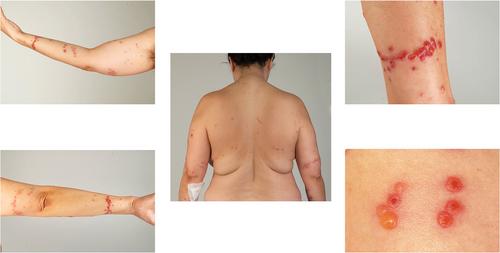
A 59-year-old female patient presented to our clinic at the end of April immediately after her return from the United Arab Emirates (UAE). One week earlier, she had fallen ill there with an itchy but painless, blistering rash on her extremities and occasionally on her trunk. After the first night in the hotel and a morning swim in the sea, the patient had felt a tingling and burning sensation on her skin. She had not noticed any suspicious sea creatures and, according to the local beach warden, it was not ‘jellyfish season’ anyway. Our patient had worn a swimsuit and a full-face mask. The next morning, the skin burning worsened after her swim, again without any recognizable cause, despite an increased search for jellyfish or other sea creatures. The accompanying husband (who had also swum in the sea) showed no dermatosis. The findings on admission consisted of bulging vesicles and bullae, each surrounded by a narrow, rich red erythema, in a mostly linear, often suggestive double-row grouping, predominantly localized on the neck and upper extremities, but also on the trunk and legs (Figure 1). The patient was also known to have atopy (Erlanger Atopy Score: 12 points).
Based on the clinical picture, we rejected the external referral diagnosis of ‘bullous pemphigoid’ and primarily considered an aquatic dermatosis (e.g. stinging). However, due to the repeated failure to identify the corresponding marine animals, an arthropod reaction (e.g. bedbug bites) also appeared possible. Corresponding investigations for a bullous autoimmune dermatosis (direct immunofluorescence, antibodies in the serum) were also negative.
Histologically, the upper and deep dermis showed a wedge-shaped, downwardly tapering lymphocytic infiltrate with abundant eosinophilic granulocytes, consistent with an arthropod reaction. However, the distribution of the vesicles and bullae led us to consider the possibility of marine-induced dermatitis.
One of the many aquatic (marine) skin diseases acquired in the sea is a seabather's eruption caused by planula larvae, an early, free-swimming (planktonic) developmental stage of marine scyphozoan jellyfish (Scyphozoa).1 However, the distribution of the welt-like skin reactions outside the swimwear (Figure 1) argued against this in this case. Only the absence of jellyfish spoke against toxic dermatitis caused by discharging cnidarian (Cnidaria) capsules floating in the sea. However, stinging is also possible due to fragments of tentacles covered with cnidarian cells that have been ripped off from jellyfish and that drift freely in sea. Therefore, the diagnosis of toxic dermatitis caused by freely drifting cnidarian (Cnidaria) cnidocyte fragments was made.
Stinging cnidarian fragments can be found floating in all oceans and often travel long distances due to drifting currents and wind. They can often be found far beyond the native habitat of the species to which they belong. The patient's holiday region is situated on a strait that connects the Persian Gulf with the Gulf of Oman. Strong ocean currents from November to April make a high occurrence of cnidarian fragments likely there.2-4
These tentacles are also known as ‘stinging threads’ due to their often thin diameter. Their translucent, usually colorless structure makes them practically invisible to the human eye in the sea. It is therefore usually not possible for water sports enthusiasts and swimmers to avoid entanglement. Furthermore, under these circumstances, it is almost never possible to identify the cnidarian behind the sting.
The severity of the corresponding skin reactions depends on the degree of entanglement, the cnidarian species and toxicity of the cnidarian venom as well as the immune status of the stung victim.5 A particular sensitivity in atopic diathesis is the subject of debate.6 However, dense body hair is thought to protect against stinging,7-9 in the majority of all fatal cases of stinging children or women are affected. The husband's lack of symptoms may therefore be explained by his increased body hair and the absence of atopic diathesis. The Amuska jellyfish (Sanderia malayensis) is widespread in the coastal area mentioned here. The strong cnidarian venom in the tentacles of this jellyfish causes welt-like skin reactions, often interspersed with vesicles and bullae. Extensive stinging can lead to skin necrosis and cardiovascular reactions.9, 10
Treatment measures that can generally be applied to all injuries caused by cnidarians are listed in Table 1. However, a number of other acute measures following contact with scyphozoan jellyfish or their tentacles are only applicable to individual species. For example, treatments that are always successful for a particular species of jellyfish may lead to fatal discharge from additional stinging capsules in another species of jellyfish. A selection of important aquatic dermatoses in seas and oceans, which must also be distinguished by differential diagnosis, can be found in Table 2.11, 12
In our patient, all skin lesions healed quickly, completely and permanently within 3 weeks under symptomatic therapy with prednisolone 1 mg/kg body weight for 3 days and a topical glucocorticoid.
期刊介绍:
The JDDG publishes scientific papers from a wide range of disciplines, such as dermatovenereology, allergology, phlebology, dermatosurgery, dermatooncology, and dermatohistopathology. Also in JDDG: information on medical training, continuing education, a calendar of events, book reviews and society announcements.
Papers can be submitted in German or English language. In the print version, all articles are published in German. In the online version, all key articles are published in English.



 京公网安备 11010802042870号
京ICP备2023020795号-1
京公网安备 11010802042870号
京ICP备2023020795号-1

 分享
分享
 求助内容:
求助内容: 应助结果提醒方式:
 扫码关注我们
