Recent infection testing to inform HIV prevention responses and surveillance in a programme context: lessons from implementation within a nationally scaled female sex worker programme in Zimbabwe
Harriet S. Jones, Fortunate Machingura, Leah Gaihai, Memory Makamba, Thomas Chanyowedza, Panganai Masvikeni, Edward Matsikire, Primrose Matambanadzo, Sithembile Musemburi, Phillip N. Chida, Jeffery Dirawo, Owen Mugurungi, Sarah Bourdin, Bernadette Hensen, Lucy Platt, Gary Murphy, James R. Hargreaves, Frances M. Cowan, Brian Rice
{"title":"Recent infection testing to inform HIV prevention responses and surveillance in a programme context: lessons from implementation within a nationally scaled female sex worker programme in Zimbabwe","authors":"Harriet S. Jones, Fortunate Machingura, Leah Gaihai, Memory Makamba, Thomas Chanyowedza, Panganai Masvikeni, Edward Matsikire, Primrose Matambanadzo, Sithembile Musemburi, Phillip N. Chida, Jeffery Dirawo, Owen Mugurungi, Sarah Bourdin, Bernadette Hensen, Lucy Platt, Gary Murphy, James R. Hargreaves, Frances M. Cowan, Brian Rice","doi":"10.1002/jia2.26391","DOIUrl":null,"url":null,"abstract":"<div>\n \n \n <section>\n \n <h3> Introduction</h3>\n \n <p>In the context of key population HIV testing programmes, identifying new HIV acquisitions, tracking incidence, and responding with prevention and treatment interventions will be critical for achieving HIV epidemic control. Laboratory tests for recently acquired HIV used as part of a “recent infection testing algorithm” (RITA), offer a potential tool to support this work. We implemented a RITA for female sex workers (FSWs) in Zimbabwe to explore opportunities and programmatic benefits.</p>\n </section>\n \n <section>\n \n <h3> Methods</h3>\n \n <p>Between October 2021 and January 2023, recency testing was offered to FSWs attending the Centre for Sexual Health and HIV/AIDS Research (CeSHHAR) Zimbabwe's key populations programme. Dried blood spot (DBS) samples were taken at 86 clinic sites across 10 provinces and Laboratory LAg Avidity and viral load testing conducted. RITA results were analysed and linked to programme data to explore geographical differences and calculate HIV incidence. We describe concurrent efforts in HIV testing for social (social network testing [SNT]) and sexual (index case testing [ICT]) contacts of those testing HIV positive.</p>\n </section>\n \n <section>\n \n <h3> Results</h3>\n \n <p>Among 24,976 FSWs tested at programme sites, 9.5% (2363/24,976) were confirmed HIV positive. We enrolled 55.5% (1311/2363) of eligible HIV-positive FSWs to our study, of whom 11.7% (153/1311) were identified as having recently acquired HIV. It took a median of 37 days (IQR 20–67) for samples to be processed. Enrolment rates varied between provinces but the proportion of recently acquired HIV was similar (range: 18.4% to 4.0%). Overall HIV incidence was 3.4 (95% CI 2.7−4.0) per 100py. Where results could be linked to routinely collected data, we found no evidence of a difference in test-positivity between the ICT and SNT contacts of those with recently acquired compared to those with long-term HIV.</p>\n </section>\n \n <section>\n \n <h3> Conclusions</h3>\n \n <p>Implementation of a RITA was possible within a nationally scaled sex worker programme, and while challenging to implement, can provide an understanding of transmission dynamics and HIV incidence in this context. Sub-optimal recruitment and data linkage limited the interpretation of our findings and opportunities for strategic gains though focusing on HIV prevention efforts.</p>\n </section>\n </div>","PeriodicalId":201,"journal":{"name":"Journal of the International AIDS Society","volume":"27 12","pages":""},"PeriodicalIF":4.9000,"publicationDate":"2024-11-26","publicationTypes":"Journal Article","fieldsOfStudy":null,"isOpenAccess":false,"openAccessPdf":"https://onlinelibrary.wiley.com/doi/epdf/10.1002/jia2.26391","citationCount":"0","resultStr":null,"platform":"Semanticscholar","paperid":null,"PeriodicalName":"Journal of the International AIDS Society","FirstCategoryId":"3","ListUrlMain":"https://onlinelibrary.wiley.com/doi/10.1002/jia2.26391","RegionNum":1,"RegionCategory":"医学","ArticlePicture":[],"TitleCN":null,"AbstractTextCN":null,"PMCID":null,"EPubDate":"","PubModel":"","JCR":"Q2","JCRName":"IMMUNOLOGY","Score":null,"Total":0}
引用次数: 0
Abstract
Introduction
In the context of key population HIV testing programmes, identifying new HIV acquisitions, tracking incidence, and responding with prevention and treatment interventions will be critical for achieving HIV epidemic control. Laboratory tests for recently acquired HIV used as part of a “recent infection testing algorithm” (RITA), offer a potential tool to support this work. We implemented a RITA for female sex workers (FSWs) in Zimbabwe to explore opportunities and programmatic benefits.
Methods
Between October 2021 and January 2023, recency testing was offered to FSWs attending the Centre for Sexual Health and HIV/AIDS Research (CeSHHAR) Zimbabwe's key populations programme. Dried blood spot (DBS) samples were taken at 86 clinic sites across 10 provinces and Laboratory LAg Avidity and viral load testing conducted. RITA results were analysed and linked to programme data to explore geographical differences and calculate HIV incidence. We describe concurrent efforts in HIV testing for social (social network testing [SNT]) and sexual (index case testing [ICT]) contacts of those testing HIV positive.
Results
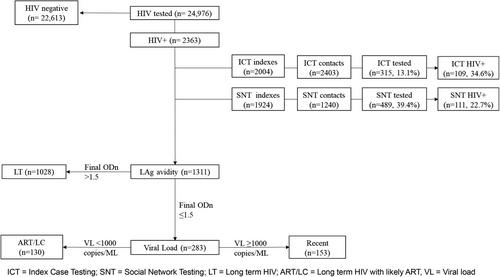
Among 24,976 FSWs tested at programme sites, 9.5% (2363/24,976) were confirmed HIV positive. We enrolled 55.5% (1311/2363) of eligible HIV-positive FSWs to our study, of whom 11.7% (153/1311) were identified as having recently acquired HIV. It took a median of 37 days (IQR 20–67) for samples to be processed. Enrolment rates varied between provinces but the proportion of recently acquired HIV was similar (range: 18.4% to 4.0%). Overall HIV incidence was 3.4 (95% CI 2.7−4.0) per 100py. Where results could be linked to routinely collected data, we found no evidence of a difference in test-positivity between the ICT and SNT contacts of those with recently acquired compared to those with long-term HIV.
Conclusions
Implementation of a RITA was possible within a nationally scaled sex worker programme, and while challenging to implement, can provide an understanding of transmission dynamics and HIV incidence in this context. Sub-optimal recruitment and data linkage limited the interpretation of our findings and opportunities for strategic gains though focusing on HIV prevention efforts.
期刊介绍:
The Journal of the International AIDS Society (JIAS) is a peer-reviewed and Open Access journal for the generation and dissemination of evidence from a wide range of disciplines: basic and biomedical sciences; behavioural sciences; epidemiology; clinical sciences; health economics and health policy; operations research and implementation sciences; and social sciences and humanities. Submission of HIV research carried out in low- and middle-income countries is strongly encouraged.



 京公网安备 11010802042870号
京ICP备2023020795号-1
京公网安备 11010802042870号
京ICP备2023020795号-1

 分享
分享
 求助内容:
求助内容: 应助结果提醒方式:
 扫码关注我们
