Andrei V. Bykov, Tatiana A. Shestimerova, Mikhail A. Bykov, Victoria E. Gontcharenko, Konstantin A. Lyssenko, Mikhail T. Metlin, Ilya V. Taydakov, Anastasia V. Grigorieva and Andrei V. Shevelkov
{"title":"Photoluminescent chain-of-dimer anion in a novel hybrid halometallate (C5H14N2)3{Sb2Br9}2: atypical behavior in one-dimensional anionic systems†","authors":"Andrei V. Bykov, Tatiana A. Shestimerova, Mikhail A. Bykov, Victoria E. Gontcharenko, Konstantin A. Lyssenko, Mikhail T. Metlin, Ilya V. Taydakov, Anastasia V. Grigorieva and Andrei V. Shevelkov","doi":"10.1039/D4DT02751E","DOIUrl":null,"url":null,"abstract":"<p >In pursuit of identifying less toxic hybrid compounds suitable for optoelectronic applications, we synthesized a novel homopiperazinium bromoantimonate(<small>III</small>), (C<small><sub>5</sub></small>H<small><sub>14</sub></small>N<small><sub>2</sub></small>)<small><sub>3</sub></small>{Sb<small><sub>2</sub></small>Br<small><sub>9</sub></small>}<small><sub>2</sub></small>. It readily crystallized from an aqueous hydrobromic acid solution and was found to be stable both in air and upon heating up to 175 °C. The crystal structure of the new bromoantimonate(<small>III</small>) consisted of {Sb<small><sub>2</sub></small>Br<small><sub>9</sub></small>}<small><sup>3−</sup></small> zigzag chains, which were composed of strongly trigonally distorted SbBr<small><sub>6</sub></small><small><sup>3−</sup></small> octahedral anions and C<small><sub>5</sub></small>H<small><sub>14</sub></small>N<small><sub>2</sub></small><small><sup>2+</sup></small> dications. Weak interactions, including (N)H⋯Br hydrogen bonds and Br⋯Br van der Waals contacts, facilitated the assembly of the structural moieties into a three-dimensional (3D) supramolecular framework. The photoluminescence (PL) spectrum of (C<small><sub>5</sub></small>H<small><sub>14</sub></small>N<small><sub>2</sub></small>)<small><sub>3</sub></small>{Sb<small><sub>2</sub></small>Br<small><sub>9</sub></small>}<small><sub>2</sub></small> displayed two broad bands in visible and near-infrared regions, which were scarcely detectable at room temperature but gained intensity upon cooling. Red emission at 645 nm, typically observed in zero-dimensional halometallates, was attributed to antimony 5s<small><sup>2</sup></small> lone-pair-driven luminescence that corresponded to the emission from the self-trapped exciton (STE) state. The title compound also exhibited an atypical PL band at 880 nm, which has been discussed along with the optical properties and Raman spectrum of (C<small><sub>5</sub></small>H<small><sub>14</sub></small>N<small><sub>2</sub></small>)<small><sub>3</sub></small>{Sb<small><sub>2</sub></small>Br<small><sub>9</sub></small>}<small><sub>2</sub></small>.</p>","PeriodicalId":71,"journal":{"name":"Dalton Transactions","volume":" 4","pages":" 1541-1551"},"PeriodicalIF":3.3000,"publicationDate":"2024-11-27","publicationTypes":"Journal Article","fieldsOfStudy":null,"isOpenAccess":false,"openAccessPdf":"","citationCount":"0","resultStr":null,"platform":"Semanticscholar","paperid":null,"PeriodicalName":"Dalton Transactions","FirstCategoryId":"92","ListUrlMain":"https://pubs.rsc.org/en/content/articlelanding/2025/dt/d4dt02751e","RegionNum":3,"RegionCategory":"化学","ArticlePicture":[],"TitleCN":null,"AbstractTextCN":null,"PMCID":null,"EPubDate":"","PubModel":"","JCR":"Q2","JCRName":"CHEMISTRY, INORGANIC & NUCLEAR","Score":null,"Total":0}
引用次数: 0
Abstract
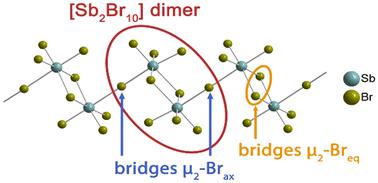
In pursuit of identifying less toxic hybrid compounds suitable for optoelectronic applications, we synthesized a novel homopiperazinium bromoantimonate(III), (C5H14N2)3{Sb2Br9}2. It readily crystallized from an aqueous hydrobromic acid solution and was found to be stable both in air and upon heating up to 175 °C. The crystal structure of the new bromoantimonate(III) consisted of {Sb2Br9}3− zigzag chains, which were composed of strongly trigonally distorted SbBr63− octahedral anions and C5H14N22+ dications. Weak interactions, including (N)H⋯Br hydrogen bonds and Br⋯Br van der Waals contacts, facilitated the assembly of the structural moieties into a three-dimensional (3D) supramolecular framework. The photoluminescence (PL) spectrum of (C5H14N2)3{Sb2Br9}2 displayed two broad bands in visible and near-infrared regions, which were scarcely detectable at room temperature but gained intensity upon cooling. Red emission at 645 nm, typically observed in zero-dimensional halometallates, was attributed to antimony 5s2 lone-pair-driven luminescence that corresponded to the emission from the self-trapped exciton (STE) state. The title compound also exhibited an atypical PL band at 880 nm, which has been discussed along with the optical properties and Raman spectrum of (C5H14N2)3{Sb2Br9}2.
期刊介绍:
Dalton Transactions is a journal for all areas of inorganic chemistry, which encompasses the organometallic, bioinorganic and materials chemistry of the elements, with applications including synthesis, catalysis, energy conversion/storage, electrical devices and medicine. Dalton Transactions welcomes high-quality, original submissions in all of these areas and more, where the advancement of knowledge in inorganic chemistry is significant.




 京公网安备 11010802042870号
京ICP备2023020795号-1
京公网安备 11010802042870号
京ICP备2023020795号-1

 分享
分享
 求助内容:
求助内容: 应助结果提醒方式:
 扫码关注我们
