{"title":"Newly Synthesized Citral Derivatives Serve as Novel Inhibitor in HepG2 Cells","authors":"Wei Gao, Xiaoju Hua, Shengliang Liao, Zhikai Xiahou, Haikuan Yang, Lifang Hu, Yunyang Chi","doi":"10.1002/open.202400112","DOIUrl":null,"url":null,"abstract":"<p>2H-pyran compound 1 synthesized from 6-methylpyridine-2,4-diol and citral, has been used for Cu-catalyzed <i>N</i>-arylation with a range of arylboric acids to obtain arylated pyranopyridine core structure derivatives (yield up to 77 %). Among them, compound <b>3 h</b> exhibited a much better inhibitory effect on HepG2 liver cancer cells compared to citral, and the IC<sub>50</sub> value was 5.3 μM following exposure with the newly synthesized derivatives (herein named <b>3 h</b> for short in this paper), which was lower than that of the cisplatin (6.5 μM). Meanwhile, the cell-cycle arrest of HepG2 cells occurred in the S phase, and the apoptosis of HepG2 cells was significantly increased with increasing drug concentration. In addition, real-time fluorescence quantification PCR and Western blotting experiments showed that the expression of apoptotic protein BAX was increased, while the expression of anti-apoptotic protein BCL2 was inhibited in a dose-dependent fashion. The results of these experiments indicated that apoptosis was promoted in HepG2 cells via apoptotic signaling pathway activated by <b>3 h</b>. Furthermore, <b>3 h</b> effectively decreased the phosphorylation levels of PI3 K, ATK and ERK, resulting in the inhibitions of MAPK/ERK and PI3 K/ATK signaling pathways. Briefly, <b>3 h</b> has been found to show inhibitory effects on the survival of HepG2 liver cancer cells and may be used as anti-cancer drug in the future.</p>","PeriodicalId":9831,"journal":{"name":"ChemistryOpen","volume":"14 4","pages":""},"PeriodicalIF":3.1000,"publicationDate":"2024-11-26","publicationTypes":"Journal Article","fieldsOfStudy":null,"isOpenAccess":false,"openAccessPdf":"https://onlinelibrary.wiley.com/doi/epdf/10.1002/open.202400112","citationCount":"0","resultStr":null,"platform":"Semanticscholar","paperid":null,"PeriodicalName":"ChemistryOpen","FirstCategoryId":"92","ListUrlMain":"https://chemistry-europe.onlinelibrary.wiley.com/doi/10.1002/open.202400112","RegionNum":4,"RegionCategory":"化学","ArticlePicture":[],"TitleCN":null,"AbstractTextCN":null,"PMCID":null,"EPubDate":"","PubModel":"","JCR":"Q2","JCRName":"CHEMISTRY, MULTIDISCIPLINARY","Score":null,"Total":0}
引用次数: 0
Abstract
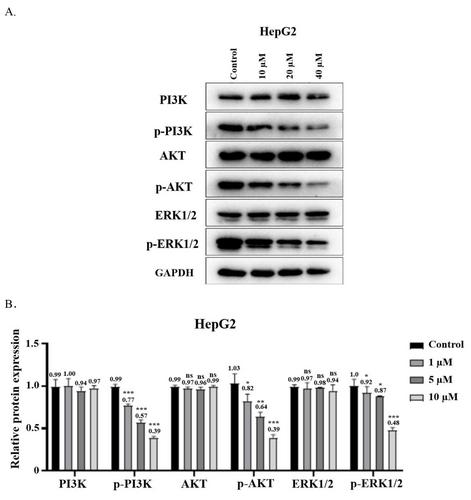
2H-pyran compound 1 synthesized from 6-methylpyridine-2,4-diol and citral, has been used for Cu-catalyzed N-arylation with a range of arylboric acids to obtain arylated pyranopyridine core structure derivatives (yield up to 77 %). Among them, compound 3 h exhibited a much better inhibitory effect on HepG2 liver cancer cells compared to citral, and the IC50 value was 5.3 μM following exposure with the newly synthesized derivatives (herein named 3 h for short in this paper), which was lower than that of the cisplatin (6.5 μM). Meanwhile, the cell-cycle arrest of HepG2 cells occurred in the S phase, and the apoptosis of HepG2 cells was significantly increased with increasing drug concentration. In addition, real-time fluorescence quantification PCR and Western blotting experiments showed that the expression of apoptotic protein BAX was increased, while the expression of anti-apoptotic protein BCL2 was inhibited in a dose-dependent fashion. The results of these experiments indicated that apoptosis was promoted in HepG2 cells via apoptotic signaling pathway activated by 3 h. Furthermore, 3 h effectively decreased the phosphorylation levels of PI3 K, ATK and ERK, resulting in the inhibitions of MAPK/ERK and PI3 K/ATK signaling pathways. Briefly, 3 h has been found to show inhibitory effects on the survival of HepG2 liver cancer cells and may be used as anti-cancer drug in the future.
期刊介绍:
ChemistryOpen is a multidisciplinary, gold-road open-access, international forum for the publication of outstanding Reviews, Full Papers, and Communications from all areas of chemistry and related fields. It is co-owned by 16 continental European Chemical Societies, who have banded together in the alliance called ChemPubSoc Europe for the purpose of publishing high-quality journals in the field of chemistry and its border disciplines. As some of the governments of the countries represented in ChemPubSoc Europe have strongly recommended that the research conducted with their funding is freely accessible for all readers (Open Access), ChemPubSoc Europe was concerned that no journal for which the ethical standards were monitored by a chemical society was available for such papers. ChemistryOpen fills this gap.






 京公网安备 11010802042870号
京ICP备2023020795号-1
京公网安备 11010802042870号
京ICP备2023020795号-1

 分享
分享
 求助内容:
求助内容: 应助结果提醒方式:
 扫码关注我们
