{"title":"Urinary tract infections: a retrospective cohort study of (mis)matching antimicrobial therapy and clinical outcome among Finnish adults.","authors":"Anu Patjas, T Sakari Jokiranta, Anu Kantele","doi":"10.1093/jacamr/dlae188","DOIUrl":null,"url":null,"abstract":"<p><strong>Objectives: </strong>With the global spread of antimicrobial resistance, treating urinary tract infections (UTIs) is becoming more challenging. Clinical data on UTI outcomes are scarce in cases with antimicrobial treatment mismatching the uropathogens' <i>in vitro</i> susceptibility profiles. We explored the association of (mis)matching antimicrobial treatment and clinical outcomes among patients with either ESBL-producing Enterobacterales (ESBL-PE) or non-ESBL-PE identified in urine samples.</p><p><strong>Patients and methods: </strong>In 2015-2019, we recruited 18-65-year-old patients with laboratory-confirmed, community-acquired ESBL-PE (<i>n</i> = 130) or non-ESBL-PE (<i>n</i> = 187) UTI. Our study involved collecting data on <i>in vitro</i> susceptibility profiles, antimicrobial therapy (microbiological match/mismatch) and clinical outcomes, and a follow-up of relapses/reinfections.</p><p><strong>Results: </strong>Non-beta-lactam co-resistance was found more frequent among ESBL-PE than non-ESBL-PE isolates. The initial antimicrobial matched the <i>in vitro</i> susceptibility for 91.6% (164/179) of those with non-ESBL-PE and 46.9% (38/81) with ESBL-PE UTI (<i>P</i> < 0.001). The clinical cure rates in the non-ESBL-PE and ESBL-PE UTI groups were 82.6% (142/172) and 62.2% (74/119) (<i>P</i> < 0.001) for all, 87.3% (131/150) and 83.3% (30/36) for those treated with matching antimicrobials, and 33.3% (5/15) and 41.9% (18/43) for those given mismatching antimicrobials, respectively. Mismatching antimicrobial therapy was not associated with relapse/reinfection over the 3-month follow-up (<i>P</i> = 0.943).</p><p><strong>Conclusions: </strong>In our data, (mis)matching microbiological susceptibility is only partially associated with the clinical outcome of UTI: microbiological matching appears to predict clinical cure better than mismatching predicts clinical failure.</p>","PeriodicalId":14594,"journal":{"name":"JAC-Antimicrobial Resistance","volume":"6 6","pages":"dlae188"},"PeriodicalIF":3.3000,"publicationDate":"2024-11-26","publicationTypes":"Journal Article","fieldsOfStudy":null,"isOpenAccess":false,"openAccessPdf":"https://www.ncbi.nlm.nih.gov/pmc/articles/PMC11589465/pdf/","citationCount":"0","resultStr":null,"platform":"Semanticscholar","paperid":null,"PeriodicalName":"JAC-Antimicrobial Resistance","FirstCategoryId":"1085","ListUrlMain":"https://doi.org/10.1093/jacamr/dlae188","RegionNum":0,"RegionCategory":null,"ArticlePicture":[],"TitleCN":null,"AbstractTextCN":null,"PMCID":null,"EPubDate":"2024/12/1 0:00:00","PubModel":"eCollection","JCR":"Q2","JCRName":"INFECTIOUS DISEASES","Score":null,"Total":0}
引用次数: 0
Abstract
Objectives: With the global spread of antimicrobial resistance, treating urinary tract infections (UTIs) is becoming more challenging. Clinical data on UTI outcomes are scarce in cases with antimicrobial treatment mismatching the uropathogens' in vitro susceptibility profiles. We explored the association of (mis)matching antimicrobial treatment and clinical outcomes among patients with either ESBL-producing Enterobacterales (ESBL-PE) or non-ESBL-PE identified in urine samples.
Patients and methods: In 2015-2019, we recruited 18-65-year-old patients with laboratory-confirmed, community-acquired ESBL-PE (n = 130) or non-ESBL-PE (n = 187) UTI. Our study involved collecting data on in vitro susceptibility profiles, antimicrobial therapy (microbiological match/mismatch) and clinical outcomes, and a follow-up of relapses/reinfections.
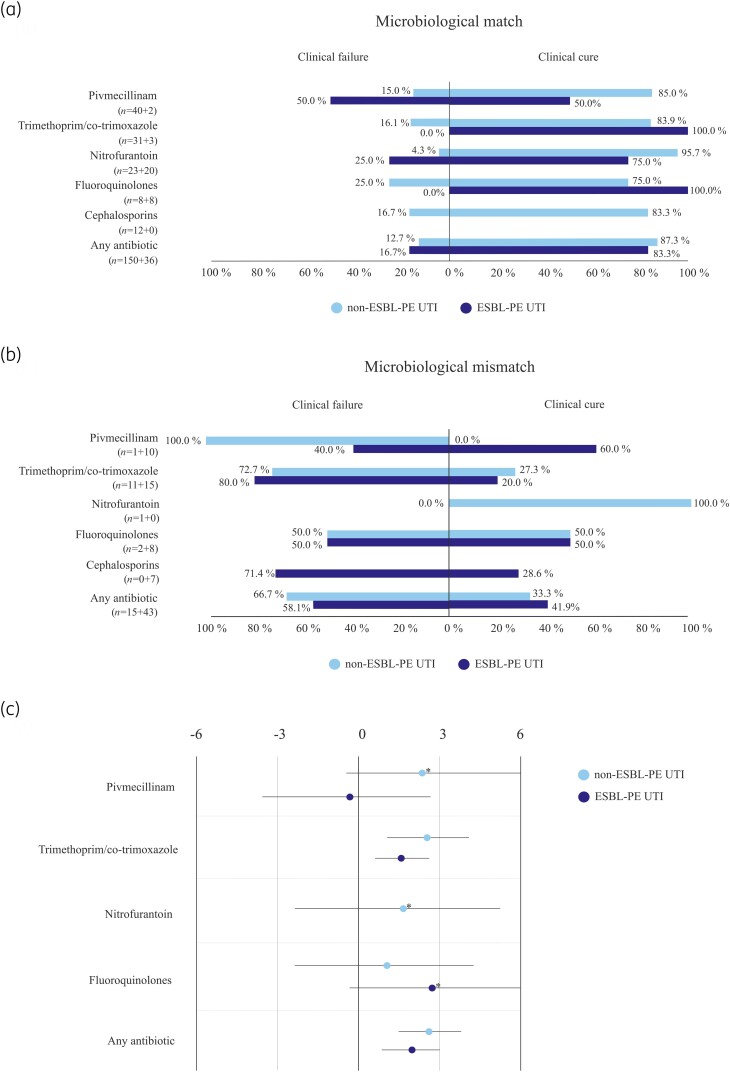
Results: Non-beta-lactam co-resistance was found more frequent among ESBL-PE than non-ESBL-PE isolates. The initial antimicrobial matched the in vitro susceptibility for 91.6% (164/179) of those with non-ESBL-PE and 46.9% (38/81) with ESBL-PE UTI (P < 0.001). The clinical cure rates in the non-ESBL-PE and ESBL-PE UTI groups were 82.6% (142/172) and 62.2% (74/119) (P < 0.001) for all, 87.3% (131/150) and 83.3% (30/36) for those treated with matching antimicrobials, and 33.3% (5/15) and 41.9% (18/43) for those given mismatching antimicrobials, respectively. Mismatching antimicrobial therapy was not associated with relapse/reinfection over the 3-month follow-up (P = 0.943).
Conclusions: In our data, (mis)matching microbiological susceptibility is only partially associated with the clinical outcome of UTI: microbiological matching appears to predict clinical cure better than mismatching predicts clinical failure.





 京公网安备 11010802042870号
京ICP备2023020795号-1
京公网安备 11010802042870号
京ICP备2023020795号-1

 分享
分享
 求助内容:
求助内容: 应助结果提醒方式:
 扫码关注我们
