{"title":"Paleobotany reframes the fiery debate on Australia's rainforest edges","authors":"Peter Wilf, Robert M. Kooyman","doi":"10.1111/nph.20301","DOIUrl":null,"url":null,"abstract":"<p>The tall eucalypt forests (TEFs) of the Australian tropics are often portrayed as threatened by ‘invasive’ neighboring rainforests, requiring ‘protective’ burning. This framing overlooks that Australian rainforests have suffered twice the historical losses of TEFs and ignores the ecological and paleobiological significance of rainforest margins. Early Eocene fossils from Argentina show that biodiverse rainforests with abundant <i>Eucalyptus</i> existed > 50 million years ago (Ma) in West Gondwana, shaped by nonfire disturbance factors such as landslides and volcanic flows. Humid volcanic environments with eucalypts were also present in eastern Australia over much of the Cenozoic. The dominance of fire-adapted eucalypts appears to be geologically recent and is linked to Neogene C<sub>4</sub> grassland expansion, Pleistocene climate cycles, and human activity. We suggest that characterizing TEFs and rainforests as adversarial results from misinterpreting the evolutionary history and expansion-contraction dynamics of a single humid forest system, whose features are now heavily modified by human activities. The resulting management practices damage the outstanding World Heritage values and carbon storage of affected areas and thus have impacts far beyond Australia. The fossil evidence shows that rainforest margins preserve ancient, still evolving, and globally significant forest interactions that should be prioritized for restoration and research.</p>","PeriodicalId":214,"journal":{"name":"New Phytologist","volume":"245 4","pages":"1355-1365"},"PeriodicalIF":8.1000,"publicationDate":"2024-11-27","publicationTypes":"Journal Article","fieldsOfStudy":null,"isOpenAccess":false,"openAccessPdf":"https://www.ncbi.nlm.nih.gov/pmc/articles/PMC11754943/pdf/","citationCount":"0","resultStr":null,"platform":"Semanticscholar","paperid":null,"PeriodicalName":"New Phytologist","FirstCategoryId":"99","ListUrlMain":"https://nph.onlinelibrary.wiley.com/doi/10.1111/nph.20301","RegionNum":1,"RegionCategory":"生物学","ArticlePicture":[],"TitleCN":null,"AbstractTextCN":null,"PMCID":null,"EPubDate":"","PubModel":"","JCR":"Q1","JCRName":"PLANT SCIENCES","Score":null,"Total":0}
引用次数: 0
Abstract
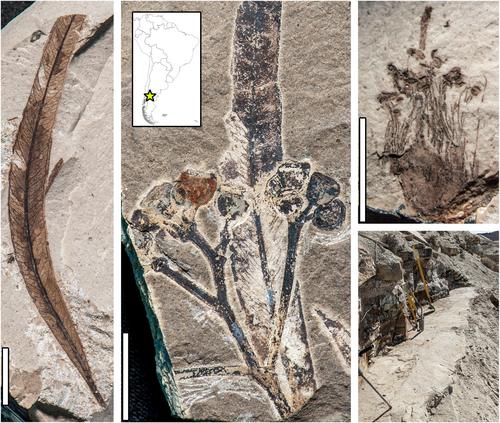
The tall eucalypt forests (TEFs) of the Australian tropics are often portrayed as threatened by ‘invasive’ neighboring rainforests, requiring ‘protective’ burning. This framing overlooks that Australian rainforests have suffered twice the historical losses of TEFs and ignores the ecological and paleobiological significance of rainforest margins. Early Eocene fossils from Argentina show that biodiverse rainforests with abundant Eucalyptus existed > 50 million years ago (Ma) in West Gondwana, shaped by nonfire disturbance factors such as landslides and volcanic flows. Humid volcanic environments with eucalypts were also present in eastern Australia over much of the Cenozoic. The dominance of fire-adapted eucalypts appears to be geologically recent and is linked to Neogene C4 grassland expansion, Pleistocene climate cycles, and human activity. We suggest that characterizing TEFs and rainforests as adversarial results from misinterpreting the evolutionary history and expansion-contraction dynamics of a single humid forest system, whose features are now heavily modified by human activities. The resulting management practices damage the outstanding World Heritage values and carbon storage of affected areas and thus have impacts far beyond Australia. The fossil evidence shows that rainforest margins preserve ancient, still evolving, and globally significant forest interactions that should be prioritized for restoration and research.
期刊介绍:
New Phytologist is an international electronic journal published 24 times a year. It is owned by the New Phytologist Foundation, a non-profit-making charitable organization dedicated to promoting plant science. The journal publishes excellent, novel, rigorous, and timely research and scholarship in plant science and its applications. The articles cover topics in five sections: Physiology & Development, Environment, Interaction, Evolution, and Transformative Plant Biotechnology. These sections encompass intracellular processes, global environmental change, and encourage cross-disciplinary approaches. The journal recognizes the use of techniques from molecular and cell biology, functional genomics, modeling, and system-based approaches in plant science. Abstracting and Indexing Information for New Phytologist includes Academic Search, AgBiotech News & Information, Agroforestry Abstracts, Biochemistry & Biophysics Citation Index, Botanical Pesticides, CAB Abstracts®, Environment Index, Global Health, and Plant Breeding Abstracts, and others.






 京公网安备 11010802042870号
京ICP备2023020795号-1
京公网安备 11010802042870号
京ICP备2023020795号-1

 分享
分享
 求助内容:
求助内容: 应助结果提醒方式:
 扫码关注我们
