{"title":"Feasibility of a Non-Anticipatory, Random-Action Target System to Improve Shooting Performance: A Brief Field Trial.","authors":"Matthew Lee Smith, Ali Boolani","doi":"10.3390/sports12110305","DOIUrl":null,"url":null,"abstract":"<p><p>Firearm shooting performance training rightfully focuses on shooting accuracy; however, additional foci should include decision processing speed and reaction time associated with decision making to avoid reaction-only based shooting responses. While advancements in realistic training environments attempt to mimic \"real-world\" situations, many remain largely anticipatory or subject to a speed-accuracy trade-off (SAT). The purpose of this brief field trial was to demonstrate the feasibility of a random-action target system (RATS) on participants' shooting performance (i.e., accuracy, omission, and commission rates) among a convenience sample of six retired police officers and competitive shooters (age range: 45-58 years, mean age = 52.5 ± 5.89). Observational data were gathered from a single-day, three-round trial to test shooting accuracy and shooting errors when shooters were unable to anticipate target appearance location and target exposure speed. In Trial 1, the target exposure time was 0.5 s, which increased to 0.7 s in Trial 2, and decreased back to 0.5 s in Trial 3. Shooting accuracy generally increased, while omission and commission generally decreased, when shooters were presented with targets exposed for longer durations. From Trial 1 to Trial 3 (both trials with 0.5 s target exposures), shooters showed higher median accuracy rates, lower median omission rates, and lower median commission rates. Findings suggest that a non-anticipatory, RATS holds promise for improving shooting performance and offset SAT among shooters with firearm experience. However, additional trials are needed with the RATS to replicate these findings among a larger and more diverse set of participants, who train with the RATS consistently, over longer durations.</p>","PeriodicalId":53303,"journal":{"name":"Sports","volume":"12 11","pages":""},"PeriodicalIF":2.9000,"publicationDate":"2024-11-11","publicationTypes":"Journal Article","fieldsOfStudy":null,"isOpenAccess":false,"openAccessPdf":"https://www.ncbi.nlm.nih.gov/pmc/articles/PMC11598038/pdf/","citationCount":"0","resultStr":null,"platform":"Semanticscholar","paperid":null,"PeriodicalName":"Sports","FirstCategoryId":"1085","ListUrlMain":"https://doi.org/10.3390/sports12110305","RegionNum":0,"RegionCategory":null,"ArticlePicture":[],"TitleCN":null,"AbstractTextCN":null,"PMCID":null,"EPubDate":"","PubModel":"","JCR":"Q2","JCRName":"SPORT SCIENCES","Score":null,"Total":0}
引用次数: 0
Abstract
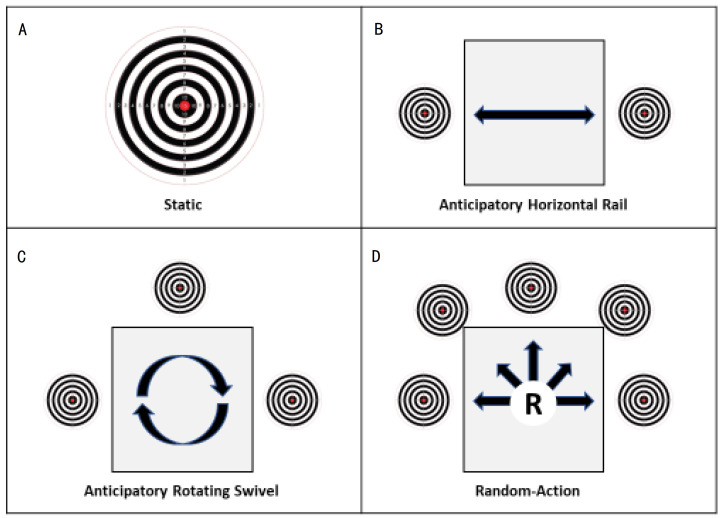
Firearm shooting performance training rightfully focuses on shooting accuracy; however, additional foci should include decision processing speed and reaction time associated with decision making to avoid reaction-only based shooting responses. While advancements in realistic training environments attempt to mimic "real-world" situations, many remain largely anticipatory or subject to a speed-accuracy trade-off (SAT). The purpose of this brief field trial was to demonstrate the feasibility of a random-action target system (RATS) on participants' shooting performance (i.e., accuracy, omission, and commission rates) among a convenience sample of six retired police officers and competitive shooters (age range: 45-58 years, mean age = 52.5 ± 5.89). Observational data were gathered from a single-day, three-round trial to test shooting accuracy and shooting errors when shooters were unable to anticipate target appearance location and target exposure speed. In Trial 1, the target exposure time was 0.5 s, which increased to 0.7 s in Trial 2, and decreased back to 0.5 s in Trial 3. Shooting accuracy generally increased, while omission and commission generally decreased, when shooters were presented with targets exposed for longer durations. From Trial 1 to Trial 3 (both trials with 0.5 s target exposures), shooters showed higher median accuracy rates, lower median omission rates, and lower median commission rates. Findings suggest that a non-anticipatory, RATS holds promise for improving shooting performance and offset SAT among shooters with firearm experience. However, additional trials are needed with the RATS to replicate these findings among a larger and more diverse set of participants, who train with the RATS consistently, over longer durations.





 京公网安备 11010802042870号
京ICP备2023020795号-1
京公网安备 11010802042870号
京ICP备2023020795号-1

 分享
分享
 求助内容:
求助内容: 应助结果提醒方式:
 扫码关注我们
